
How to use AI skills to do consulting work
The tech world has spent years declaring consulting dead. The dunk is always the same: consultants run a bunch of analysis, drop a 200-page deck, and bounce.
Then, over the past month, the tech world moved into consulting in a big way.
The two big AI labs just opened consulting arms
On May 4, 2026, Anthropic announced a new enterprise AI services firm with Blackstone, Hellman & Friedman, and Goldman Sachs, backed by a wider group of investors that includes General Atlantic, Apollo, GIC, and Sequoia. Fortune reported the firm had about $1.5 billion in committed capital. The structure is the interesting part. According to the Blackstone announcement, the new company is “a standalone entity with Anthropic engineering and partnership resources embedded directly within its team,” and it will sell into the portfolio companies of those investment firms and other mid-size businesses.
Fortune described what that means without flinching: the model “mirrors Palantir’s forward-deployment model and undercuts traditional consultants by combining implementation capability with ownership of the underlying model.”
A week later, on May 11, OpenAI launched its own version, the OpenAI Deployment Company, with more than $4 billion of initial investment from 19 investors. The round was led by TPG, with Advent, Bain Capital, and Brookfield as co-leads, at a reported valuation near $10 billion. OpenAI also acquired Tomoro, a UK applied AI consulting firm, which brings “approximately 150 experienced Forward Deployed Engineers and Deployment Specialists” on day one, per OpenAI’s announcement.
Who else is in? From the same announcement: “Investors also include leading consulting and systems integration firms, including Bain & Company, Capgemini, and McKinsey & Company.”
In tech, they like to call these people “forward-deployed engineers,” a term Palantir coined in the early 2010s for engineers who embed inside a customer’s operation and build until the thing actually works. Strip the branding (or the tech industry’s weird fear of the word consultant) and they’ve reinvented a 100+ year old profession from first principles.
AI will probably mean more jobs, for now
For me it’s a strong signal that the story labs have about automating all knowledge work is premature.
There are two things worth noting. First, they are following a path that many technology firms have taken for years. Firms like IBM established consulting arms in the 1980s because the roadblock to them making more money was implementation and resistance to change. Second, services remains a high value part of the economy, despite Anthropic saying it will be extinct in a couple of years. As the venture firm Sequoia put it in its essay “Services: The New Software”, “For every dollar spent on software, six are spent on services.” And this is probably why McKinsey is investing in these partnerships too.
Many people outside of consulting don’t realize that the firms like McKinsey only do a small amount of the “deliver a 100-page strategy deck” engagements. The majority of their work has shifted to implementation, training, long-term organizational change, transformation work, and technology transformations. One of the reasons consulting exists is that most organizations don’t have a large number of employees who are skills in driving a major change program.
Here’s how I’m betting on it
Right now the most interesting change for my business and how I’m teaching these things is the emergence of agentic coding platforms like Claude Code, Claude Cowork, and Codex (while the regular chat apps are becoming agentic too).
With these new “harnesses,” as they are called, people are able to pair workflows with things like “skills” which give the agent direction. I quickly realized that a lot of my resources on this site and in the course would be great to test.
And so I’ve taken my course, Think Like A Strategy Consultant, along with years of blog posts and most of my workshop material, and turned it into six AI skills:
Four of them are components of the process:
- Problem Framer (
/problem-framer) turns a messy situation into a structured problem. - Structure & Synthesize (
/structure-synthesize) takes scattered notes, research, or raw data and turns them into an insight or an argument. - Strategy Communicator (
/strategy-communicator) presents that thinking in a structured way that fits the audience. - Strategy Slides (
/strategy-slides) handles slide design and PPTX creation, based on the design principles I teach in the course.
Two wrap around the rest:
- Strategy Coach (
/strategy-coach) is the end-to-end version. It bundles the four component skills and routes you through the full problem-solving process from the course. - Strategy Writing (
/strategy-writing) is a craft layer that strips out AI patterns, forces specificity, and gets prose to read simply and clearly.
Three ways to use them
You can use the skills as a coach, when you want to learn the frameworks. The AI walks you through SCQA, MECE, or the Pyramid Principle, asks you the right questions, and helps you build the skill yourself. Ask it to quiz you, write you a learning plan, or generate practice material.
Example prompts
Use the Problem Framer skill to teach me SCQA. Walk me through it one piece at a time with a real example, then quiz me on a new situation and grade my answer.I have 30 minutes. Use Structure & Synthesize to build me a learning plan for the Pyramid Principle, then give me one exercise to start on right now.Coach me on MECE. Give me a messy business problem, ask me to break it into an issue tree, and point out where my branches overlap or leave gaps.You can use them as a sparring partner, when you’ve done the work and want it pressure-tested. Paste in your draft, your issue tree, or your slide outline and ask where the weak branch is, what’s missing, and what a skeptical executive would push back on. Have it role-play your manager, your customer, or your client.
Example prompts
Here is my issue tree for [your problem]. Using Problem Framer, find the weakest branch, tell me what's missing, and list three questions a skeptical executive would ask.Pressure-test this slide headline with Strategy Communicator. Does it pass the ten-second test? Rewrite it three ways and tell me which is strongest and why.Role-play a skeptical client CFO. Here is my recommendation and the logic behind it: [paste]. Push back hard, then tell me where my argument actually broke.Or you can have it do the work. Give it enough context and it will rework slides, synthesize information into insights, and draft a deck from scratch. Hand it the situation and let it produce the SCQA, the issue tree, the synthesis, or the deck outline. You review and edit instead of starting from a blank page.
Example prompts
Here are my situation and raw notes: [paste]. Use Structure & Synthesize to turn it into a one-line answer, an SCQA, and a MECE issue tree I can react to.Take these findings: [paste]. Use Strategy Slides to draft a six-slide outline with action titles, one idea per slide.Use Strategy Coach to run this problem end to end: define it with SCQA, structure it, and hand me a first-draft deck outline I can edit.Using AI tools kickstarts a “reverse sensemaking” process
I’ve been surprised at how fast I can get in a learning loop when I am trying new things with AI. This is because you can quickly get to a finished product with something. For example, the first time I created the skills that I’m selling, I was amazed. Wow this is incredible.
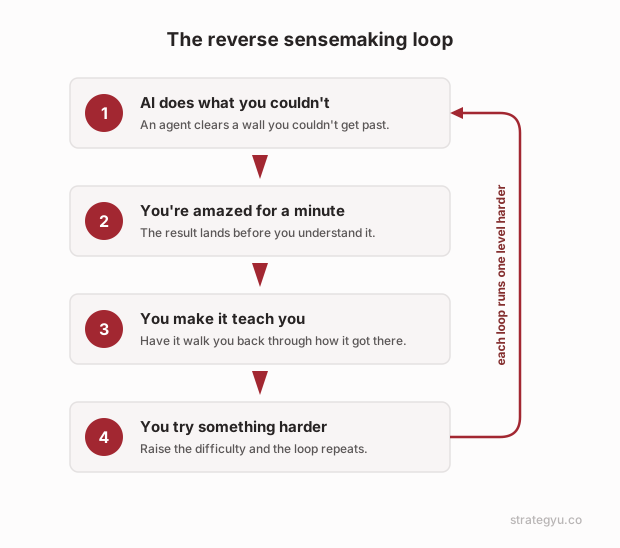
However, the opportunity here is to realize that the work, and more importantly, the learning, has just begun:
- An agent or tool helps me do something I couldn’t do before.
- I’m amazed for a minute.
- I get curious about how it actually happened, so I have the AI walk me back through the process and teach me.
- I try something harder, and I notice I’m learning faster than I used to.
I’ve started thinking of this as reverse sensemaking.
The failure mode, or negative side of this is creative bypassing, where you are too quickly satisfied with the output and are not curious about the process behind it.
The normal consulting process runs the other way. You define the problem, then you grind. Bottom-up research, top-down hypotheses, back and forth, sometimes hundreds of loops, until the mess resolves into a story you understand. Sensemaking comes first and the output comes last. You earn the answer slowly.
Reverse sensemaking flips the order. The output comes first. AI produces the issue tree, the synthesis, or the deck, and then you work backward to understand why it holds up, where it’s weak, and what you’d need to know to do it yourself. The finished artifact becomes the thing that teaches you.
In a sense, you are acting as the project manager or senior partner of your work instead of only the analyst.
This matters because of the biggest limit i’ve found in teaching these skills: that the best way to get better is to get hands-on intensive coaching and iterative feedback from people who are both good at the skills and good at teaching them. But I couldn’t clone myself, or at least not offer my time cheaply.
Now, am intelligent AI model + the skills can. They’re a more patient version of me, available at 11pm when you’re stuck on the weak branch of an issue tree, willing to explain the same point four different ways. You can kind of, sort of clone me. Or at least clone the part of me that asks the next good question.
I’m still tinkering with all of this. It changes based on new model releases and is getting easier and better over time. But its clear that AI will change knowledge work, make different options for learning and training possible, and give individuals with motivation superpowers.
Am I cannibalizing my own course?
Why would I build this? Wouldn’t it eat the course?
Here’s my hunch: People are going to build cooler things with these skills than I can build myself. That genuinely excites me. I’ve always wanted to widen access to this way of thinking and to the work of consultative problem-solving.
If these end up free and open one day and I’m no longer running the course, I think I’d be fine with it. I’d have to sort out the income side. But my hunch is that the opportunities from working this way are going to be bigger than what exists now.
What they work with
These work with almost any LLM or agentic coding tool, and that list changes almost weekly. You’ll get the best results from the latest models out of Anthropic and OpenAI, and the best outcomes from building your own workflows in Codex or Claude Code.
Get the skills
The six skills are $79, with lifetime access and free updates. The full course is $797 and adds the complete masterclass plus an AI Module with three detailed walkthrough videos, each one showing the skills run on a real problem end to end:
- A full run through Claude of a “where should I move after graduation” problem, applying Problem Framer, Structure & Synthesize, Strategy Slides, Strategy Coach, and Strategy Communicator end to end.
- A PDF slide critique built in Claude Code. I pointed the Strategy Coach skill at a public McKinsey deck and had it return an annotated PDF with sticky-note feedback on every slide, then generate alternative versions of a single slide as a feedback partner.
- A slides-and-dashboard build in Codex. Analyze a UFO sightings dataset, generate a deck, then build an editable HTML viewer to iterate on headlines and design without opening PowerPoint.
Buy the full course and I’ll answer your questions over email for the next three months. You can also see everything laid out on the AI Skills page.