
How to become a strategy consultant (with or without an MBA)
Most people who want to “become a consultant” don’t actually want to become a consultant.
What they want is a job. They want to know how to prepare for a certain kind of interview so that they can pass through a gate and start working in the prestigious consulting industry.
I think this is a missed opportunity because the skills of consulting are incredibly valuable: thinking clearly, structuring messy problems, and communicating ideas in a way that gets taken seriously.
I get it. When I was sitting in a cubicle at GE, I didn’t dream about making slides at 2 a.m. I dreamed about having a special job and finally being freed from needing to slog out 30 years climbing the ladder at a fading industrial giant.
I eventually did break into McKinsey, but it took me multiple years and endless rejections. Once I started doing the actual work, I realized something: the skills that made consultants good at their jobs weren’t locked behind a McKinsey badge. They were learnable. And most of my time trying to break into the industry, I spent zero time actually just trying to “do” consulting.
This guide is for two kinds of people: those who want to work at a consulting firm, and those who just want to think and work like a consultant in whatever they’re already doing.
What consultants actually do differently
People assume consulting is about being smart. It’s not. Plenty of smart people work in consulting but plenty of these smart people are also terrible consultants. I had many smart b-school friends that realized three months into the gig that they needed to escape. They weren’t wired for it.
At the top firms, you will learn a rigorous process for how consultants approach problems.
I go into a lot of depth into the consulting process in several articles, and there are many basic processes, but the core approach is worth understanding:
- Identify problems
- Break down problem into questions or hypotheses
- Do Analysis & Research
- Process that information into structured recommendations
In addition to this, I think it’s worth understanding there is a 2nd layer on top of everything, bottom-up and top-down process, which you’ll shift into throughout each of these steps.
In addition, to “be” a consultant is to orient around:
Structured thinking over brainstorming. When most teams face a hard question, they brainstorm. They generate ideas, debate them, pick one, and move forward. Consultants do something different: they break the problem apart into pieces before generating any ideas. The breakdown itself is the work. If you structure the problem well, the answers often become obvious. If you skip the structure, you end up solving the wrong thing. The tool for this is called MECE (mutually exclusive, collectively exhaustive), and it’s the single most foundational concept in consulting.
Hypothesis-driven work. Instead of collecting all available data and then figuring out what it means, consultants start with a hypothesis about the answer and then test it. This sounds backwards, but it’s what makes consulting projects finish in weeks instead of months. You don’t boil the ocean. You form a point of view early, build an issue tree to figure out what you’d need to prove or disprove it, and go find the evidence.
Communication as a skill, not an afterthought. Most professionals think of communication as something you do after the work is done. Write up your findings, present them, move on. In consulting, the communication is the work. A recommendation that the CEO can’t follow is the same as no recommendation. This is why Barbara Minto’s Pyramid Principle is treated like scripture at most firms: it teaches you to lead with the answer and organize everything beneath it in a logical structure the audience can follow. Through this lens, almost every conversation, email, and shared document was a practice attempt at better and better communication.
Synthesis, Synthesis, Synthesis. Synthesis is not the same as summarizing. Summarizing is repeating what you found. Synthesis is figuring out what it means. Consultants are obsessed with finding patterns in everything. This is the core information “work” of a consultant — you are pulling together data from different sources and forming a coherent point of view.
Okay, now you got the basics, now here are the skills to build (and where to start)
If you’re starting from scratch, here’s what to focus on and roughly in what order. This isn’t a rigid sequence. These skills build on each other, but you can work on several at once.
Learn to define problems clearly
Before you can solve a problem, you have to define it. This sounds obvious, but most people skip it. They jump straight to solutions without agreeing on what the problem actually is.
The SCQA framework (Situation, Complication, Question, Answer) is the best tool I’ve found for this. It forces you to articulate the current state, what changed, what question that raises, and your proposed answer. In two or three sentences, you can align an entire team on what you’re actually trying to figure out.
Learn to break problems apart
Everything in consulting starts with problem decomposition. You take a big, messy question (“Why is profit declining?”) and break it into smaller, answerable pieces (“Is it a revenue problem or a cost problem? If revenue, is it volume or price?”).
The core tool is MECE thinking. It’s a discipline for making sure your categories don’t overlap and don’t leave gaps. Sounds simple. It takes real practice to do well, especially when the problem is ambiguous.
Once you’re comfortable with MECE breakdowns, learn to build issue trees. An issue tree is a visual map of all the questions you need to answer to solve a problem. It forces you to think through the full scope of an issue before you start doing analysis.
You can practice by asking an AI agent to give you a business problem and then tell it you are going to generate a MECE list of hypotheses and see how you do. For example:
Problem: I want to cut personal spending
My hypotheses could be:
- I can cut spending on existing spend
- I can buy less stuff
Underneath these two high-level hypotheses are endless “levers” (yes, consultant jargon) that you can pull to hopefully make the hypotheses true (in the sense that you have determined it is possible).
Learn to communicate like a consultant
Consulting communication is built on a few specific frameworks:
The Pyramid Principle teaches you to lead with the answer and organize supporting arguments in a logical hierarchy. Most people do the opposite: they build up context, walk through their analysis, and eventually arrive at a conclusion. In consulting, you flip that. Conclusion first. Then the reasons why. Then the supporting evidence.
Once you understand the Pyramid Principle, learn how to translate it into slides and presentations. A good consulting deck isn’t a collection of bullet points. Each slide makes one clear argument, supported by a chart or piece of evidence. The title of each slide is a complete sentence that states the point. If you read just the slide titles in order, they should tell the full story.
Learn the major strategy frameworks
You don’t need to memorize fifty frameworks. You need to understand a handful well enough to know when each one is useful and when it isn’t:
- Porter’s Five Forces — for understanding industry structure and profitability
- The growth-share matrix — for portfolio strategy
- The value chain — for understanding where a company creates value
- SWOT analysis — limited, but useful as a starting point for situations where you genuinely don’t know much
The goal isn’t to fill in frameworks mechanically. It’s to build a mental library of ways to look at a problem. When a client says “we’re losing money,” you should be able to think through whether it’s an industry problem, a competitive position problem, a cost structure problem, or something else entirely. Case interview frameworks are one way to get comfortable with this, even if you never plan to interview.
Over time you can naturally freestyle your own assessment of companies and industries just by doing it so many times. But before you work in a firm or if you’re getting started, try to practice with companies you are interested in. Follow people writing about an industry or try to write yourself. Start with questions like:
- Why is company A so much more profitable than company B?
- Why did company B fail in industry Y?
- What does this new technology trend mean for cost dynamics in industry Z?
What the work actually looks like
Before you invest months learning consulting skills, it helps to know what you’re signing up for.
At a high level, strategy consultants get hired by companies to help them answer hard questions. Should we enter this market? Why are we losing money? How should we reorganize? What should our growth strategy be? The client is usually paying hundreds of thousands (sometimes millions) for a team of 3-6 consultants to work on the problem for 8-12 weeks.
A typical week on a project involves gathering data (interviews, financial analysis, market research), structuring that data into insights, and building a recommendation in slide format. You present progress to the client weekly and deliver a final recommendation at the end. Work as a freelance consultant is similar, just that you act as both the client and individual contributor.
If you want a deeper look at this, I’ve written about what consultants actually do and the different roles at McKinsey, BCG, and Bain.
The work is genuinely interesting. You get exposed to a dozen different industries in your first two years. You learn to think under pressure. And the people are, on average, very smart.
The downsides are real too. The hours are long (60-80 hour weeks are normal, not exceptional). You travel constantly. The average tenure at most firms is under three years. And the work can feel disconnected from impact because you’re always the outsider making recommendations, only sometimes the person implementing them.
The consulting industry is also changing. AI is reshaping the research and analysis parts of the job. Firms are adding more digital and implementation work. The pure-strategy boutique model that defined the industry for decades is evolving.
The different paths into consulting
The good news about the consulting industry is that these firms have dramatically increased in size and have a diversity of roles and kinds of work they actively hire for. There are many paths in.
On-campus recruiting (the traditional path)
If you’re at a “target school” (think Harvard, Stanford, Wharton, and about 20-30 others globally), firms come to you. They host information sessions, do on-campus interviews, and extend offers before graduation. This is still how the majority of new hires at MBB firms get in.
If you’re at a non-target school, this path is harder but not impossible. I went to UConn and eventually got into McKinsey. It just took longer and required more persistence. The firms do hire from non-target schools, but you have to find them rather than waiting for them to find you.
MBA recruiting
An MBA from a target business school is the most common reset button for getting into consulting. Most firms hire a large class of post-MBA associates every year. If you’re serious about working at a top firm and didn’t go to a target school for undergrad, an MBA is the most reliable (and most expensive) path.
That said, an MBA is a big investment of time and money. Make sure you actually want to do consulting, not just that you want the option of consulting.
Experienced hires and lateral moves
Firms also hire from industry, especially for specialized roles. If you have deep expertise in healthcare, technology, energy, or financial services, firms will bring you in as a subject matter expert. This path has grown as consulting has expanded beyond pure strategy into implementation, digital, and analytics.
These firms increasingly have expert tracks with separate career paths that don’t require you to make partner. You can build a career as a deep specialist — in pricing, operations, or a specific industry — without the up-or-out pressure of the traditional consulting ladder.
Specialized and non-traditional roles
Most people picture consulting as one job: generalist strategy work on a small team. But the big firms have built out entire organizations around specialized functions, and these are real career paths with their own hiring pipelines.
McKinsey has its Knowledge Network, a global group of researchers, analysts, and subject matter experts who support client teams without being on the traditional consultant track. BCG has a similar structure. I worked in BCG’s Knowledge Network as a “Knowledge Expert” in the transformation practice. It was a unique role: I worked with a global team focused on practice operations, helped several partners shape their go-to-market strategies (developing proposals, pitching clients), wrote a large report on our firm’s point of view, and worked directly with client teams on many one-off tasks and mini-workstreams. If you’re great at research and synthesis but don’t want to be on the road four days a week, these roles are worth looking into.
BCG built GAMMA, its advanced analytics and data science group. McKinsey has a similar team (QuantumBlack) and Bain has its Advanced Analytics Group. These teams hire data scientists, engineers, and machine learning specialists — people who would never come through a traditional case interview pipeline.
Then there are the implementation and results delivery teams. McKinsey Implementation, BCG’s TURN, and Bain’s Results Delivery all hire people with operational experience to help clients actually execute recommendations. This is a growing part of the business as clients push back on paying for advice they can’t implement.
Design is another path that didn’t exist a decade ago. McKinsey acquired LUNAR Design and built McKinsey Design. BCG brought in design firms and built BCG X. These groups hire designers, product managers, and technologists to work alongside traditional strategy consultants.
McKinsey Solutions builds software products and tools that clients use independently. If you come from a product or engineering background, this is a way into McKinsey that has nothing to do with case interviews or MBA recruiting.
The point is that “getting into consulting” doesn’t have to mean getting the classic generalist associate role. There are dozens of entry points now, and many of them value skills that the traditional path ignores.
The independent and freelance route
You don’t have to work at a big firm to do consulting work. Independent consulting is a legitimate path, especially if you’ve built expertise in a specific domain. I’ve written about this in detail in the freelance strategy consulting playbook.
The trade-off is that you skip the training, the brand name, and the network. You gain control over your time, your clients, and your rates. Many of the most experienced consultants I know left the big firms after 3-5 years and built independent practices that are more profitable and more sustainable than their salaried careers ever were.
A five-month plan for self-study
This section is adapted from a plan I originally wrote for someone on Quora who wanted to teach themselves consulting skills. I’ve updated it based on what I’ve learned since.
Month 1: Build the foundation & confirm your curiosity
Test your actual interest. Do you just want the job or are you deeply curious about the industry? There is so much good stuff to read.
Here are some initial suggestions:
- Ethan Rasiel’s The McKinsey Mind for a practical overview of how consultants think and work
- Barbara Minto’s Pyramid Principle for structured communication (this book is dense — don’t try to read it in a weekend)
- The articles on this site covering MECE, issue trees, SCQA, and problem solving
- Read case books to prepare for consulting interviews to understand the basics of the consulting process at a deeper level
- Read about the business and how organizations operate, including some criticisms of the status quo. My top recommendations here would be The Halo Effect, Innovators Dilemma, Drive, Originals, and Work Rules!
- Read alternative takes on the business world like Gervais Principle, Ben Thompson’s Stratechery, Matt Levine’s Money Stuff, and Byrne Hobart’s The Diff
- Read non-traditional books about famous advisers: Counselor: A Life at the Edge of History
Months 2-3: Practice on real problems
The internet changed consulting. You don’t need a firm to consult. You need a problem, a client, and a willingness to do the work.
Here are ways to start:
- Pick a business question you’re curious about and write a structured analysis of it. Post it on LinkedIn, Medium, or Substack. This forces you to use the tools in practice, not just theory. If you’re taking my Think Like A Strategy Consultant course, try applying the principles to a real business issue. (If you e-mail it to me, I’ll give you feedback.)
- If you’re already employed, volunteer for cross-functional projects or strategy work inside your company. This is why I volunteered for Six Sigma projects at GE early in my career.
- Sign up for freelance platforms and take on small projects. Be transparent about your experience level. Bid low if you have to. The experience matters more than the fee.
- Offer to help a local business or nonprofit with a specific problem. Frame it as a project with a defined scope, not open-ended “consulting.” Everyone has problems. Most don’t have someone with time to spend on them.
Before I quit my job to become self-employed, I did two pro-bono projects, one for a non-profit junior board I was part of and another for a startup in Boston. This was a way for me to overcome the fear of landing a client and also to test my own abilities.
With the one in Boston, I was talking to a founder of an organization I was a member of (a social group) and she shared some business problems she was working on. I pitched her later over email:
“Hey, thanks for sharing a bit about your challenges. I’m thinking about becoming a freelancer and would be open to doing a pro bono assignment for you as a way to test the waters. All I’d ask is if you devote time to it like you are paying me and would offer feedback and/or a reference if you valued the work at the end.”
It was a small project, helping assess their strategy, direction, and alignment inside the small but growing startup. But it was HUGE in terms of my confidence in taking the leap about two years later.
Months 3-5: Deepen and specialize
Keep reading. The books worth investing time in at this stage:
- Read about the consulting industry itself — how it works, who the players are, what the different roles look like
- Build pattern recognition by reading industry analyses across different sectors. The more you practice looking at businesses through a structured lens, the faster you’ll spot what matters
- If you’re interested in the history behind these ideas, Walter Kiechel’s Lords of Strategy is the best single book on how strategy consulting became what it is
If you’re targeting a consulting career, this is also when you start preparing for interviews. Practice cases with other people, not just by yourself. Get honest feedback. And keep refining your story about why consulting.
Two paths forward
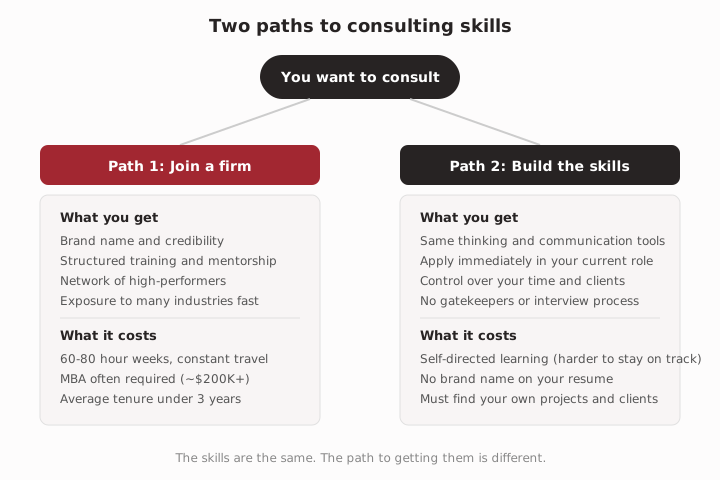
At this point, people tend to go in one of two directions.
Path 1: You want to work at a consulting firm
The hiring process at top firms (McKinsey, BCG, Bain) is well-documented, and I won’t pretend it isn’t hard. If you’re from a “non-target” school, it’s even harder. I was there. UConn isn’t in anyone’s on-campus recruiting list for MBB.
The one thing I’d urge you to consider is being open to a wider diversity of roles as mentioned above: things like Analytics, Knowledge Network, and implementation teams. These roles are often less competitive than the traditional consulting track, and they still get you inside the firm.
A few things that helped me and that I’ve seen help others:
Find ways to build the skills directly. If you’ve spent months actually practicing structured thinking, building issue trees, and doing real project work, you have something to talk about in an interview that most candidates don’t. Most applicants study case interview tricks. Having a pro bono client or something similar, especially early in career, would make you stand out and make it clear you validated an interest in the work.
Network with purpose. This doesn’t mean sending mass LinkedIn messages. It means finding specific people at firms who share your background or interests, having genuine conversations, and building relationships over time. One warm introduction to someone at a firm is worth more than fifty cold applications. I’ve received hundreds of messages over the years and the majority will be like “I want to learn about consulting, can we chat.” More effective is to do a lot of the studying and work above and come instead with curiosity: “Hey I noticed you were interested in topic X, I’ve been reading about it and wrote this article about the topics. Would love to share, no pressure to read.”
Don’t take rejection personally. I got rejected from McKinsey before I eventually got in. I even got rejected from BCG twice before working there, too. It wasn’t because I suddenly got smarter between applications. The timing, the team’s needs, and the interview questions all changed. If you think it will be a good industry for you, keep trying.
An MBA from a target school makes the process easier. There’s no point pretending otherwise. But it’s not the only path, and plenty of people get in without one.
Path 2: You want consulting skills in your current role
This is the path most of my readers are on, and honestly, it might be the more useful one.
Structured thinking, clear communication, hypothesis-driven problem solving — these work just as well inside a company as they do at McKinsey. In some ways they work better, because you actually know the business. You know the politics, the history, and the constraints that an outside consultant has to spend weeks discovering.
Here’s what this looks like in practice:
Use MECE and issue trees in your own work. Next time your team faces a hard question, don’t jump to brainstorming. Spend thirty minutes breaking the problem down first. Write the issue tree on a whiteboard. You’ll be amazed at how this changes the conversation.
Write top-down. Start every email, memo, and presentation with the conclusion. Then support it. The Pyramid Principle works in a two-paragraph email just as well as it works in a 50-slide deck.
Think in hypotheses. Before you start a project, write down what you think the answer is. Then figure out what evidence would prove you wrong. This is faster and more rigorous than “let’s gather data and see what we find.”
Build slides that argue, not slides that display. Every slide should make one point. The title should be a sentence, not a label. If someone reads your slide titles in order, they should understand the full recommendation without looking at any charts.
These aren’t easy, of course. They take practice. My course can help with this, but so can AI tools. Just build your own lesson plan and practice on your own.
The real question
When I was getting rejected from firm after firm, I had to ask myself a hard question: Do I want to be a consultant, or do I want the halo of prestige that comes from working at a consulting firm?
They’re different things. The prestige is real, and I won’t pretend it doesn’t matter. Working at McKinsey opened doors I couldn’t have opened otherwise. But the skills are what actually made me good at the work, and I’ve watched plenty of people build those skills without ever setting foot in a top firm.
A final word
As someone who has worked at these firms, it would be hypocritical to say that the benefits of working at these firms are not enormous.
However, as I have become a freelance consultant, I have found that the 10 years of consulting experience in a full-time job were not as valuable as I expected.
When I landed my first clients as a freelancer, I was faced with the new reality of having to level up my game and own the entire process with my clients. I quickly realized how much I had been supported by an enormous firm and resources in the past.
Many of the things I could rely on others for — document editing, feedback, formatting, tools, teamwork, Partners selling projects — I now had to do myself. While the experience in these firms helped me build my confidence, I was quickly humbled by how much I did not know yet when I took the leap.
If you really want to consult, there is no better time than now to become a freelance consultant. You are one LinkedIn message or e-mail to a family friend away from becoming a consultant. The real question is: do you still need access to a firm, or are you ready to learn on your own?