Blue ocean strategy: how to use the strategy canvas to find uncontested markets
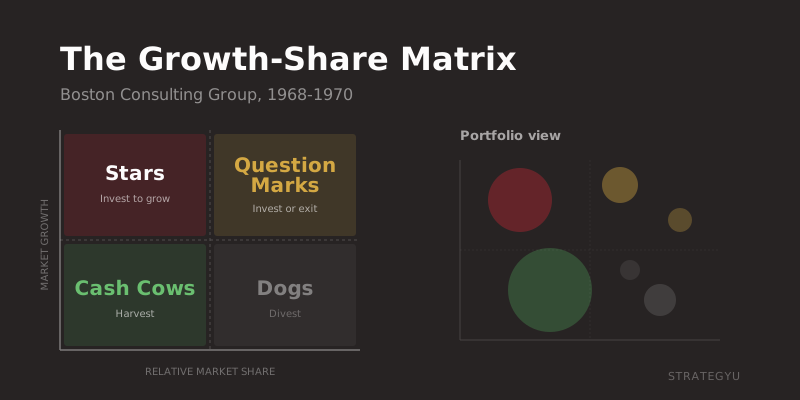
Most strategy frameworks start with your competitors and work inward. Porter’s Five Forces maps the structural forces that shape industry profitability. The BCG Growth-Share Matrix sorts business units by relative market share and growth. The Ansoff Matrix plots products against markets. All of them assume a known competitive arena where the goal is to position yourself better than the other players.
Blue Ocean Strategy asks a different question: what if you stopped competing altogether?
The origin and the idea
W. Chan Kim and Renee Mauborgne are professors at INSEAD, the business school based in Fontainebleau, France. Their ideas developed through a series of Harvard Business Review articles in the late 1990s, starting with “Value Innovation: The Strategic Logic of High Growth” in 1997. The 2005 book Blue Ocean Strategy pulled these ideas together into a single framework, and it became one of the best-selling business books of the decade.
The book’s central metaphor is simple. Red oceans are existing markets where industry boundaries are defined and companies compete for shares of known demand. Blue oceans are new market spaces where competition doesn’t yet exist because the rules haven’t been written.
Kim and Mauborgne write in Blue Ocean Strategy that the book is grounded in more than fifteen years of research and data stretching back more than a hundred years. They studied 108 business launches and found that 86% were incremental improvements within existing market space. Those launches accounted for 62% of total revenues but only 39% of total profits. The remaining 14% of launches were aimed at creating blue oceans, and they generated 38% of revenues and 61% of total profits.
That 14/61 split is the statistic that makes the whole framework worth understanding. A small minority of strategic moves aimed at creating new market space produced the majority of profits.
One counterintuitive finding from their research: most blue oceans aren’t created by startups or outsiders. As Kim and Mauborgne wrote in their original 2004 Harvard Business Review article:
The blue oceans made by incumbents were usually within their core businesses. In fact…most blue oceans are created from within, not beyond, red oceans of existing industries. This challenges the view that new markets are in distant waters. Blue oceans are right next to you in every industry.
The intellectual context matters. By the mid-1990s, Michael Porter’s positioning school dominated strategic thinking. Porter’s frameworks all operate within defined industries. You analyze the five forces, pick a position (low cost, differentiation, or focus), and defend it. Kim and Mauborgne argued that this was only half the strategic picture. They wrote in the HBR article that “corporate strategy is heavily influenced by its roots in military strategy. The very language of strategy is deeply imbued with military references.” Described this way, strategy is all about red ocean competition.
As Walter Kiechel describes in The Lords of Strategy, Kim and Mauborgne concluded “with wonderful audacity” that if there is no perpetually high-performing company, then the company is not the right unit of analysis for understanding high performance. They proposed the strategic move as the unit of analysis instead.
This was an implicit challenge to the entire positioning school. If the best strategic moves create new market space rather than winning within existing space, then frameworks built around industry analysis are incomplete. They explain how to compete in red oceans. They don’t tell you how to create blue ones.
The core concept: value innovation
The idea at the center of Blue Ocean Strategy is value innovation, which Kim and Mauborgne define as simultaneously pursuing differentiation and low cost. This directly contradicts the conventional strategy trade-off that Porter described, where companies must choose between being the low-cost producer or the differentiated provider.
As they put it in the original HBR article: “Perhaps the most important feature of blue ocean strategy is that it rejects the fundamental tenet of conventional strategy: that a trade-off exists between value and cost.”
Kim and Mauborgne argue in Blue Ocean Strategy that value innovation happens when companies “align innovation with utility, price, and cost positions.” Value without innovation means incremental improvements. Innovation without value means technology-driven ideas that shoot past what buyers want. Value innovation is the overlap.
In practice, value innovation means you don’t just add features to your product and charge more. You simultaneously eliminate and reduce the factors your industry takes for granted, while raising and creating entirely new factors. This is what makes it possible to break the value-cost trade-off.
The strategy canvas
The strategy canvas is the main diagnostic tool in Blue Ocean Strategy. It’s a line chart with the factors of competition on the horizontal axis and the offering level on the vertical axis.
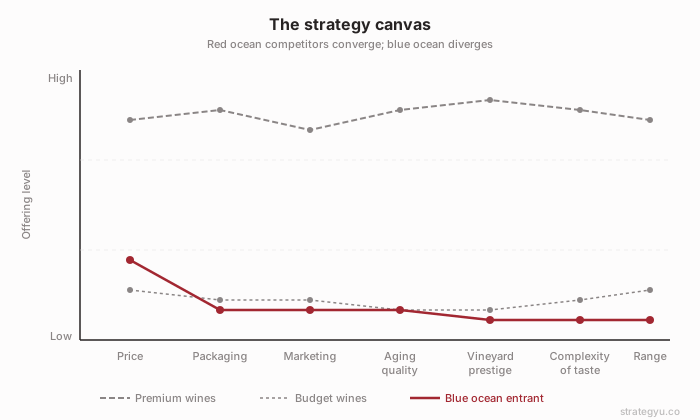
Every competitor in an industry has a value curve, which is their profile across all the factors the industry competes on. When you plot competitors on the strategy canvas, a consistent finding emerges: most of them look the same. Their value curves converge, even if individual companies think they’re differentiated.
Kim and Mauborgne describe the US wine industry in the early 2000s as a case study. More than 1,600 wineries competed in the US market, yet from the buyer’s perspective their value curves were almost identical. Premium wines all scored high across the same factors: price, packaging prestige, above-the-line marketing, aging quality, vineyard prestige, taste complexity, and range. Budget wines scored low across all the same factors. Both groups were “different in the same way.”
That convergence is the visual signature of a red ocean. Everyone competes on the same dimensions at the same relative levels.
A blue ocean strategy shows up on the canvas as a value curve that diverges from everyone else’s. It goes high where others go low, and low where others go high, and it often introduces entirely new factors that didn’t exist before.
The four actions framework
The operational tool for creating a new value curve is the four actions framework. It asks four questions:
- Eliminate. Which factors that the industry takes for granted should you remove entirely?
- Reduce. Which factors should you drop well below the industry’s standard?
- Raise. Which factors should you push well above the industry’s standard?
- Create. Which factors should you offer that the industry has never provided?
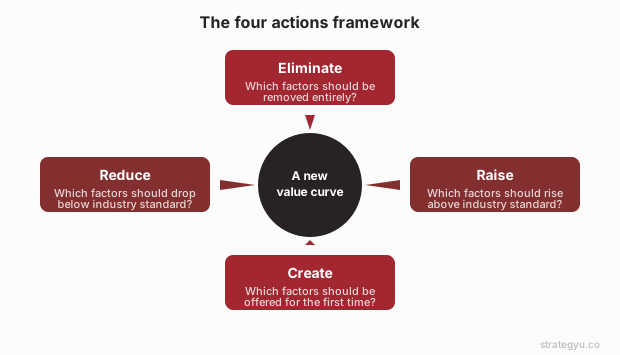
The first two actions (eliminate and reduce) cut your cost structure. The second two (raise and create) increase buyer value. Doing all four simultaneously is what breaks the trade-off between differentiation and low cost.
Kim and Mauborgne point out in Blue Ocean Strategy that managers rarely think systematically about what to eliminate and reduce. The instinct is always to add. Companies benchmark competitors and pile on features. The result is rising costs and complex business models, and the strategic profiles converge even further. The eliminate and create questions are the most important ones because they force you to change the factors of competition themselves, not just adjust their levels.
How it works in practice
Cirque du Soleil: reinventing the circus
Kim and Mauborgne open Blue Ocean Strategy with Cirque du Soleil. The company’s growth is the framework’s best advertisement: within two decades of its founding, it matched the revenues that Ringling Bros. and Barnum & Bailey had taken over a century to build. And it did this in an industry that every traditional analysis said was declining. Audiences were shrinking, costs were rising, and the competitive dynamics were brutal.
Cirque didn’t try to win a share of shrinking demand. Instead, it applied the four actions to rethink what a circus could be. Kim and Mauborgne describe the logic in Blue Ocean Strategy:
Whereas other circuses focused on offering animal shows, hiring star performers, presenting multiple show arenas in the form of three rings, and pushing aisle concession sales, Cirque du Soleil did away with all these factors. These factors had long been taken for granted in the traditional circus industry, which never questioned their ongoing relevance. However, there was increasing public discomfort with the use of animals. Moreover, animal acts were one of the most expensive elements, including not only the cost of the animals but also their training, medical care, housing, insurance, and transportation.
On the create side, Cirque looked across the market boundary to theater:
By looking across the market boundary of theater, Cirque du Soleil also offered new noncircus factors, such as a story line and, with it, intellectual richness, artistic music and dance, and multiple productions. These factors, entirely new creations for the circus industry, are drawn from the alternative live entertainment industry of theater.
The result was a product that didn’t compete with traditional circuses for the same audience. Cirque attracted adults and corporate clients willing to pay several times the price of a Ringling Bros. ticket for what was, in effect, a different kind of live entertainment. It eliminated the most expensive elements of the traditional circus (animals, stars, three-ring logistics) while creating new reasons to pay theater-level prices.
[yellow tail] wine: making wine approachable
The US wine industry in the early 2000s had over 1,600 wineries competing for a stagnant pool of consumers. Despite all that supply, American per capita wine consumption ranked only thirty-first in the world. Most wineries were fighting each other over the same existing drinkers, differentiating on complexity, vineyard prestige, and aging.
Casella Wines’ [yellow tail] took the opposite approach. As Kim and Mauborgne describe in Blue Ocean Strategy:
Instead of offering wine as wine, Casella created a social drink accessible to everyone: beer drinkers, cocktail drinkers, and traditional drinkers of wine. In the space of only two years, the fun, social drink [yellow tail] emerged as the fastest-growing brand in the histories of both the Australian and the US wine industries and the number-one imported wine into the United States, surpassing the wines of France and Italy. By August 2003, it was the number-one red wine in a 750-ml bottle sold in the United States, outstripping California labels.
The mechanics were straightforward. [yellow tail] dramatically reduced or eliminated everything the wine industry competed on: tannins, oak, complexity, aging, vineyard prestige, technical jargon. It offered just two wines at launch (a Chardonnay and a Shiraz), put a kangaroo on the label in bright colors, and priced above budget wines but well below premium. And it did all this without any advertising in the initial years.
Southwest Airlines: the speed of a plane at the price of a car
Kim and Mauborgne also use Southwest Airlines as an example of blue ocean thinking, though Southwest predates the framework by decades. As they write in Blue Ocean Strategy:
Southwest Airlines created a blue ocean by breaking the trade-offs customers had to make between the speed of airplanes and the economy and flexibility of car transport. To achieve this, Southwest offered high-speed transport with frequent and flexible departures at prices attractive to the mass of buyers.
Their analysis of the value curve is revealing. Southwest’s competitors invested across all the traditional factors of airline competition: meals, seating classes, hub connections, lounges. Southwest “emphasizes only three factors: friendly service, speed, and frequent point-to-point departures” and doesn’t invest in anything else. The tagline they propose captures the blue ocean logic: “The speed of a plane at the price of a car, whenever you need it.”
The airline industry has terrible structural economics. Four of five forces work against profitability. Southwest succeeded not by hoping the forces would be more favorable, but by redefining what it was competing on. Its value curve looked like a different industry because, in a meaningful sense, it was.
How to build a strategy canvas
If you want to apply this to your own business or a client engagement, here’s the practical process.
Identify the factors of competition
List every factor your industry competes on. Not just the obvious ones like price and quality, but the specific dimensions that companies invest in and that buyers evaluate. In the wine example, these were price, packaging, marketing spend, aging quality, vineyard prestige, taste complexity, and range. In airlines, they include meals, lounges, seating classes, hub connectivity, speed, frequency, and friendliness.
A good test for whether you’ve captured the right factors: look at your industry’s advertising, trade publications, and customer reviews. What do they talk about? What do buyers compare across competitors? Those are the factors.
Plot the value curves
Rate every major competitor on each factor (high, medium, low) and draw their value curves. This is where the convergence usually becomes obvious. Companies that think they’re differentiated often discover their value curves track almost identically with competitors.
Also plot your own company. Where does your curve sit relative to everyone else’s? If it overlaps with the competition, you’re in a red ocean regardless of what your internal strategy deck says.
Apply the four actions
Go factor by factor and ask the four questions. This is harder than it sounds because the eliminate question runs against every instinct in business. Managers resist removing features that the industry has always competed on. But that resistance is exactly why the opportunity exists. If every competitor assumes a factor is necessary, and you prove that buyers don’t actually value it, you’ve found a cost advantage that’s difficult for competitors to copy because it requires them to stop doing something they believe in.
The create question is equally hard because it requires looking beyond your industry’s boundaries. Kim and Mauborgne describe this as looking at “alternatives and noncustomers.” Cirque du Soleil looked at theater. [yellow tail] looked at beer and cocktails. Southwest looked at car travel. The insight almost always comes from outside the industry’s conventional frame.
Test for focus, divergence, and a compelling tagline
Kim and Mauborgne propose three tests for a good blue ocean strategy. First, focus: the value curve should concentrate on a few factors, not spread investments across everything. Second, divergence: the curve should stand apart from competitors’ curves. Third, a compelling tagline: you should be able to describe the offering in a single clear sentence that speaks to buyers.
If your proposed strategy fails any of these tests, it probably isn’t a blue ocean. If the value curve doesn’t diverge, you’re still in the red ocean. If you can’t compress the idea into one sentence, the positioning is muddled.
Where the framework breaks down
Blue Ocean Strategy is an attractive idea, and the examples are well chosen. But there are real limitations worth being honest about.
Survivorship bias
The most serious critique is that Kim and Mauborgne studied successful blue ocean moves and worked backward to explain them. We don’t see the companies that tried to create new market space and failed. For every Cirque du Soleil, there were likely dozens of entertainment concepts that attempted something equally unconventional and went bankrupt. The framework describes what successful market creation looks like after the fact. That doesn’t necessarily mean it can predict what will succeed going forward.
The execution gap
Creating a strategy canvas is the easy part. Getting an organization to actually eliminate factors it has invested in for decades, ignore the competition it has always benchmarked, and bet on untested customer segments is a different problem entirely. Kim and Mauborgne address execution in the second half of the book, but the analytical frameworks in the first half are so clean that they can create a false sense of certainty about what is, in reality, a very uncertain process.
Tension with Porter’s positioning school
The relationship between Blue Ocean Strategy and Porter’s work is more complicated than the “red ocean vs. blue ocean” framing suggests. Porter’s argument is that competitive advantage comes from making choices about where to compete within an industry structure. Kim and Mauborgne’s argument is that the best moves create new industries or redefine existing ones, making the industry structure question irrelevant.
But even companies that create blue oceans eventually face the same structural forces Porter describes. Cirque du Soleil created a new market, but over time that market attracted competitors and imitators. The structural forces reassert themselves. In that sense, blue ocean strategy describes how to start a period of competitive advantage, but Porter’s frameworks describe what happens next. They’re more complementary than competing.
The broader point is that being different and being sustainably profitable are not the same thing. A blue ocean is only as valuable as your ability to defend it once competitors notice what you’re doing.
The demand creation assumption
Blue Ocean Strategy assumes companies can create demand, not just compete for existing demand. That’s true sometimes. Cirque du Soleil genuinely attracted people who would never have gone to a traditional circus. But it’s not always true. Many market spaces are “blue” not because nobody has thought of them but because there isn’t sufficient demand to support a business there. The framework doesn’t provide a reliable way to distinguish between a genuine untapped market and a market that doesn’t exist for a reason.
How to think about it
The real contribution of Blue Ocean Strategy isn’t the red ocean/blue ocean metaphor, which is clever but simplistic. It’s the strategy canvas as a diagnostic tool.
Drawing value curves for an industry and seeing the convergence is genuinely useful. It forces the question that most competitive analysis skips: are we all competing on the same dimensions in the same way?
The four actions framework is useful for the same reason. Most strategic planning processes are additive. Companies ask “what should we do more of?” and almost never ask “what should we stop doing?” The eliminate question alone is worth the price of the book.
Where I’d push back on the framework is the implicit promise that you can systematically create blue oceans. The tools are good for diagnosis. They’re good for spotting opportunities. But the actual creation of new market space involves judgment, timing, and luck in proportions that no framework can fully account for. The 108 business launches in Kim and Mauborgne’s study didn’t succeed because they followed a process. They succeeded because they made a bet about what customers would want, and they happened to be right.
That’s worth keeping in mind the next time someone pulls up a strategy canvas in a planning session. The canvas can show you where the competition has converged and where the white space might be. Whether that white space contains real demand, and whether your organization can execute the move to get there, are questions the framework can’t answer for you.
Recommended reading
W. Chan Kim and Renee Mauborgne’s Blue Ocean Strategy is worth reading in full. The first half on analytical tools is the strongest part. The second half on execution and organizational hurdles is less distinctive but still practical. Joan Magretta’s Understanding Michael Porter is the best companion read because it lays out the positioning school’s argument clearly, and understanding both frameworks together gives you a much more complete view of strategy than either one alone. Walter Kiechel’s The Lords of Strategy places both Porter and Kim/Mauborgne in the broader history of strategic thought.