Case interview frameworks: the complete guide
Most people prepare for case interviews by memorizing frameworks. They make flashcards for the 4 Cs, the 4 Ps, and Porter’s Five Forces, and then they walk into an interview and try to force one of those frameworks onto whatever question they get.
This almost never works.
Though this is basically what I tried to do when I applied to consulting my senior year of college. (I’ve written separately about whether case interviews even work and why I think they’re an enormous waste of energy.) Not knowing how much people at feeder schools like Harvard and Stanford prepare, and not having people at my school thatI could practice with, I devoured online case books and then tried to “perform” cases in the mirror by myself. It wasn’t enough (I got rejected from 100+ companies.)
The Vault Guide to the Case Interview warns against this directly: “We must remind you that [framework]s are just that - frameworks, not a solution in and of themselves. Don’t tell your interviewer ‘I’m going to use the Four Cs.’ Just do it!”
So why bother learning frameworks at all?
Because they give you a place to start. Think of them as learning arithmetic before you do calculus. You need to understand basic structure so that you can them remix something that fits a custom scenario given in the interview. The best case interviewees know all frameworks but have done enough practice that they can just generate their own synthesis and structure on the spot.
This guide covers every framework worth knowing for case interviews. But the real skill is knowing when and how to combine pieces from different frameworks to fit the problem in front of you.
The core information processing tools
Before you get into breaking down a business problem, you need to understand the “processing tools” that help you break down and organize information in different ways.
First, MECE (mutually exclusive, collectively exhaustive)
MECE is how consultants make sure they’ve covered all the ground without double-counting anything. When you break a problem into parts, each part should be distinct (mutually exclusive) and all parts together should cover the whole picture (collectively exhaustive).
This sounds simple. It isn’t. Most people’s first attempt at structuring a problem has overlaps and gaps they don’t even notice. A classic test: break down the reasons a company’s revenue might be declining. If your buckets are “fewer customers,” “lower prices,” and “worse economy,” you’ve got problems. The economy isn’t a separate bucket from fewer customers and lower prices. It’s a cause of those things.
MECE is the discipline that makes every other framework actually work. If your profitability tree or your issue tree isn’t MECE, the whole analysis has holes in it.
Next, SCQA and Issue Trees
SCQA stands for Situation, Complication, Question, Answer. It’s how consultants define problems before solving them. The Situation is what’s happening (facts everyone agrees on). The Complication is what changed or what’s wrong. The Question is what needs to be decided. The Answer is your hypothesis.
In a case interview, SCQA happens in the first sixty seconds. The interviewer gives you the situation and complication. Your job is to identify the right question and form an initial answer (hypothesis) to test. Getting this wrong means you spend the rest of the case solving the wrong problem.
Once you’ve defined the problem by naming the situation and complication, you develop questions or hypotheses. A good way to organize this is with issue trees.
An issue tree is how you decompose a big, vague question into smaller questions you can actually answer. “Should our client enter the Chinese market?” is too big. But broken into branches (market size, competitive dynamics, regulatory barriers, operational readiness, financial viability), each branch becomes something you can investigate.
The issue tree is probably the single most useful tool for case interviews because it works for any type of case. They can also be combined with other frameworks, like the profitability one below.
They’re also useful because it’s also how real consulting projects work. The first week of a McKinsey engagement usually involves the team defining a problem and sketching out an issue tree to map out the full scope of the problem into high-level hypotheses.
For more on how structured problem solving works in practice, see McKinsey’s structured problem solving approach.
Finally, the Pyramid Principle
Barbara Minto’s Pyramid Principle is about communication structure: lead with the answer, then support it with reasons. For case interviews, this matters most when you summarize your findings. Don’t build up to your recommendation. State it first. Then explain why.
An interviewer sitting through a long preamble before hearing your answer is an interviewer losing patience. Start with “I recommend the client enter the market, for three reasons” and then explain each one. That’s the Pyramid Principle in action.
Answering the Case
The Vault Guide describes a six-step process for case responses, attributed to Accenture:
- Listen to the case.
- Clarify the problem.
- Decompose the problem.
- State a hypothesis.
- Test the hypothesis.
- Summarize your findings.
Forming a clear hypothesis early (step four) is what separates a structured answer from an aimless one.
Hypothesis-driven thinking means you don’t just explore aimlessly. You form a point of view early, then ask questions designed to prove or disprove it. “My initial hypothesis is that the profit decline is driven by the cost side, specifically rising raw material prices. I’d like to test that by looking at the cost breakdown over the last three years.”
This is how actual consultants work, too. You’re not collecting all the data and then deciding what it means. You’re forming a view, testing it, and revising.
The most basic business framework - profitability
Two options: increase revenue or cut costs
If there’s one framework you use more than any other in case interviews, it’s the profitability framework. The Vault Guide lists the “falling profits case” first among its eight standard business case types, noting the key task is to “explore the possible reasons behind a company’s drop in profits.” It’s the most common case type for a reason: profitability is the bottom line of most business questions.
The core equation is simple:
Profit = Revenue - Costs
If profits are declining, either revenue has decreased, costs have increased, or both. From there, you break each side down further:
Revenue = Price x Volume
And volume can be further broken down by product line, customer segment, geography, or channel. Price might have changed due to competitive pressure, a shift in product mix toward lower-margin offerings, or actual price cuts.
Costs = Fixed Costs + Variable Costs
Fixed costs include things like rent, salaries, and depreciation. Variable costs move with production volume: raw materials, shipping, sales commissions.
The important thing about this breakdown is knowing when to stop drilling. You could list dozens of factors that might affect revenue or costs, but the interviewer doesn’t want a laundry list. They want to see that you can identify the two or three factors most likely to matter for this specific business and explain why those are the ones worth investigating. That prioritization — showing you know what matters most and why — is what separates a good answer from a mediocre one.
How to use it in a case
Say you get: “Our client is a national retailer that has seen profits decline 15% year over year. Why?”
Start with the profit equation. Ask whether revenue has declined, costs have increased, or both. Suppose the interviewer says revenue is flat but costs are up. Now you’re on the cost side. Ask about the split between fixed and variable costs. If variable costs rose, ask what happened to input prices, labor costs, or logistics costs. You’re drilling down methodically, not guessing.
This framework is a starting point, not a script. The specific follow-up questions depend entirely on the business and the facts the interviewer gives you.
Market entry and new market frameworks
“Should our client enter this market?” is one of the most common case types. The Vault Guide identifies it as one of eight standard case categories, with variations including entering a new product category, a new geographic market, or deciding whether to build, buy, or partner.
There’s no single named framework for this, but the standard questions fall into a few buckets:
Market attractiveness: How big is the market? Is it growing? What does the competitive structure look like? Are there high barriers to entry? (This is where Porter’s Five Forces becomes genuinely useful. Don’t name the framework. Just ask about buyer power, supplier power, substitute threats, entry barriers, and competitive intensity.)
Company fit: Does the client have the capabilities, brand, distribution, or technology to compete? What would it need to build or acquire?
Economics: What would it cost to enter? How long to break even? What market share would the client need to make the investment worthwhile? This is where contribution analysis comes in: calculate the unit contribution (price minus variable cost per unit), then the break-even volume (fixed costs divided by unit contribution), then ask what market share that volume represents. If the break-even market share is unrealistically high, the economics don’t work regardless of how attractive the market looks.
Risks: What could go wrong? Regulatory barriers, cultural differences (for geographic expansion), competitor response, execution risk.
The Ansoff Matrix as a lens
The Ansoff Matrix is a useful mental model here. It maps growth options on two dimensions: existing vs. new markets, and existing vs. new products. Market penetration (existing product, existing market) is the lowest risk. Diversification (new product, new market) is the highest. In a case interview, knowing where your client’s proposed move falls on that grid tells you something about the level of risk and the kinds of questions you need to ask.
M&A and competitive response
Mergers and acquisitions
M&A cases ask whether a company should acquire another. The Vault Guide summarizes the question as: “Determine whether a particular acquisition would be advisable.”
The thinking usually covers:
- Strategic rationale: Why does this acquisition make sense? Revenue synergies (cross-selling, access to new markets), cost synergies (consolidating operations, eliminating redundancy), or capability acquisition (buying technology, talent, or IP the acquirer lacks)?
- Financial viability: What is the target worth? Can the acquirer afford it? Will the deal be accretive or dilutive to earnings?
- Integration risk: Can these two companies actually be combined? Culture clashes, systems incompatibility, and customer attrition are where many mergers fail in practice.
- Alternatives: Could the acquirer build this capability instead of buying it? Could they partner?
Competitive response
The interviewer tells you a competitor has just made a move. Should your client respond, and how? These cases test whether you can think through second-order effects. If a competitor cuts prices, matching the cut might be the wrong answer if it starts a price war that destroys industry profitability for everyone.
The marketing and strategy frameworks
These are the named frameworks that show up in every case prep book. They’re useful as checklists for making sure you haven’t missed something obvious. They’re not useful as rigid templates.
The 4 Cs (customers, competition, cost, capabilities)
The 4 Cs framework appears across virtually every case prep resource. The Vault Guide calls it “especially useful for analyzing new product introductions and for industry analysis” and organizes it around four questions:
Customers: How is the market segmented? What are the purchase criteria that customers use? Who buys, who uses, and what drives their purchase decision?
Competition: What is the market share of the competitors? What is their market position and strategy? What is their cost position, and do competitors have any market advantages?
Cost: What kind of economies of scale does the client have? What is the client’s experience curve? Will increased production lower cost?
Capabilities: What resources can the client draw from? How is the client organized? What is the production system? This is the internal analysis — understanding what the company can actually do well.
The 4 Ps (product, price, place, promotion)
The 4 Ps is a marketing framework. You’ll use it most often in product launch or marketing strategy cases. The Vault Guide lists it alongside market analysis and competitor analysis as the go-to toolkit for new product introduction cases.
- Product: Market positioning, differentiation, brand equity, product-market fit
- Price: Cost-based pricing vs. value-based pricing. What do competitors charge? What are customers willing to pay? As the Vault Guide notes, “the price a firm sets for its product or service can be a strategic advantage. For example, it can be predatory (set very low to undercut the competition), or it can be set slightly above market average to convey a ‘premium’ image.” Small changes in price can have outsized effects on profitability, which is why pricing questions are such a common case type.
- Place: Distribution channels. Direct to consumer, through retailers, through distributors? The channel has to match the positioning.
- Promotion: Marketing strategy, advertising, branding. Not the most common area for case interview questions, but worth understanding for product launch cases.
SWOT analysis
Strengths, Weaknesses, Opportunities, Threats. The Vault Guide calls it “simple to employ and useful in trying to understand the position of a company.” Strengths and Weaknesses are internal (what the company is good and bad at). Opportunities and Threats are external (what’s happening in the market and industry).
This is one of those frameworks that tricks you into thinking you are being comprehensive and deep when in fact, it’s a bit too generic. I want to know about the strengths and weaknesses of a specific initiative, or unit of a company, not the high-level analysis. That said, it’s a reasonable first-pass structure when you’re handed a vague strategy question and need a minute to organize your thoughts.
Strategy frameworks that appear in cases
These come from the academic strategy canon. You won’t use them as standalone structures in most cases, but pieces of them show up regularly.
Porter’s Five Forces
Porter’s Five Forces analyzes the competitive structure of an industry through five lenses: threat of new entrants, bargaining power of suppliers, bargaining power of buyers, threat of substitutes, and rivalry among existing competitors. As the Vault Guide explains, “the Porter’s Five Forces framework helps determine the attractiveness of an industry. Before any company expands into new markets, divests product lines, acquires new businesses, or sells divisions, it should ask itself, ‘Is the industry we’re entering or exiting attractive?’”
In a case interview, you’re not going to walk through all five forces. But you might use one or two that are relevant. If the case is about a company facing margin pressure, buyer power might be the explanation. If it’s about whether to enter a new industry, entry barriers and rivalry matter most.
The key caveat: Five Forces is a starting point for industry analysis, not a complete answer on its own. It tells you about the structural attractiveness of an industry but says nothing about a specific company’s ability to compete within it. You’ll almost always need to combine it with internal analysis (capabilities, cost position, value chain) to build a complete picture.
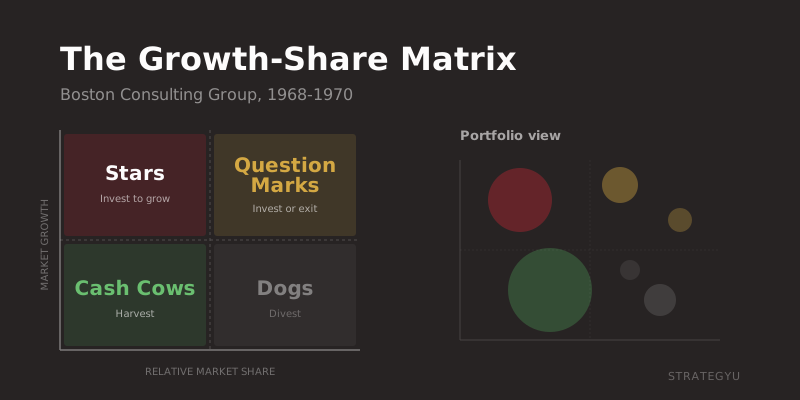
The BCG Growth-Share Matrix
The BCG Growth-Share Matrix plots business units on two axes: market growth rate and relative market share. This produces four quadrants: stars (high growth, high share), cash cows (low growth, high share), question marks (high growth, low share), and dogs (low growth, low share).
It shows up in portfolio strategy cases. When a conglomerate is deciding where to invest and where to divest, the BCG matrix is a useful way to categorize its businesses. The Vault Guide describes it as “perhaps the most famous 2x2 matrix.”
The experience curve
The experience curve is the idea that as a company produces more of something, its unit costs fall predictably. This shows up in cases about pricing strategy (should we price low to gain volume and ride the cost curve down?) and in market entry cases (can a new entrant overcome the incumbent’s cost advantage?).
This framework isn’t really something you “use” but rather something you might mention to demonstrate you understand this principle:
I will assume that the company will become more efficient at manufacturing over time. We can assume something like a 10% annual reduction in cost. (To Interviewer) Do you think this is reasonable?
Value chain analysis
Value chain analysis breaks a company’s operations into stages and asks where value is actually created. As the Vault Guide explains:
Value chain analysis attempts to identify a competitive advantage by deconstructing the various “changes” a company’s business processes perform on a set of raw materials or other inputs. Most can be easily copied by other competitors, but there is usually a unique subset that represents the “value-added” qualities only the company under scrutiny possesses. This set is that company’s competitive advantage, or “value chain.”
In a case, you might use value chain thinking to figure out where a company’s costs are out of line or where it has a competitive edge worth protecting.
The McKinsey 7S Framework
The Vault Guide calls the 7S Framework “a McKinsey favorite.” It breaks a company into seven elements: Strategy, Structure, and Systems (the “hard” elements) plus Staff, Skills, Style, and Shared Values (the “soft” elements). The idea is that all seven need to be aligned for a strategy to work.
You’ll rarely use the full 7S in a case interview. But the underlying insight, that a strategy can fail because the organization isn’t set up to execute it, is relevant in any case involving organizational change, post-merger integration, or strategy implementation.
The situational frameworks
These aren’t standard named frameworks. They’re structured approaches to specific types of cases that come up repeatedly.
Pricing
Pricing cases ask you to figure out what a company should charge. The thinking usually combines:
- Cost-plus: What does it cost to make? What margin does the company need?
- Value-based: What is it worth to the customer? What would they pay?
- Competitive: What do alternatives cost? What are substitutes priced at?
The answer is usually somewhere in the zone between cost-plus (the floor) and value-based (the ceiling), adjusted for competitive pressure.
Market sizing (guesstimates)
Market sizing questions test your ability to structure a problem and do rough math. “How many gas stations are there in the United States?” “What’s the market size for dog food in France?”
The approach is always the same: break it into pieces you can estimate, multiply through, and sanity-check the result. For gas stations, you might start with the U.S. population, estimate cars per household, estimate fill-ups per week, estimate how many customers a single station can serve per day, and work backward to the number of stations needed.
Always use round numbers. Estimating the U.S. population? Use 300 million, not 331 million. The interviewer is testing your logic and structure, not your ability to multiply ugly numbers in your head. The Vault Guide makes this point about mental math in cases: “Interviewers are fond of cases that require multiplication and division with lots of zeros, and it’s easy to add or drop a zero and be off by a factor of 10.” Round numbers keep the math clean so you can focus on the reasoning.
Operations and supply chain
Some cases focus on operational problems: a factory with quality issues, a supply chain with bottlenecks, or a logistics network that needs redesigning. There’s no standard framework for these. You need to understand the basics: capacity utilization, throughput, cycle time, inventory management, and where costs accumulate in the production and distribution process.
How to actually use frameworks (instead of memorizing them)
The Vault Guide puts it well:
“The model and concepts are like a basic recipe,” says one consultant. “Any creativity or alteration you make to that model is like seasoning. Your audience - the interviewer - will appreciate it.”
Here’s what that means in practice:
#1 Build a custom structure for each case. When you hear the case question, don’t think “which framework fits?” Think “what are the two or three most important questions I need to answer?” Those questions might pull from different frameworks. A market entry case might need the market attractiveness lens from Porter’s Five Forces, the internal capability lens from the 4 Cs, and the financial analysis from a profitability tree.
#2 Use MECE and practice high-level structure. MECE is your best friend when it comes to breaking down various situations. Find problem statements online (or even ask AI to generate them) and practice using the rule of three to generate three areas of focus. You’ll find that sometimes the ideas aren’t parallel and other times, they aren’t collectively exhaustive. But over time you’ll get a feel for how to break down an issue.
#3 Tell the interviewer your structure. After you’ve taken a minute to think, lay out your approach. “I’d like to look at this in three parts: first, whether the market is attractive enough to enter; second, whether the client has the capabilities to compete; and third, whether the economics work.” That’s a custom structure built from framework components, but it sounds like original thinking because you’ve tailored it to the specific case.
#4 Stay flexible. Your interviewer might steer you away from one branch and toward another. That’s not a trap. It’s how actual consulting engagements work. New information changes the analysis. The Vault Guide notes that “your interviewer may suggest a relevant factor that you have not asked about or included among your assumptions, and you now must take that into account.” This is basically the OODA loop in action: observe the new information, orient it within your structure, decide how to adjust, and act.
#5 Practice building structures, not memorizing them. The best case prep isn’t reading about frameworks. It’s practicing with actual case questions and building a custom structure for each one. As the Vault Guide notes:
Students at top business schools engage in 30 live practice cases and read another 30 cases before they go to their first interview.
That kind of repetition builds the muscle memory that lets you structure a new problem on the spot.
While I think this practice is good for landing a job, I am still somewhat skeptical that case interviews are really the most valuable thing to actually learn consulting skills.
Common mistakes
Announcing your framework. “I’m going to use the 4 Cs.” The Vault Guide is blunt about this: “Don’t tell your interviewer ‘I’m going to use the Four Cs.’ Just do it!” Naming a framework signals that you’re applying a template rather than thinking about the specific problem. The interviewer wants to see you build a structure that fits the case, not announce which textbook chapter you’re reciting from.
Forcing a framework that doesn’t fit. If you’ve got a profitability case and you start walking through Porter’s Five Forces, you’re going to lose the interviewer. Match the tool to the problem.
Going too broad. You don’t get credit for listing every possible factor. You get credit for identifying the most important ones and explaining why they matter. Part of what makes a consultant successful is the ability to quickly separate what’s important from what’s not. A candidate who rattles off fifteen possible causes of a profit decline looks less impressive than one who identifies three likely causes and explains why those are the ones worth investigating. The Vault Guide describes cases where “a parade of facts” gets thrown at you, and the interviewer “wants to see how well you separate the critical information from the clutter.”
Not doing the math. Many candidates shy away from quantitative analysis. But a well-structured back-of-the-envelope calculation can be the strongest part of your case. Don’t avoid the numbers.
Freezing when you make a mistake. The Vault Guide quotes a consultant on this:
“One of the most common mistakes case interviewees make is to screw up once and then freeze. They assume that they’ve irrevocably ruined their chances at the firm. But in fact, learning from mistakes is a big part of being a consultant. The interviewer will be impressed if the candidate can rebound.”
Correct your course and keep going. The interviewer cares about your recovery as much as your initial answer.
Where to go from here
Frameworks are the starting vocabulary. The real skill is fluency, being able to combine, adapt, and apply them under time pressure to problems you’ve never seen before.
If you’re just getting started, learn the profitability framework and issue trees first. Those two cover the widest ground. Then build up your familiarity with the situational frameworks (market entry, M&A, pricing) and the strategy concepts (Porter’s Five Forces, value chain, BCG matrix).
For deeper dives on the thinking tools underneath case frameworks, start here:
- MECE for structuring any problem
- Issue trees for breaking big questions into answerable pieces
- The Pyramid Principle for communicating your answer
- SCQA for defining the problem and hypothesis
- Problem solving 101 for the broader skill set
And for the strategy frameworks themselves:
- Porter’s Five Forces for industry analysis
- BCG Growth-Share Matrix for portfolio strategy
- Ansoff Matrix for growth strategy
- Experience curve for cost and pricing dynamics
- Consulting frameworks overview for the full list