Duck's change curve: the emotional side of organizational change
Jeanie Daniel Duck’s change curve is a different way of thinking about organizational change. Instead of mapping out tactical phases or “steps,” something like Kotter’s 8-step model, it maps what people feel during a transformation, not what the project charter says should happen next. And it argues that those feelings, not the strategy or the systems, determine whether the change actually sticks.
I think her model is great because it can be a good complement to the others. Ultimately, when doing large-scale change projects, you have to abstract away the strategy across a company and across many employees. But the Change Monster forces the conversation around the inner battle of change: our resistance and all the other unspoken competing interests and political fault lines in the company.
The origin and the idea
Duck was a senior vice president at the Boston Consulting Group who focused on the human side of corporate transformations.
Her 1993 Harvard Business Review article, “Managing Change: The Art of Balancing,” became one of HBR’s most popular reprints. In 2001, she expanded the ideas into a book, The Change Monster.
The central metaphor is the “change monster,” Duck’s term for the complex, sometimes frightening human emotions that surface during any major organizational change. Fear, confusion, exhaustion, paranoia, rage, and occasionally something like hope. Duck argues that these emotions aren’t side effects of the change process. They are the change process. As she wrote in The Change Monster:
“Emotions truly are data and have just as much relevance as data on sales, profits, or any other ‘tangible’ aspect of organizational performance.”
Ignore them and the transformation fails, no matter how good the strategy looks on paper. Duck was blunt about why this keeps happening: “Too many leaders are slow to identify the human issues, fail to recognize their significance, and are very reluctant to confront them directly.”
Duck’s original HBR article opens with a vivid image of what goes wrong when companies treat change as a set of parallel workstreams:
“It’s like the company is undergoing five medical procedures at the same time. One person’s in charge of the root-canal job, someone else is setting the broken foot, another person is working on the displaced shoulder, and still another is getting rid of the gallstone. Each operation is a success, but the patient dies of shock.”
The problem, as Duck saw it, was that leaders kept slicing change into manageable pieces and assigning each piece to a different team. In her HBR article she wrote, “We keep breaking change into small pieces and then managing the pieces.” That works fine for physical work. It fails for the emotional side, because people don’t experience the restructuring, the new systems, and the layoffs as separate projects. They experience all of it at once.
Her alternative metaphor was a mobile. As she put it, “The proper metaphor for managing change is balancing a mobile.” Touch one piece and every other piece moves. The leader’s job is not to manage each initiative in isolation but to manage the connections between them.
The framework she built around this insight is the change curve, a five-stage model of how organizations actually move through transformation:
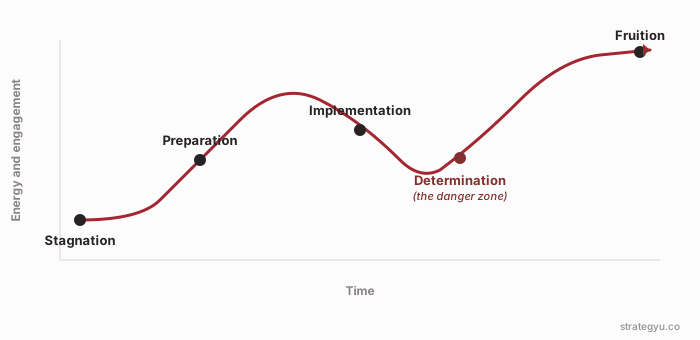
- Stagnation. The organization has stopped adapting. People know something is wrong, but nothing is changing. Leadership may not yet recognize the need for change, or they recognize it but aren’t acting.
- Preparation. A leader or external force breaks the inertia. Planning begins. There’s energy and anxiety in roughly equal measure. This is where the vision gets articulated, but it’s also where people start to wonder what the change means for them personally.
- Implementation. The changes start happening. Restructuring, new roles, and new processes. Energy is high but chaotic. People are doing new things but haven’t yet internalized why.
- Determination. This is the stage that kills most change efforts. The initial energy has faded. The disruption is real but the benefits aren’t visible yet. People are tired, frustrated, and looking for any excuse to go back to the way things were. Duck argues that this is the stage where leaders most need to stay engaged, and it’s the stage where they’re most likely to declare victory early and move on.
- Fruition. The change takes hold. New behaviors become habits. The organization starts to see the results, and people feel competent in the new way of working. But even here, Duck warns, leaders need to keep reinforcing the change or the organization can slide back into stagnation.
Why the emotional arc matters
The change curve works best as a diagnostic: where are your people emotionally, and does your leadership approach match?
IBM under Gerstner: reading a transformation through the change curve
An example we can analyze through the change curve is IBM’s transformation under Lou Gerstner in the 1990s. Gerstner became CEO in April 1993, arriving at a company widely considered to be in crisis. IBM had posted billions in losses, its stock had cratered, and layoffs had hit a workforce that had long operated under an implicit promise of lifetime employment.
As Gerstner later wrote in Who Says Elephants Can’t Dance?:
“I came to see, in my time at IBM, that culture isn’t just one aspect of the game, it is the game.”
The stagnation was visible from the outside. IBM had organized around hardware product lines, with divisions operating independently. The mainframe business still drove most of the profits, and it was shrinking. People inside knew something was wrong, but the culture assumed IBM’s past success would carry it forward.
Gerstner’s preparation was fast. He decided early to keep IBM together as a single company rather than break it up, which the board and analysts had been pushing for. His bet was that IBM’s real advantage was integration, the ability to help clients across their entire technology stack. He made aggressive cost cuts and eliminated visible symbols of the old culture, like the dress code. Small signals mattered.
Implementation was painful. Gerstner pushed IBM from a hardware company toward services, building what became IBM Global Services. He moved the company toward open software standards, which meant IBM’s proprietary systems would have to compete on merit. More people were let go. The culture, built around internal consensus and technical hierarchy, resisted at every step.
This is exactly the kind of resistance Duck was writing about. In her HBR article, she argued that leaders who treat change as a purely rational exercise miss the point entirely:
“Change is fundamentally about feelings; companies that want their workers to contribute with their heads and hearts have to accept that emotions are essential to the new management style.”
At IBM, the emotions were real. People who had spent careers building mainframes were being told that the future was services. That’s not just a strategic pivot. It’s an identity crisis for thousands of engineers.
The determination phase is the one that matters most for Duck’s framework. The services strategy was producing financial results, but many IBM veterans didn’t believe in it. They still saw themselves as hardware engineers, not consultants. Gerstner had to keep reinforcing the message: the old IBM wasn’t coming back.
Duck had a rule of thumb for this stage. In her HBR article she wrote:
“If there is a single rule of communications for leaders, it is this: when you are so sick of talking about something that you can hardly stand it, your message is finally starting to get through.”
That’s what Gerstner did for nine years. The constant repetition mattered more than the initial announcement. By the time people two or three levels down actually internalized the new direction, Gerstner had been saying it so long he was probably sick of hearing himself say it.
By the time Gerstner left in 2002, IBM had transformed from a declining hardware company into a services and software business. That’s fruition, but it took nine years of sustained pressure to get there.
The determination trap
Most change models treat the middle of a transformation as an execution problem. Duck treats it as an emotional one.
The pattern is consistent: the initial excitement of a new strategy fades, people get exhausted, and the organization looks for a way to stop. Leaders face a specific temptation at this point. They’ve been driving the change for months or years. They’re tired too. They want to declare progress and move to the next thing.
But if they ease off during determination, the organization will snap back to its old patterns like a stretched rubber band.
Duck argues that the core issue at this stage is trust. People are watching leadership closely, looking for signs that the change is real or that it’s just another initiative that will quietly die. In her HBR article, she boiled it down to two things:
“Trust in a time of change is based on two things: predictability and capability.”
If people can’t predict what leadership will do next, or if they don’t believe leadership can actually pull off the change, they disengage. And once that trust erodes during determination, it’s very hard to rebuild.
How to use it
In practice, the change curve is a diagnostic lens, not a step-by-step implementation guide.
Figure out which stage you’re actually in
Most leaders overestimate their progress on the change curve. They announce a new strategy (preparation), start reorganizing (implementation), and assume the change is nearly done. In reality, the hardest part hasn’t started yet.
A good test: ask people two levels down from leadership what they think the change is about and whether they believe in it. If they can’t articulate the “why” or they’re going through the motions without conviction, you’re probably in early implementation at best, regardless of what the project plan says.
Match your leadership to the stage
Each stage requires different things from leaders:
- In stagnation, the job is to create urgency and name what isn’t working. Most people know something is off. Saying it out loud creates permission to act.
- In preparation, the job is to be honest about what will change and what won’t. Ambiguity breeds fear, and fear breeds resistance.
- In implementation, the job is to stay visible and absorb the chaos. People will be confused. That’s normal, not a sign that the plan is failing.
- In determination, the job is to hold the line. Don’t declare victory. Don’t move on to the next initiative. Keep reinforcing why the change matters, even when it feels repetitive.
- In fruition, the job is to lock in the new behaviors before they revert. Celebrate what’s working. Connect the results to the effort people put in.
Create space for the emotions (the “Pity City” technique)
One of the best practical examples in Duck’s HBR article is a project director who found a simple way to make the emotional side of change manageable. He scheduled Tuesday and Friday meetings where for the first 15 minutes, the group would “visit Pity City,” a designated window to gripe, complain, and vent about how the change was affecting them. Then for the next 15 minutes, they’d go around and share small victories.
The rule was that everyone had to participate in both. You couldn’t just complain. You couldn’t just celebrate. Over ten months, this built what Duck describes as remarkable camaraderie. The team got through determination because they had a structure for processing the frustration instead of letting it fester in hallway conversations and private resentment.
It’s a small thing, and it sounds a little silly. But that’s what makes it useful. Most organizations have no mechanism at all for acknowledging that the change is hard. They just expect people to absorb the disruption and keep performing. Duck’s point is that the emotions are going to surface somewhere. Better to give them a scheduled outlet than let them sabotage the project underground.
Watch for the emotional signals, not the project metrics
The project dashboard might show green across the board while the organization is emotionally stuck in determination. The feelings are the leading indicator, not the metrics. Strategy, structure, and systems can all look right on paper while the people underneath are exhausted and cynical. That gap matters. If the people aren’t with you, it doesn’t matter that the restructuring is “on track.”
Where the framework breaks down
Duck’s change curve has a few genuine weaknesses.
The biggest one: it’s built on anecdote, not data. Duck developed the framework from decades of consulting experience, and her examples in The Change Monster use fictional company names. That makes the ideas difficult to validate empirically. The stages feel intuitive to anyone who’s lived through a transformation, but “it feels right” isn’t the same as “it’s been tested.” Plus, from my own experience, many executives haven’t quite done the inner work to be emotionally attuned to their own states in the first place.
The widely cited statistic that 70% of change initiatives fail, which gets attached to frameworks like Duck’s, is itself on shaky ground. The number has been repeated so often that it feels like established fact, but the sourcing behind it is thin. Beer and Nohria stated it in their 2000 Harvard Business Review article “Cracking the Code of Change”, and it quickly became conventional wisdom. But Mark Hughes examined the claim in a 2011 paper in the Journal of Change Management and found “the absence of valid and reliable empirical evidence” to support it.
The framework also doesn’t tell you what to change. Duck herself was clear about this in The Change Monster. She described three essentials for successful change: a sound strategy (“a passionate belief in where you’re going”), good basic management and execution, and managing the emotional dynamics. The change curve only addresses the third one. You could be on the wrong path and move through all five stages beautifully. The curve only tells you whether the people inside your organization can handle the transition, not whether the transition is worth making.
And the stages are neater than reality. Organizations don’t move through them in a clean sequence. A merger might put different divisions in different stages simultaneously, and a new CEO can push from stagnation to implementation so fast that preparation barely happens. The curve is a useful simplification, but it can make change look more orderly than it is.
How to think about it
The change curve’s real contribution is a single idea: the emotional journey of change is predictable, and it can be managed.
That sounds obvious, but most organizations ignore it. They build detailed implementation plans for the operational side of change and leave the human side to chance. Then they’re surprised when people resist, check out, or actively sabotage the effort.
Duck closed her HBR article with a line that still holds: “The real contribution of leadership in a time of change lies in managing the dynamics, not the pieces.” Most leaders are wired to manage pieces. They assign workstreams, set milestones, and track deliverables. That’s the comfortable part. The uncomfortable part is paying attention to how people actually feel and adjusting your approach based on what you find.
Duck herself acknowledged the difficulty but also the reward. As she wrote in The Change Monster: “The change process may be complicated, time-consuming, and filled with truths you might wish you never had to face, but it can also be the most satisfying, challenging, and spirited work of a career.”
The question worth carrying forward: how do the people doing the work actually feel about this change, and what would it take to move them forward?
Recommended reading
Duck’s The Change Monster is the full treatment of the change curve framework, with detailed descriptions of each stage and the emotional dynamics within them. Her 1993 HBR article “Managing Change: The Art of Balancing” covers the core idea more concisely and is available through the HBR archive. For comparison, Lou Gerstner’s Who Says Elephants Can’t Dance? covers the IBM transformation from the inside, and every stage of Duck’s curve is visible in that story.