
Why Clayton Christensen was wrong about the disruption of consulting
In October 2013, Clayton Christensen, Dina Wang, and Derek van Bever published “Consulting on the Cusp of Disruption” in the Harvard Business Review. Christensen, who literally wrote the book on disruption theory, turned his framework on the consulting industry and made a prediction:
“We have come to the conclusion that the same forces that disrupted so many businesses, from steel to publishing, are starting to reshape the world of consulting.”
The article was widely read. Partners at top firms circulated it. Business school professors assigned it. And the thesis seemed plausible. Modular providers would replace the integrated solution shops. Freelance platforms like Eden McCallum and Business Talent Group would march upmarket. Big data would commoditize the analysis that junior consultants spent their nights producing. A “thinning of the ranks” was coming for the top tier.
It’s been more than twelve years. What actually happened?
McKinsey, BCG, and Bain got bigger. A lot bigger.
The numbers tell a different story
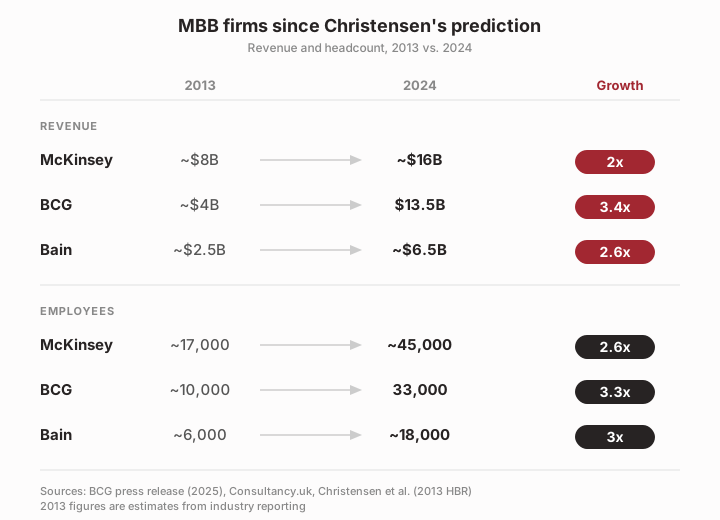
When the article was published in 2013, McKinsey’s annual revenue was estimated at roughly $8 billion. Its last self-published figure was $16 billion, for 2023, and it has disclosed nothing since. BCG has kept publishing and closed 2025 at $14.4 billion, its 22nd consecutive year of growth. Bain publishes no revenue at all; Forbes estimates $7.5 billion.
By any measure, the top-tier consulting firms have grown dramatically since Christensen’s prediction. McKinsey’s revenue doubled. BCG grew even faster. Bain more than doubled. The firms didn’t just survive. They thrived during a period when, according to disruption theory, they should have been losing ground to modular, lower-cost competitors.
And it’s not just revenue. The firms added headcount. McKinsey’s alumni network alone went from 27,000 in 2013 (a number Christensen cited in the article) to over 50,000 today. BCG reported 33,500 employees at the end of 2025. The apprenticeship model wasn’t dismantled through the 2010s. It was expanded.
The qualifier that matters is what happened next. Headcount at the big firms stopped growing in 2025 for the first time in years, McKinsey fell from 45,100 to around 40,000, and Bain’s assured sustainability filings show a 5% drop in 2024. Christensen’s mechanism still looks wrong. The growth story it was wrong about has stalled anyway.
The broader consulting industry tells the same story. The global management consulting market has grown from roughly $250 billion in 2013 to over $300 billion. Strategy consulting, which Christensen specifically identified as vulnerable, remains the highest-margin, highest-prestige segment.
The alternative firms that were supposed to lead the disruption? Eden McCallum and Business Talent Group still exist. They serve a real niche. But they remain small. They haven’t marched upmarket to displace McKinsey on CEO-level strategy engagements. They’re useful for specific situations, like a company that needs a single experienced consultant for a scoped project, but they haven’t replicated what the big firms do.
What Christensen’s framework missed
Christensen himself acknowledged two factors that historically protected consulting from disruption. The first was opacity:
“It’s incredibly difficult for clients to judge a consultancy’s performance in advance, because they are usually hiring the firm for specialized knowledge and capability that they themselves lack.”
The second was agility:
“Their primary assets are human capital and their fixed investments are minimal; they aren’t hamstrung by substantial resource allocation decisions.”
He named these as strengths but treated them as temporary shields. He argued that transparency, data democratization, and new business models would eventually erode both advantages. He was wrong, and the reasons are worth understanding.
Opacity is a feature, not a bug
Christensen framed opacity as a market inefficiency that would eventually be corrected. Clients couldn’t evaluate consultants properly, so they overpaid. Once information improved, the premium would shrink.
But he misread what clients are actually buying. A CEO hiring McKinsey for a post-merger integration isn’t buying information. They’re buying the ability to tell their board that McKinsey evaluated the situation. They’re buying pattern recognition across hundreds of similar deals. And they’re buying cover, the kind of career insurance that comes from hiring the most credible name in the room.
More than this, they’re buying a weird sord of magical unit that is the small consulting team, with unique tactic knowledge that only seems to work inside that actual companny. I saw this first-hand after I left places like BCG and McKinsey. It was harder to do work at the same level, and I felt like I had invisible walls constraining around me.
None of this becomes less important when data gets cheaper. If anything, the flood of available data makes the consulting team embedded in a world-class culture more useful, and much more valiuable.
You can’t productize the apprenticeship
Christensen’s framework predicted that modular providers would unbundle the consulting firm. You’d get your analysis from a data firm, your strategy from a freelancer, and your implementation support from a different vendor. Cheaper, more efficient, better fit.
This sounds logical if you think of consulting as a set of discrete deliverables. But the core product of a top consulting firm isn’t a deliverable. It’s a person who has been trained for two to four years in a specific way of thinking, communicating, and problem-solving. The structured problem-solving approach that McKinsey consultants learn isn’t a methodology you can download. It’s a set of reflexes built through hundreds of team rooms, client interactions, and feedback sessions.
Eden McCallum and Business Talent Group assemble teams of experienced freelancers, many of them former MBB consultants. This works for some engagements. I personally worked for one of these small firms, a-connect. One of the biggest challenges the firm faced was scaling. You just don’t get economies of scale staffing individual consultants. And if you do, its even harder to keep doing it. The big firms have permanent employees and as they grow, they have even more flexibility internally to build global superteams.
Consulting firms absorb everything
This is the factor Christensen most underestimated. He noted that consulting firms were agile, but he seems to have expected that agility to fail when confronted with real disruption. It didn’t.
The firms just absorbed whatever came next. Digital transformation? They built digital practices. Design thinking? They acquired design firms like LUNAR and Doblin. Data science? They hired PhDs in statistics. Every new capability that was supposed to disrupt consulting from the outside got pulled inside the firm within a few years.
McKinsey launched McKinsey Solutions, and Christensen identified it as the firm’s hedge against disruption:
“the driving force is almost certainly larger: McKinsey Solutions is intended to provide a strong hedge against potential disruption”
McKinsey Solutions still exists. It hasn’t replaced the core model. Instead, it became one more capability layered on top of the traditional engagement model. The firm didn’t pivot to a tech company. It absorbed tech capabilities into its existing structure. This is exactly what disruption theory says incumbents can’t do, because they’re supposed to be locked into their existing value network. But consulting firms, with their minimal fixed assets and flexible staffing models, turned out to be better at absorbing new capabilities than almost any other industry.
Brand and trust compound over time
Disruption theory works well in industries where customers switch based on performance and price. Steel buyers don’t care whether their rebar comes from U.S. Steel or a minimill. They care about specs and cost.
But a Fortune 500 CEO choosing a firm for a bet-the-company strategy engagement cares very much about which firm’s name is on the recommendation. The brand carries weight in the boardroom, with investors, and in the press.
And that brand premium doesn’t erode with new technology. If anything, in periods of uncertainty, CEOs become more risk-averse about their advisors, not less. When the stakes are high and the situation is ambiguous, you hire the name you trust. The 2020 pandemic should have been the moment for lean, modular, digital-first consulting alternatives. Instead, the big firms won even more work because every company suddenly needed help navigating something nobody had seen before.
What he got right
It would be unfair to score Christensen as completely wrong. Several of his observations were accurate, even if the overall prediction didn’t land.
The Big Four grew massively. Deloitte, PwC, EY, and KPMG all expanded their consulting divisions over the past decade. Deloitte Consulting alone is now larger by revenue than McKinsey. But they didn’t grow by disrupting MBB from below with cheaper, modular offerings. They grew by copying the MBB model at a different price point and bundling it with their existing audit and tax relationships. This is competition, not disruption in the Christensen sense.
Christensen’s observation about the declining share of strategy work was also accurate:
“At traditional strategy-consulting firms, the share of work that is classic strategy has been steadily decreasing and is now about 20%, down from 60% to 70% some 30 years ago”
This was true in 2013 and remains directionally true today. The firms do more implementation, digital, and operations work than they used to. But this wasn’t disruption and internally (I helped shape the transformation practice at BCG), this was celebrated as these longer term projects are more stable AND more profitable. The firms can still crush a short strategy study but they can do all the follow-on work without a problem now, too.
He was right that clients got more sophisticated. The proliferation of MBB alumni in corporate roles made clients smarter buyers of consulting. Many companies now have former McKinsey partners in their C-suite who know exactly what a consulting engagement should and shouldn’t cost. This has put pressure on fees for routine work. But sophisticated buyers still buy. They just buy more precisely.
And analytics did become important. Data science is now central to most consulting engagements. But analytics got absorbed into the existing model. The biggest open secret of getting a job at these top firms in the past ten years had been to get in through the analytics group. They were hiring people at a rapid pace.
The AI question
Christensen wrote with certainty: “If our long study of disruption has led us to any universal conclusion, it is that every industry will eventually face it.”
He also hedged: “we can say with utter confidence that whatever its pace, some incumbents will be caught by surprise.”
So is AI the disruption that actually arrives?
The honest answer is that nobody knows, including the people running consulting firms who are betting billions on it. But it’s worth applying the same logic that explains why previous predictions of disruption failed.
Start with judgment. AI can generate a market analysis, build a financial model, and produce a deck. What it can’t do, at least not yet, is sit in a room with a CEO who is terrified about a $4 billion acquisition and help them think through the decision. That requires reading the room, managing egos, knowing when to push and when to back off. Clients pay premium rates for this kind of executive therapy.
And the absorption playbook is running on schedule. McKinsey, BCG, and Bain are all investing aggressively in AI, building proprietary tools, training consultants to use them, positioning AI as something that makes the existing model better. This is exactly what they did with analytics, digital, and design.
But there’s a reasonable case that AI is different in kind, not just degree. Previous technologies (databases, analytics, design tools) changed what consultants produced. AI changes how they think. If an AI can do 80% of a first-year analyst’s job in an hour, the apprenticeship model starts to face challengs. The big firms may still hire a handful of super genius cracked AI wizards, but at the margin they are just going to hire more highly paid experts than junior consultants to do the grunt work.
The other variable is timing. Christensen’s predictions about consulting weren’t necessarily wrong in theory. They were wrong on the timeline. Maybe all those forces, modularity, freelance talent, data democratization, do eventually reshape the industry. Maybe AI is the accelerant that makes it happen in the next decade instead of the next century. Or maybe the firms absorb AI the way they absorbed everything else, and in 2038 someone writes another article predicting consulting’s imminent disruption.
What this tells us about disruption theory itself
There’s a broader lesson here that goes beyond consulting. Christensen’s disruption framework is one of the most influential ideas in business strategy. It explains steel minimills, disk drives, and department stores with genuine explanatory power. But it has a weakness: it assumes that the thing customers value can be measured and compared on a clear performance dimension.
In steel, the performance dimension is obvious: tensile strength, cost per ton. In consulting, the performance dimension is… what, exactly? The quality of the recommendation? The confidence it gives the CEO? The career cover it provides to the person who hired the firm? Consulting frameworks can be copied, but the trust embedded in a thirty-year client relationship can’t be unbundled and sold at a lower price point.
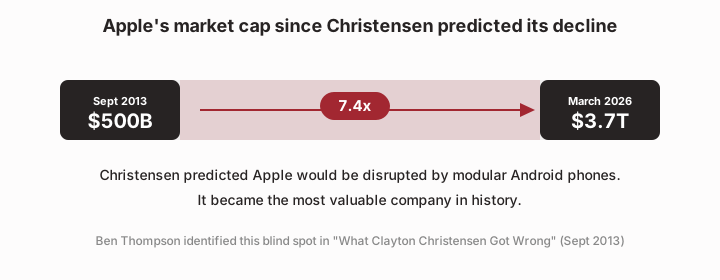
Ben Thompson made a version of this argument about Apple just weeks before Christensen’s consulting article was published. In his September 2013 essay “What Clayton Christensen Got Wrong”, Thompson pointed out that Christensen’s examples of disruption were almost entirely drawn from business-to-business markets:
That is the problem: Consumers don’t buy aircraft, software, or medical devices. Businesses do.
Thompson’s point was that business buyers are rational in the way disruption theory requires. They compare spec sheets, weigh costs against features, and will switch to a cheaper product that’s “good enough.” But consumers care about things that can’t be measured on a spec sheet: how a product feels, the design, the experience. Apple had been focused on exactly this kind of differentiation, which is why Christensen kept predicting Apple’s decline and kept being wrong.
When Thompson wrote that essay, Apple’s market cap was roughly $500 billion. Today it’s over $3.7 trillion. The company that Christensen said would be disrupted by modular Android phones became the most valuable company in history.
The parallel to consulting is direct. CEOs choosing a consulting firm aren’t making the kind of rational, measurable decision that disruption theory assumes. They’re making a judgment call based on trust, reputation, past experience, and the intangible sense that one firm “gets” their situation. Those are the same unmeasurable attributes that protect Apple in the consumer market. And just like Apple, the consulting firms have compounded their advantages rather than watching them erode.
Christensen warned that “there may be nothing as vulnerable as entrenched success.” It’s a good line. But more than a decade later, the entrenched success of both Apple and the top consulting firms looks less like vulnerability and more like a compounding advantage that his framework simply couldn’t account for.
My prediction: consulting firms may not continue to grow rapidly with headcount, but their revenues will continue to grow 5%+ for the next ten years.
The Christensen, Wang, and van Bever article “Consulting on the Cusp of Disruption” was published in the October 2013 issue of the Harvard Business Review. I’ve written about the history of the strategy consulting industry in depth.