
Types of consulting firms: a complete guide to the consulting industry
“Consulting” is a broad term in today’s world. Globally, the overall market is hard to assess but it is likely worth somewhere between half a trillion and a trillion dollars.
When people think about consulting, they often think about the most famous firms: McKinsey, Bain, and BCG. But there are many more players and even far more smaller divisions within each of these firms.
Beyond these giants, the consulting landscape is populated by numerous specialized firms and boutique agencies, each offering expertise in areas ranging from technology and human resources to environmental sustainability and legal compliance.
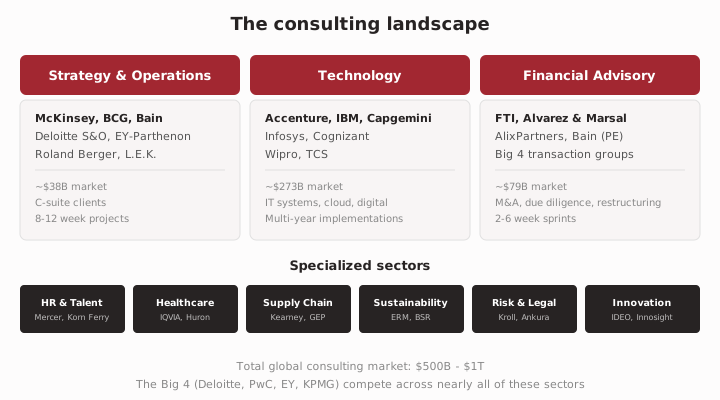
The three biggest sectors · Strategy · Technology · Financial advisory
People & organization · Implementation & operations
Specialist & industry-specific · Emerging: AI & business operations
The three biggest consulting sectors
The three biggest areas of consulting are strategy and operations, technology, and financial and transaction advisory. They are the most famous because they are either working with the senior most levels of organizations (strategy and operations), are a high-ticket item (technology implementations), or are involved in high-status M&A transactions (financial advisory).
Strategy and operations consulting
At the top of the consulting world are firms like McKinsey, Bain, and BCG. These firms, along with the big players like Deloitte and PwC, are involved in strategy and operations consulting, which means they work directly with C-level executives and boards of major companies.
Their job is to help clients with big-picture decisions, like entering new markets, restructuring, and solving high-stakes problems using structured frameworks. These companies often set the framework for broader strategies and help guide decision-making at the very top, working only at the highest levels of organizations. The industry has grown dramatically over the past decade despite predictions of disruption, and its history stretches back further than most people realize.
But outside of these firms, there’s a huge spectrum of smaller consultancies doing similar strategy work with directors, VPs, and middle management, often building successful businesses with long-term clients.
Market size estimate: Allied Market Research estimates that this was a $38.4 billion global market in 2021. More recent estimates as of 2024 put the figure between $45 billion and $53 billion, depending on how broadly you define the sector, growing at roughly 9-12% per year.
Example project: A leading retail chain is struggling to adapt to the rise of e-commerce and wants to shift part of its business online. A strategy consulting team from McKinsey works with their C-suite to develop a digital transformation roadmap. Over three months, the consultants assess the company’s strengths, identify gaps in its current operations, analyze competitors, and create a phased implementation plan that integrates online and in-store experiences, including inventory and customer service updates.
Example firms:
- McKinsey & Company
- Bain & Company
- Boston Consulting Group
- EY-Parthenon
- OC&C Strategy Consultants
- Roland Berger
- L.E.K. Consulting
Technology consulting
Another huge category is technology consulting, with companies like Oracle and Accenture leading the charge. Technology consultants help clients implement big IT systems, whether it’s their own software, like Oracle, or third-party solutions, like SAP, in Accenture’s case.
These projects often carry enormous price tags, taking years to implement and almost always going over budget. But technology consulting goes beyond that to include smaller, newer firms that work with startups to integrate cloud apps and streamline HR, legal, and other systems into cohesive, agile solutions.
Market size estimate: The global IT consulting market size was valued at USD 273.13 billion in 2022. As of 2024, estimates range from $73 billion to $562 billion depending on scope, with the market expected to grow at a compound annual growth rate (CAGR) of roughly 6-12% through 2030.
Example project: A healthcare provider needs to replace outdated systems across its network of hospitals with a centralized electronic health records (EHR) system. Accenture’s technology consultants lead the project, coordinating across departments to identify needs, select the right EHR software, and integrate the system with existing technology for smoother workflows and compliance with healthcare regulations.
Example firms:
- Accenture
- Capgemini
- IBM Global Services
- Infosys Consulting
- Cognizant Technology Solutions
Financial and transaction advisory
Then there’s financial consulting, especially transaction advisory and due diligence, which companies like Bain excel at. This type of consulting often serves private equity firms that are considering acquisitions. Consultants dive into a target company’s financials, analyze operations, and assess fit with the buyer’s strategic portfolio.
Due diligence is a high-intensity area of consulting, where teams work around the clock for a few weeks to get as much analysis and insight as possible into a potential acquisition. Financial consulting also covers post-merger integrations, restructurings, and advising companies going through tough transitions like bankruptcies.
Market size estimate: According to Allied Market Research, “The global financial advisory services market was valued at $79.4 billion in 2020, and is projected to reach $135.6 billion by 2030, growing at a CAGR of 5.8% from 2021 to 2030.” Example project: A private equity firm is considering the acquisition of a midsize pharmaceutical manufacturer. Bain’s transaction advisory team is hired to conduct due diligence on the target company. The team examines the company’s financial records, assesses its production capabilities, evaluates its market position, and highlights any potential legal or regulatory issues that could impact profitability.
Example firms:
- FTI Consulting
- Alvarez & Marsal
- AlixPartners
- Transaction groups of the strategy firms, especially Bain & Company for Private Equity
- Most of the Big 4 Accounting firms also have notable transaction and M&A groups
People and organization consulting
This sector covers everything on the human side of organizations: talent strategy, executive search, compensation, change management, board governance, and organizational culture. People don’t always think of this as “consulting,” but it’s a massive area that touches some of the most strategic decisions a company makes — like what to pay the CEO, how to restructure after a merger, or who should sit on the board.
HR and talent consulting
HR consultants deal with everything from executive search to compensation benchmarking for boards. They work on strategic questions around people and organizational culture, like helping a company figure out what to pay their CEO or orchestrating large-scale workforce transformations with the CHRO.
This work can be very strategic, involving deep people strategy. It also includes more tactical work, like employee benefits and compensation, which keeps everything running smoothly behind the scenes. Firms like Oliver Wyman and Towers Perrin are well-known in this space.
Example project (talent strategy): An international tech firm needs help navigating cultural challenges and retaining talent as it expands into multiple global markets. An HR consulting team from Deloitte is brought on board to develop a global HR strategy, covering compensation benchmarking, diversity and inclusion practices, and leadership training programs.
Example project (compensation benchmarking): A large nonprofit hospital group wants to ensure its executive compensation is competitive but in line with both industry standards and nonprofit regulations. To achieve this, the board engages Willis Towers Watson, a compensation consulting firm, to conduct a compensation benchmarking analysis.
Change management consulting
Supports organizations through major transformations, such as mergers or culture shifts, by aligning people, processes, and technology.
Example project: Assisting a telecommunications company with employee training and communications during a large-scale restructuring.
Board advisory consulting
This sector focuses on providing guidance to boards of directors on corporate governance, risk management, succession planning, and strategic decision-making. Board advisory consultants work closely with board members to ensure alignment with shareholder expectations, regulatory requirements, and long-term strategic goals. They also help with CEO transitions, governance structure, and crisis management.
Example project: Assisting a Fortune 500 company’s board with succession planning for the CEO role. The consulting firm conducts a comprehensive assessment of internal and external candidates, advises on governance best practices, and develops a transition plan to ensure continuity and stability within the organization.
Example firms across people and organization consulting:
- Mercer
- Willis Towers Watson
- Deloitte (Human Capital Division)
- Korn Ferry (Executive Search and Leadership Development)
- Aon (Talent, Rewards & Performance Division)
- Spencer Stuart
- Russell Reynolds Associates
- Egon Zehnder
- Prosci
- PwC (People and Organization)
Implementation and operations consulting
This sector is about making things work — optimizing supply chains, managing digital transformations, and improving the operational machinery of large organizations. If strategy consulting answers “what should we do?”, implementation and operations consulting answers “how do we actually do it?”
Supply chain and operations consulting
This sector helps companies improve supply chain efficiency, reduce costs, and enhance production processes. It’s especially critical in manufacturing and retail.
Example project: Working with a global electronics manufacturer to optimize its supply chain, reduce lead times, and manage supplier risk amid global disruptions.
Example firms:
- Chainalytics
- GEP
- Kearney
Digital transformation and innovation consulting
This sector guides companies in adopting new technologies and transforming digital strategies, including AI, IoT, blockchain, and other emerging tech.
Example project: Helping a traditional bank launch a digital-only subsidiary, incorporating AI-driven customer service, mobile banking, and digital marketing.
Example firms:
- BCG Digital Ventures
- IBM iX
- Accenture Digital
Specialist and industry-specific consulting
Beyond the major sectors above, there’s a long tail of specialist consulting firms that serve specific industries or solve narrow but high-value problems. These firms tend to be smaller but deeply expert in their domain.
Healthcare and life sciences consulting
Specializing in pharmaceutical, biotech, and healthcare industries, this sector focuses on regulatory compliance, clinical development, and market access.
Example firms: Huron Consulting, IQVIA, ClearView Healthcare Partners, The Chartis Group.
Example project: Supporting a biotech company in navigating FDA approval processes and developing a go-to-market strategy for a new drug.
Economic consulting
This sector provides data analysis and expert testimony in regulatory and legal cases, often involving market trends, pricing, or policy impact.
Example firms: Cornerstone Research, NERA Economic Consulting, Analysis Group.
Example project: Conducting an economic impact study for a new federal policy, analyzing how it would affect specific industries and consumer behavior.
Environmental and sustainability consulting
This sector helps organizations improve their environmental impact, adopt sustainable practices, and meet regulatory and ESG (Environmental, Social, and Governance) standards.
Example firms: ERM (Environmental Resources Management), BSR (Business for Social Responsibility), Deloitte (Sustainability Services).
Example project: Guiding a manufacturing company in reducing its carbon footprint, designing a roadmap to transition to renewable energy, and aligning with ESG goals.
Marketing and sales consulting
This sector focuses on assisting companies in growing revenue by refining marketing strategies, enhancing brand positioning, and optimizing sales processes.
Example firms: ZS Associates, Simon-Kucher & Partners, NielsenIQ.
Example project: Helping a retail company redesign its customer loyalty program to improve engagement and increase customer lifetime value.
Risk and compliance consulting
This sector focuses on guiding regulatory compliance, risk management, and internal controls, often for highly regulated industries like finance, healthcare, and energy.
Example firms: Protiviti, Marsh & McLennan, Control Risks.
Example project: Assisting a bank with compliance program development to meet anti-money laundering regulations, ensuring systems and procedures align with regulatory requirements.
Legal and investigative consulting
Provides forensic analysis, litigation support, and investigative services, often for legal disputes or compliance issues.
Example firms: Ankura, Kroll, Deloitte (Forensic & Dispute Services).
Example project: Conducting a corporate investigation for a financial institution facing allegations of internal fraud.
Innovation and product development consulting
This sector helps companies develop new products and services, drive innovation, and refine product strategies. Consultants in this field work on idea generation, prototype development, and go-to-market strategies. They often collaborate with R&D teams to bring innovative products to market faster and more efficiently.
Example firms: IDEO, Innosight, Doblin (Deloitte).
Example project: Working with an electronics company to develop a new line of smart home devices. The consulting team leads ideation workshops, assists in prototyping, and designs a launch strategy to position the products competitively in the market.
Emerging: AI and business operations consulting
This is the newest category and it’s still taking shape. Two things are happening at once.
First, every major firm has built an AI practice. McKinsey acquired QuantumBlack (originally a Formula 1 analytics firm). BCG built GAMMA, which later folded into BCG X. Bain has its Advanced Analytics Group. This is the normal pattern: new technology shows up, and the big firms add a practice area.
Second, a different kind of firm is showing up. Companies like Tenex don’t advise on AI strategy. They embed AI-augmented engineering teams inside client organizations and charge per feature delivered, not per hour billed. The deliverable is working software, not a deck. Other firms like Distyl AI customize off-the-shelf AI models for specific enterprise workflows. These are hybrids of consulting and software.
The business model is the interesting part. Traditional consulting sells time. These firms sell output. That’s a fundamentally different economic structure than what has sustained the industry for decades.
Whether this actually disrupts the big firms or gets absorbed the way analytics, digital, and design all got absorbed is an open question. The big firms have pulled in every prior wave. But moving from selling time to selling outcomes requires changing how you hire, staff, price, and make money. That’s harder than bolting on a new practice area.
Example firms:
- McKinsey (QuantumBlack), BCG (BCG X/GAMMA), Bain (Advanced Analytics Group)
- Tenex, Distyl AI
- Palantir (enterprise AI platforms that replace parts of the consulting workflow)
Example project: A mid-size retailer wants to automate its demand forecasting and inventory replenishment. Instead of hiring a consulting team to build a model and hand over a recommendation, they contract an AI operations firm that builds the forecasting system, integrates it with their ERP, and maintains it on a subscription basis. The deliverable is a running system, not a report.
If you’re interested in breaking into consulting yourself, check out our guide on how to become a strategy consultant. And if you want to sharpen the analytical thinking that consultants use every day, our case interview frameworks guide is a good place to start.