Industry & History
Do 70% of change initiatives really fail?
Tracing the most-cited statistic in change management back to its source. The number has no empirical origin, but the real data tells a more interesting story.

Frameworks, insights, and strategies from the consulting world
Tracing the most-cited statistic in change management back to its source. The number has no empirical origin, but the real data tells a more interesting story.
A guide to Jeanie Daniel Duck's change curve from BCG, the five stages of organizational transformation, and why most change efforts die in stage four.
How Blue Ocean Strategy works, with the strategy canvas and four actions framework explained through Cirque du Soleil, yellow tail wine, and Southwest Airlines.
How Porter's value chain disaggregates a company into activities that create value, with real examples from IKEA, Walmart, and the PC industry.
A practical guide to the McKinsey 7S framework: its origin at McKinsey, real examples of organizational alignment, and where the model breaks down.
A practical guide to building real strategy consulting skills, including structured thinking, problem solving, and communication, whether or not you work at a firm.
In 2013, Clayton Christensen predicted consulting would be disrupted like steel and publishing. More than a decade later, McKinsey, BCG, and Bain are bigger than ever. Here's what his framework missed.
The industry analysis frameworks consultants actually use on engagements: Porter's Five Forces, PESTEL, value chain analysis, and strategic group mapping.
How strategy consultants at McKinsey, BCG, and Bain actually evaluate whether a company should enter a new market. Covers market attractiveness, competitive position, entry mode, and the common mistakes.
Every case interview framework worth knowing, from profitability trees to Porter's Five Forces. How to actually use frameworks in consulting interviews instead of just memorizing them.
Real compensation data from 795 strategy consultants across McKinsey, BCG, Bain, and 10 other firms, from entry-level analyst to partner.
SWOT analysis is the most widely used strategy framework in the world. Most people use it badly. Here's how to make it produce real strategic insight.
How John Boyd's OODA Loop actually works, where it came from, and how companies like Zara and Amazon apply its principles to make faster, better decisions.
How to use the Ansoff matrix to evaluate growth strategies by risk, with real examples from Amazon, Quaker-Snapple, and Starbucks.
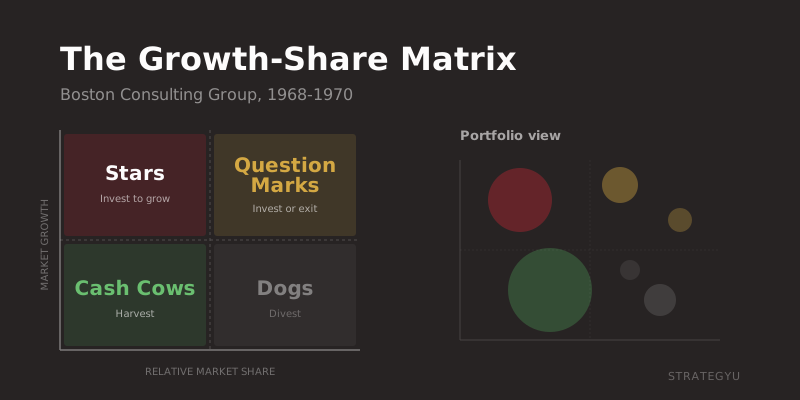
The real origin story of the BCG matrix, from a Monday morning conversation to the million-dollar slide, with practical guidance and real examples.
How a Cleveland lawyer turned a small accounting firm into the world's most powerful consultancy. Bower's career, principles, and contradictions.
The career of Michael Porter, from aerospace engineering to five forces to healthcare reform, and what his work actually changed about strategy.
How to use Porter's Five Forces to analyze any industry, with real examples from airlines, heavy trucks, and cement, plus data on why industry structure drives profitability.
Part 3 of the Pyramid Principle book review covers how to define problems clearly, structure your analysis, and use logic trees and diagnostic frameworks.
Every consulting slide you've ever seen is a variation of one of these fourteen layouts. Learn the anatomy of each one so you can build decks faster and communicate more clearly.
A practical guide to choosing the right data visualization — and why the chart you pick changes the story your data tells.
High-performing consulting firms don't just follow a process, they obsess over the meta-process. Three elements that separate great firms from the rest.
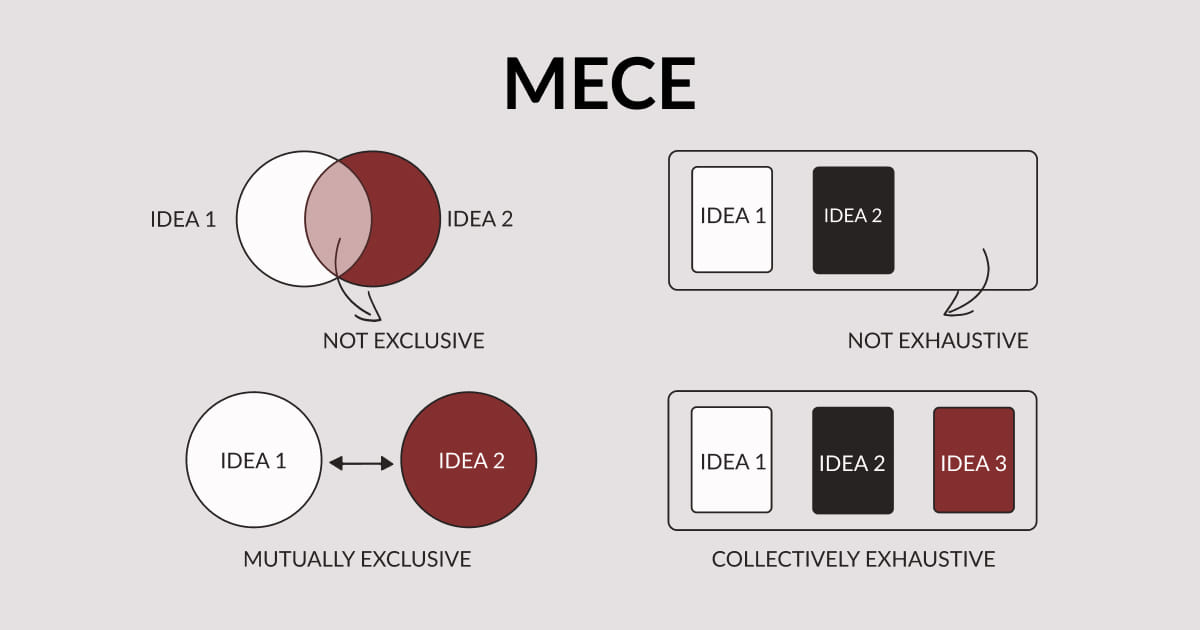
Ten MECE breakdown examples across revenue streams, cost structures, marketing channels, and more -- each with analysis of what works and how to improve it.
A detailed breakdown of what consultants actually do day-to-day, from diagnosing problems and building slide decks to running client workshops.
A five-step process for building consulting-style presentations using SCQA, the Pyramid Principle, ghost decks, and action titles. Includes examples.
2025 strategy consulting industry overview with MBB compensation data, firm sizes, global footprints, career paths, and emerging trends in AI and ESG.

A practical walkthrough of the Pyramid Principle with examples showing how to structure ideas bottom-up and communicate them top-down like a CEO.
A practical introduction to MECE (Mutually Exclusive, Collectively Exhaustive) with clear examples showing how consultants use it to simplify complex ideas.
Every type of consulting explained with market sizes, example firms, and what each one actually does. From McKinsey-style strategy to Accenture-style technology and Big 4 advisory.
The seven traits that separate great consulting problem solvers from the rest, from curiosity and systems thinking to a bias for action.
Excellence in consulting isn't declared, it's built. Three principles from McKinsey and top firms: top-management mindset, process obsession, and standards.
A 5-step feedback process from McKinsey that replaces the tired feedback sandwich with timely, specific coaching that actually drives improvement.
A practical breakdown of five consulting frameworks used on the job: MECE, McKinsey 7S, Porter's Five Forces, BCG Matrix, and Ansoff Matrix.
A breakdown of the McKinsey Solve Game mini-games including Ecosystem Building and Redrock Study, with five actionable tips to boost your score.
Four real-world MECE examples in marketing, product management, and finance showing how to apply Mutually Exclusive, Collectively Exhaustive thinking at work.
An insider breakdown of how McKinsey, BCG, and Bain actually solve problems -- why it is not linear, and how the top-down/bottom-up process really works.
Case interviews don't predict consulting job performance, according to research. A former McKinsey consultant on what's wrong with the process and what would work better.
Breaking down common consulting stereotypes, from layoffs and scapegoating to the stealing-your-watch cliche, and what actually happens on engagements.
A 25-step playbook for becoming a freelance strategy consultant, covering mindset shifts, business setup, finding clients, and pricing your work.
Eight patterns that hold back boutique consulting firms, from founder dependency to weak training culture. Based on working with 10+ small firms.
How consultants scope projects by finding the real problem, writing it down, managing scope creep, and keeping the client aligned throughout.
Why asking so what is the most important habit in consulting and knowledge work, and how it turns raw analysis into actionable client insights.
Why most business presentations bury the lead. A former McKinsey consultant explains how to start with the answer and avoid book report thinking.
An insider look at McKinsey's AI tool Lilli and why its decades-long investment in knowledge management gives it a massive edge over smaller consulting firms.
Practical ways consultants can use AI tools like ChatGPT to generate ideas, simplify writing, and role-play client scenarios for better meeting prep.
Part 2 of the Pyramid Principle book review covers logical ordering, avoiding intellectually blank assertions, and completing your thinking.
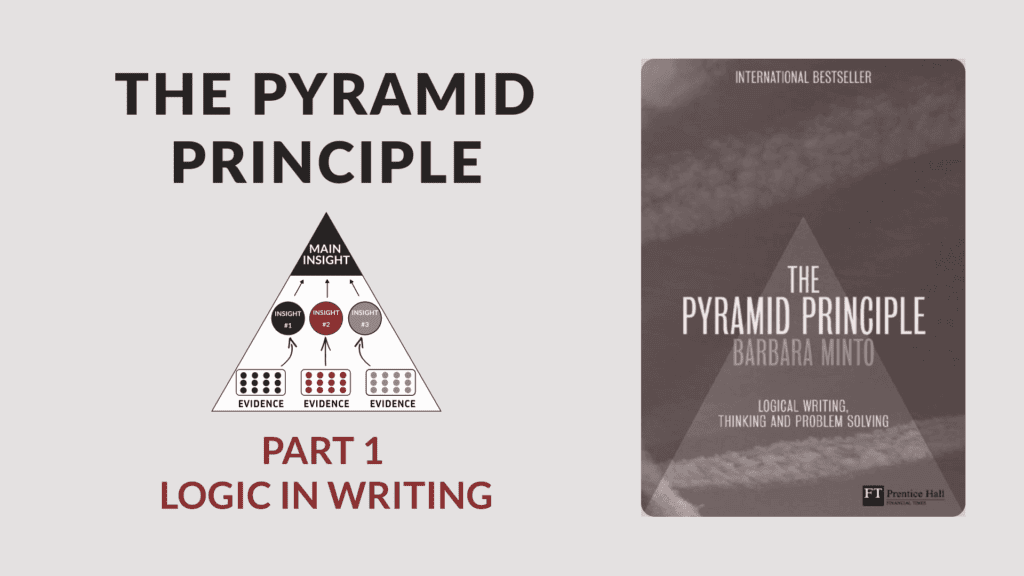
An in-depth review of Barbara Minto's Pyramid Principle covering logic in writing, SCQA, deductive vs. inductive reasoning, and practical tips.
Bruce Henderson's Rule of Three and Four explained with modern examples from beer, digital ads, and laptops, plus how to use consulting frameworks.
Side-by-side comparison of every consulting role, title, salary, and promotion timeline at MBB firms, from entry-level analyst to senior partner.
How BCG's experience curve connects cumulative production to falling costs, why it dominated corporate strategy for decades, and where it breaks down.
Three ways consultants use frameworks to simplify analysis, share takeaways, and tell compelling stories -- plus how to build your own from scratch.
A four-step process to develop your own strategic perspective at work, with a real Pepsi strategy example showing how CEOs think about corporate strategy.
Five hard-won freelance consulting lessons on commitment, naming, pricing models, client materials, and deliverables from a former McKinsey consultant.
How to build an issue tree that breaks complex business problems into MECE components, with profitability examples and templates you can apply at your company.
What critical thinking actually means and how to practice it. Includes examples from consulting, investing, and real-world decision-making frameworks.
What John Legend, Indra Nooyi, Pete Buttigieg, and other famous alumni of McKinsey, BCG, and Bain say they took away from strategy consulting.
Five ways the same Fortune 500 CEO dataset can be charted to tell completely different stories -- and how to spot data manipulation in presentations.
The history of strategy consulting in 11 chapters, from Frederick Taylor's scientific management to the rise of McKinsey, BCG, and Bain.
The five skills that separate elite strategy consultants from average ones: epistemic humility, comfort with uncertainty, synthesis, writing, and creativity.
A slide-by-slide redesign of Softbank's infamous WeWork deck, applying consulting presentation principles like clear titles and honest messaging.
A step-by-step MECE walkthrough using social media platforms -- iterating from a rough list to a truly mutually exclusive, collectively exhaustive grouping.
Psychological safety, non-hierarchical attitudes, and iterative feedback -- the three elements that make consulting teams at McKinsey so effective.
A step-by-step walkthrough of the five-stage consulting process showing when to use SCQA for problem definition and the Pyramid Principle for communication.
Why consultants organize everything into groups of three. How the rule of three simplifies complex thinking and makes business communication memorable.
An honest comparison of McKinsey vs BCG from someone who worked at both -- covering culture, values, knowledge networks, analytical focus, and alumni treatment.
MECE (mutually exclusive, collectively exhaustive) is how McKinsey consultants structure every problem. Learn the framework with clear examples you can apply to your own work.
SCQA - A Framework For Defining Problems & Hypotheses
A UConn grad who landed a McKinsey offer shares what non-target school students actually need to do to break into top consulting firms.
20 presentation tips from a former McKinsey consultant, combining strategy consulting techniques with persuasion science to make your slides memorable.
How the consulting problem-solving process works in practice: iterating between bottom-up research and top-down hypothesis testing to find the answer.
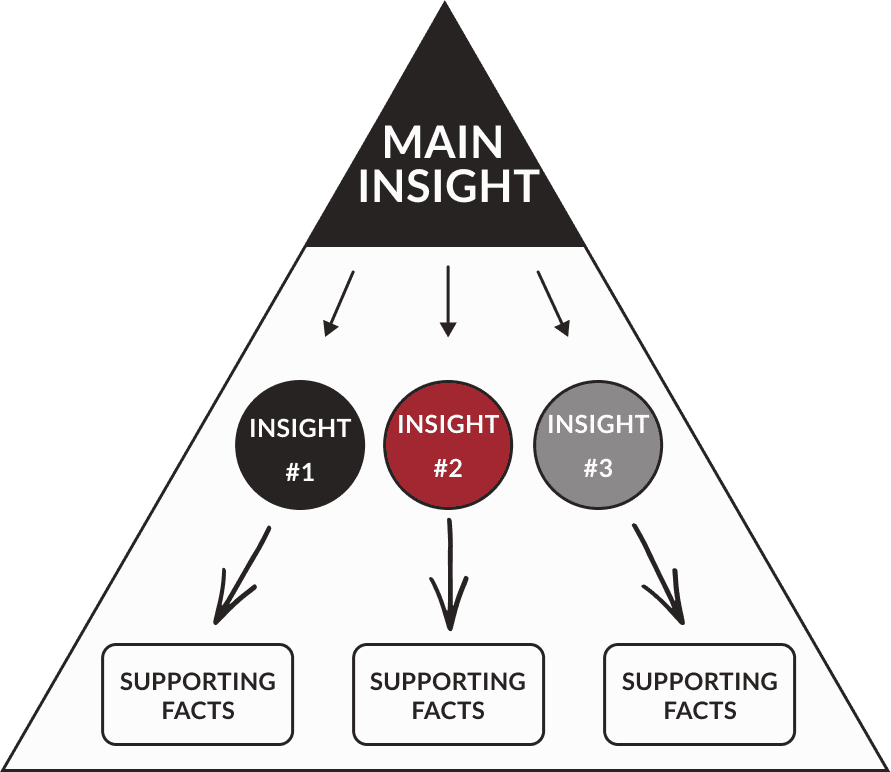
How to use the Pyramid Principle to communicate top-down, with a memo-writing method and guidance on when to use direct vs. indirect storytelling.
A step-by-step guide to bottom-up synthesis using the Pyramid Principle and MECE, with a business example of grouping data into structured insights.
The three flow principles McKinsey uses for PowerPoint storytelling: vertical flow within slides, horizontal flow across titles, and overall story structure.
“Why the consulting mindset requires both a relentless drive to improve and the discipline to avoid copying best practices blindly -- and how to build both.”
The biggest mindset shift for new consultants: stop waiting for instructions and start mastering the structured problem-solving process instead.
Six steps from McKinsey's structured problem-solving process -- from defining the real problem to building MECE arguments and persuasive consulting slides.
What makes McKinsey's culture work, from a former insider. Three pillars that drive high-performance: people development, values, and long-term focus.
After 100+ consulting rejections from a non-target school, one candidate landed a McKinsey offer. Six lessons from the experience that shaped his career.