Growth strategy frameworks: how consultants plan and evaluate expansion
Most consulting work is about helping companies grow. That might be surprising, since consulting firms usually only make headlines when they’re helping companies cut staff. But the incentives are clear: companies take credit when things go well and blame outsiders when they don’t.
Growth is hard, though, especially in established industries. How do you shift an organization that has operated one way for decades? How do you chase new opportunities without blowing up the core business?
The frameworks below come at the growth question from different angles. Some address where growth should come from. Others address which businesses to fund and which to starve. A few ask the uncomfortable question: will this growth actually create value, or just add revenue?
The growth question in consulting
Growth strategy in consulting usually comes down to two decisions.
The first is where to play. Which markets, which customer segments, which geographies, which product lines? The second is how to win in those chosen arenas. Low cost? Differentiation? Speed?
Porter is blunt about what happens when companies skip this step. In his 1996 Harvard Business Review article “What Is Strategy?,” he calls out the growth instinct directly:
“Among all other influences, the desire to grow has perhaps the most perverse effect on strategy. Trade-offs and limits appear to constrain growth.”
His example is Continental Airlines. Continental saw Southwest winning and tried to do both: run a low-cost spinoff alongside its full-service network. Porter describes what followed:
“Trade-offs ultimately grounded Continental Lite. The airline lost hundreds of millions of dollars, and the CEO lost his job. Its planes were delayed leaving congested hub cities or slowed at the gate by baggage transfers. Late flights and cancellations generated a thousand complaints a day.”
Continental paid what Porter calls “an enormous straddling penalty.” His conclusion: “the absence of trade-offs is a dangerous half-truth that managers must unlearn.”
The frameworks consultants use keep pulling back to the same question: where can you grow without destroying what makes you competitive?
The Ansoff matrix: the simplest growth map
The Ansoff matrix is where most growth analysis starts. Igor Ansoff published the framework in a 1957 Harvard Business Review article called “Strategies for Diversification.” He was trying to bring analytical discipline to growth decisions at a time when American conglomerates were acquiring companies with more ambition than logic.
Two dimensions: products (existing or new) and markets (existing or new). Four quadrants, arranged by increasing risk:
- Market penetration. Sell more of what you already sell to customers you already serve. Lowest risk.
- Product development. Create something new for existing customers.
- Market development. Sell existing products to new customers or new geographies.
- Diversification. New products for new markets. Highest risk, because you’re operating with the least knowledge on both dimensions.
The value isn’t the four labels. It’s the risk gradient. The further you move from what you already know, the more likely you are to get it wrong. Quaker Oats paid $1.7 billion for Snapple in 1994, thinking their Gatorade experience gave them beverage expertise. They sold it twenty-seven months later for roughly $300 million.1 On the matrix, the acquisition looked like a small step. The two businesses had almost nothing in common.
Full walkthrough with more examples in the Ansoff matrix deep-dive.
The BCG growth-share matrix: portfolio-level decisions
The Ansoff matrix works for a single business deciding where to grow. The BCG growth-share matrix works for a corporation deciding which of its businesses to fund.
BCG’s early work on the experience curve gave companies a way to think about cost advantage in a single business. But as Walter Kiechel writes in Lords of Strategy, most of BCG’s clients had a harder problem:
“The experience curve and the sustainable-growth equation provided insight bracing enough to build a strategy around if the company were in a single business, tracking down just one curve. But most of BCG’s clients, actual and potential, weren’t.”
The growth-share matrix solved this by plotting every business unit on two axes: market growth rate and relative market share. Four quadrants:
- Stars: high growth, high share. Winning in growing markets but consuming cash to stay there.
- Cash cows: low growth, high share. Mature businesses throwing off more cash than they need.
- Question marks: high growth, low share. Could become stars. Could fail. Hardest allocation call.
- Dogs: low growth, low share. Often candidates for divestiture.
The portfolio logic: use cash cows to fund question marks, invest in stars, and divest dogs. Kiechel writes in Lords of Strategy that when a client’s business units were plotted on the matrix, the result was often what consultants called “the million-dollar slide”:
“a single image that captured and conveyed so much information about a company’s strategic situation that by itself, it was worth a million dollars in consulting fees.”
More detail in the BCG growth-share matrix deep-dive.
The experience curve: growth through cost advantage
The experience curve is the economic logic underneath the BCG matrix. Kiechel doesn’t mince words about its importance in Lords of Strategy:
“The experience curve was, simply, the single most important concept in launching the strategy revolution.”
The premise: unit costs decline at a predictable rate as cumulative production increases. BCG’s move was connecting that to market share. As Kiechel puts it:
“The essential insight here was heartening or terrifying, depending on how your company was situated: the market-share leader should be the low-cost producer in any industry.”
If costs fall with volume, gaining share faster than competitors builds a durable cost advantage. BCG used this to argue that companies should pursue aggressive growth in their strongest businesses.
The limits are real. Cumulative experience doesn’t guarantee cost reduction. A new entrant with better technology can leapfrog an experienced competitor entirely. But as a mental model for when market share growth creates real strategic advantage, it still holds up. Full analysis in the experience curve article.
McKinsey’s three horizons: growth over time
The three horizons framework tackles the dimension the others ignore: time. Where does growth come from today, where will it come from in three to five years, and where might it come from a decade out?
Mehrdad Baghai, Stephen Coley, and David White described the framework in a 1996 McKinsey Quarterly article, “Staircases to growth,” and built their 1999 book The Alchemy of Growth around it.
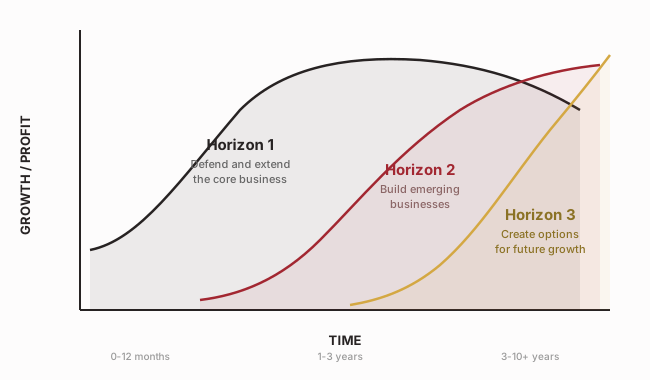
Horizon 1 is the core business. What makes money today. Defend and extend it.
Horizon 2 is emerging businesses. Past the experimental stage, generating real revenue, not yet at full scale.
Horizon 3 is the seedlings. Ideas, research projects, small bets. The ones that work become Horizon 2 businesses.
The reason the model persists: companies that only invest in Horizon 1 watch their core mature with nothing behind it. Companies that skip straight to Horizon 3 run out of cash before anything pays off. You need a pipeline across different stages of maturity.
The standard criticism is that in fast-moving industries, the horizons compress, and a new business can reach the core much faster than the timelines people attach to the chart. Fair. But the underlying logic still applies.
More detail and examples (Amazon, Microsoft, Apple) in the three horizons deep-dive.
Profit pools and value chain expansion
Sometimes the best growth opportunity isn’t a new market or a new product. It’s capturing more of the profit in a value chain where you already operate.
Orit Gadiesh and James Gilbert of Bain & Company introduced the concept of “profit pools” in a 1998 Harvard Business Review article. Their core observation: revenue and profit don’t follow the same distribution across a value chain. The highest-revenue step isn’t necessarily where the money is.
Instead of diversifying into unrelated businesses (Ansoff’s riskiest quadrant), look at the profitable steps in your own value chain that you aren’t participating in yet. Apple didn’t just sell hardware; they built the App Store and Apple Music. Amazon didn’t just sell products; they built the logistics and cloud infrastructure that other companies now pay to use.
This connects directly to Porter’s Five Forces. The forces that shape industry profitability vary across a value chain. If suppliers are capturing most of the margin, vertical integration might be a better growth path than horizontal expansion.
What the firms are saying now
The classic frameworks above are 40+ years old. The firms have kept building on them.
Bain: Engine 1 / Engine 2
Bain’s Engine 1 / Engine 2 framework splits growth into two distinct jobs. Engine 1 is the core. In Bain’s framing, Engine 2 is:
“a new business built within an existing company that uses the existing scale benefits—namely, the assets and capabilities of the strong core business (Engine 1)—to grow to a large size faster than an independent start-up could.”
The shift from the old playbook is real. Bain’s research found that historically, over 90% of profitable growth came from optimizing the core. That ratio has changed. According to Bain, nearly 60% of the most successful sustained-growth companies now derive significant value from Engine 2 businesses. AWS is the canonical example. Orsted’s wind energy business, which now comprises more than half the company, is another.
BCG: The C-Curve
BCG’s C-Curve framework (2025) goes after the most dangerous instinct in growth strategy: the belief that you can grow your way out of bad performance. About one in seven public companies globally have persistently low returns on capital. Most of them try to expand. According to BCG, it backfires:
“Companies that attempted to grow their way out of a low-return starting position tended to generate little, if any, value for shareholders.”
The companies that actually created value did the opposite. They shrank first, cutting down to a profitable core, then improved returns, and only then reignited growth. BCG calls this the C-curve because the revenue line dips before it climbs. The winners in BCG’s analysis delivered 28% TSR from 2019 through 2024.
McKinsey: The Growth Code
McKinsey’s growth research studied roughly 5,000 of the world’s largest public companies. Per their report:
“On average, 80% of growth comes from a company’s core industry and the remaining 20% from secondary industries or expansion into new ones.”
And the stat that should give every growth-obsessed executive pause: according to McKinsey, fewer than one in four companies in their sample outpaced industry peers on both revenue and profit growth. Growth is common. Profitable growth that creates shareholder value is rare.
McKinsey also found that companies expanding in ways that increased the similarity of their portfolios earned an additional percentage point of annual TSR. Companies that diversified into dissimilar industries mostly destroyed value.
All three firms keep landing in the same place. The core matters more than most companies want to believe. Growth for its own sake is usually destructive.
How to use these in a case interview
The frameworks above are the analytical backbone of growth cases. Interviewers don’t want you to recite the Ansoff matrix. They want structured thinking applied to a specific situation.
Start with an issue tree. Decompose the growth question into component parts using a MECE structure. Where is growth coming from today? Is the company growing below, at, or above the market rate? Organic or inorganic? Revenue growth or margin expansion?
Once you understand the situation, the Ansoff matrix lays out options fast. Is the opportunity in selling more to existing customers, building new products, entering new geographies, or some combination?
If the client is diversified and deciding where to allocate capital, the growth-share matrix logic applies even if you don’t draw the chart. Which businesses are growing? Which throw off cash? Where should the next dollar go?
Don’t forget profit pools. A surprising number of growth cases have an answer that involves moving along the value chain rather than expanding horizontally.
Common mistakes
Treating growth as inherently good. Growth that destroys competitive position is worse than no growth. Porter’s Continental example is the cautionary tale here. They grew revenue on the low-cost routes while undermining their full-service business.
Ignoring the risk gradient. The Ansoff matrix exists because people consistently underestimate how much harder it is to succeed in unfamiliar territory. Quaker paid $1.7 billion for Snapple and sold it for roughly $300 million. HP paid $11 billion for Autonomy and wrote down roughly $8.8 billion.2 Same pattern: the acquirer assumed adjacency meant understanding.
Confusing revenue growth with value creation. A company can grow revenue by acquiring at high multiples, entering low-margin markets, or subsidizing growth with cash from the core. None of that creates value unless the growth generates returns above the cost of capital. McKinsey’s research confirms this: most companies in their sample that grew revenue didn’t outpace peers on profit.
Analyzing growth in isolation. If your plan is to enter a new market, what happens when incumbents respond? Growth frameworks need to work alongside industry analysis and competitive positioning.
Skipping the numbers. Frameworks are thinking tools, not answers. The Ansoff matrix tells you diversification is risky, but not whether a specific acquisition is worth the price. Market size, growth rates, cost structures, competitive share, return on invested capital. The framework points you in a direction. The analysis tells you whether to walk.
How these frameworks connect
The Ansoff matrix tells you the direction. The BCG growth-share matrix sits above it, at the corporate level, asking which businesses deserve growth investment and which should fund it. The experience curve provides the economic logic underneath: the connection between volume, cost position, and competitive advantage. The three horizons add the time dimension. Profit pool analysis reminds you the best growth opportunity might be vertical, not horizontal.
A SWOT analysis often comes before any of these. Knowing where the company is strong and where it’s exposed tells you which type of growth makes sense. In fast-moving industries, the OODA Loop matters too: the company that reads the market and repositions faster can outgrow a competitor with better frameworks on paper.
Most of these frameworks are over forty years old. They persist because the underlying questions don’t change. Where should we grow? What’s the risk? Which businesses deserve capital? Where is the profit?
Footnotes
Quaker’s Snapple acquisition and sale are widely documented. The $1.7 billion purchase price and roughly $300 million sale price are from contemporary reporting by the Wall Street Journal and New York Times. ↩
HP’s $11 billion Autonomy acquisition and subsequent $8.8 billion write-down were reported by multiple outlets including the Wall Street Journal in November 2012. ↩
The course
Think Like a Strategy Consultant
Structured problem solving, MECE, the Pyramid Principle, and slides that make a point, in one self-paced video course. 1,400+ students in 65 countries.
Or 2 payments of $398.
Watch a free lesson from Think Like A Strategy Consultant →Free
Start with the email course
Six short lessons on consulting fundamentals, one a day.