Industry analysis frameworks: how consultants evaluate markets and competition
Most consulting projects start with the same question: what’s going on in this industry?
It sounds straightforward. But “understanding the industry” is actually several different analyses layered on top of each other. You need to know who the players are, how they make money, what forces are squeezing their margins, how the broader environment is shifting, and where the opportunities sit. Each of those questions calls for a different tool.
The good news is that consultants aren’t reinventing this from scratch each time. There’s a set of frameworks that have been used across thousands of engagements over the past 40-plus years. Some of them, like Porter’s Five Forces, are famous enough that people learn them in business school and then forget how to actually use them. Others, like strategic group mapping or industry lifecycle analysis, are less well-known but show up constantly in the actual work.
This guide covers the main industry analysis frameworks, what each one does, and how they fit together on a real project. If you’ve read the individual deep-dives on this site (or the broader overview of consulting frameworks), think of this as the guide that connects the industry-specific tools. If you haven’t, this is a good starting point.
Porter’s Five Forces: the foundation
Any serious industry analysis starts here. Porter’s Five Forces is the single most widely used framework for understanding industry structure, and for good reason.
Michael Porter published “How Competitive Forces Shape Strategy” in the Harvard Business Review in 1979. The intellectual backstory matters. Porter came out of industrial organization (IO) economics, and as Walter Kiechel recounts in The Lords of Strategy, that field shaped everything that followed:
Industrial organization (IO) economics is a world of models that depict the effect of forces, at the highest level all purposed at explaining why competition exists in certain industries but not in others, and hence why some industries are more profitable. It had grown out of the work of two other Harvard economists, first Edward Mason in the 1930s and then Joe Bain (no relation to Bill) in the 1950s.
Like most economists, Mason and Bain initially held the assumption that profits were, in some sense, an aberration … In the perfect world dreamed of in their philosophy, the laws of supply and demand should quickly compete away any supernormal profit-making advantage. If this didn’t happen, why not? And was something sinister going on?
Indeed, much of the thrust of IO economics, particularly as developed by Joe Bain, revolved around whether what was going on in a profitable industry somehow reflected behavior by companies aimed at denying the public the benefits of competition, such as low prices.
Porter saw the same tools and pointed them in the opposite direction. As Kiechel puts it, Porter would take the conceptual apparatus of IO and — “to use the expression employed by almost everyone who knows this story” — “turn it on its head,” focusing instead on what structural factors created opportunities in an industry that a company could exploit to its competitive advantage.
The framework identifies five forces that determine how much profit is available in any industry:
- Rivalry among existing competitors. How intense is the competition between companies already in the market?
- Threat of new entrants. How easy is it for new players to come in?
- Bargaining power of suppliers. Can the companies providing your inputs dictate terms?
- Bargaining power of buyers. Can your customers pressure you on price or quality?
- Threat of substitutes. Can customers solve their problem in a completely different way?
The point isn’t just to list these forces. It’s to understand which ones are strongest in your specific industry and what that means for profitability. As Joan Magretta documents in Understanding Michael Porter, from 1992 to 2006 pharmaceutical companies averaged above 30% return on invested capital while U.S. airlines averaged about 5.9%. The difference isn’t talent. It’s industry structure: patents and regulatory barriers protect pharma; overlapping routes, commodity products, and powerful suppliers crush airline margins.
Porter was specific about calling this a framework, not a model. As he told Kiechel: “The five forces is a system that’s in motion at all times, and industry, technology, and consumer forces and all these outside forces are always acting on the five.” It’s not a snapshot. It’s a way of understanding the ongoing dynamics of competition.
I’ve written a full practical guide to Porter’s Five Forces with examples from airlines, heavy trucks, and the PC industry. If you want the deep dive, start there.
PESTEL: the macro environment
Five Forces tells you about the competitive dynamics within an industry. But industries don’t exist in a vacuum. They’re shaped by broader forces that no single company controls.
That’s what PESTEL analysis covers. It’s an acronym for six categories of macro-environmental factors:
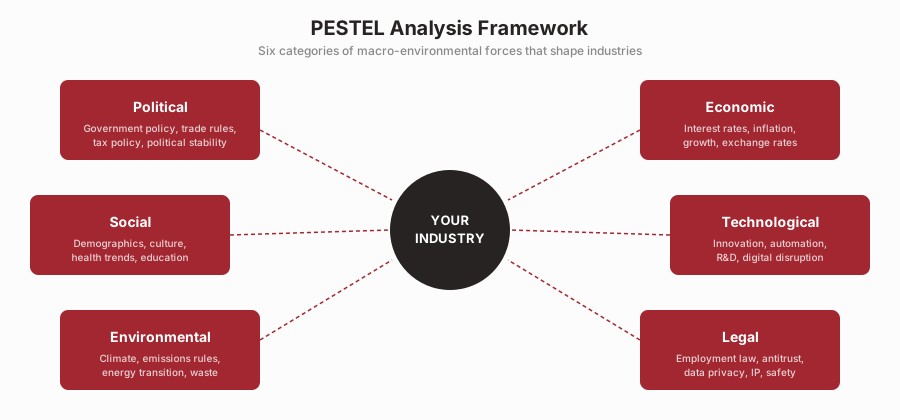
- Political. Government policy, regulation, trade restrictions, tax policy. Think about how the Inflation Reduction Act reshaped economics for electric vehicle manufacturers, or how tariff changes can restructure entire supply chains overnight.
- Economic. Interest rates, inflation, currency exchange rates, economic growth. A rising interest rate environment hits capital-intensive industries like construction and real estate harder than asset-light software businesses.
- Social. Demographics, cultural trends, consumer behavior shifts. The aging population in Japan and Europe is reshaping demand across healthcare, financial services, and consumer goods simultaneously.
- Technological. New technologies that change what’s possible or economically viable. Cloud computing didn’t just create a new industry; it restructured the economics of software, media, retail, and banking.
- Environmental. Climate regulation, sustainability requirements, resource scarcity. Carbon pricing in the EU is fundamentally changing the cost structure of steel, cement, and chemicals production.
- Legal. Industry-specific regulation, employment law, data privacy rules. GDPR changed how every company operating in Europe handles customer data, with compliance costs running into the hundreds of millions for large firms.
The common mistake with PESTEL is treating it as a checklist. Teams go through each letter, write a few bullet points, and call it done. That’s not analysis. The useful version asks: which of these factors is actually changing the industry’s profit pool, and on what timeline?
For example, a PESTEL analysis of the European automotive industry in 2020 would flag the EU’s tightening CO2 emissions standards under the Environmental heading. But the real insight isn’t “environmental regulations are increasing.” It’s that a 100% cut in new-car CO2 emissions by 2035 ends sales of new combustion cars, which puts a deadline on factories that had been building engines for decades. That’s a structural shift, not a bullet point.
It is also a good illustration of why a scan has a shelf life. In December 2025 the Commission proposed lowering that 2035 target to 90%, and the proposal is still moving through Parliament and the Council. The direction of travel has not changed. The endpoint is being renegotiated in public, and a 2020 analysis would have booked it as settled.
PESTEL works best at the start of an engagement, before getting into Five Forces. It answers the question: what external forces are changing the rules of the game? Five Forces then tells you how those changing rules affect competitive dynamics. The full guide to PESTEL goes through the six categories with worked examples.
Value chain analysis: where the money gets made
Porter introduced the value chain in his 1985 book Competitive Advantage. The same year, he and Victor Millar published an HBR article that laid out the concept clearly. As they wrote:
An important concept that highlights the role of information technology in competition is the “value chain.” This concept divides a company’s activities into the technologically and economically distinct activities it performs to do business. We call these “value activities.” The value a company creates is measured by the amount that buyers are willing to pay for a product or service. A business is profitable if the value it creates exceeds the cost of performing the value activities. To gain competitive advantage over its rivals, a company must either perform these activities at a lower cost or perform them in a way that leads to differentiation and a premium price.
The value chain has nine generic categories. Five are primary activities — inbound logistics, operations, outbound logistics, marketing and sales, and service. Four are support activities — firm infrastructure, human resource management, technology development, and procurement. As Porter and Millar note, “a company’s value chain is a system of interdependent activities, which are connected by linkages.”
Why does this matter for industry analysis?
Because it shows you where value gets created and captured in an industry, and those two things aren’t always the same. In the personal computer industry, PC makers like Dell, HP, and Lenovo perform most of the primary activities: they assemble the products, market them, sell them, and service them. But Microsoft and Intel captured the lion’s share of the industry’s profits by controlling two critical supplier inputs (the operating system and the processor). Analyzing only the PC makers’ rivalry would miss where the real money went.
Value chain analysis is also how consultants identify opportunities for cost advantage or differentiation. If you map out every activity a company performs and compare it to competitors, you can see where the differences are. Maybe one company has a 15% cost advantage in procurement because of scale. Maybe another has built a service operation that justifies a price premium. Those differences don’t show up in market share numbers. They show up in the value chain.
On real engagements, this often gets extended beyond a single company. Porter and Millar describe what they call the “value system”:
The value chain for a company in a particular industry is embedded in a larger stream of activities that we term the “value system” … The value system includes the value chains of suppliers, who provide inputs (such as raw materials, components, and purchased services) to the company’s value chain. The company’s product often passes through its channels’ value chains on its way to the ultimate buyer. Finally, the product becomes a purchased input to the value chains of its buyers, who use it to perform one or more buyer activities.
Understanding how value flows through the entire system, not just within one company, is where the best industry insights come from.
Competitive positioning and strategic group mapping
Five Forces tells you about the industry. Value chain analysis tells you about activities. But neither one directly answers the question: where does each competitor sit relative to the others?
That’s where strategic group mapping comes in. A strategic group is a set of companies within an industry that follow similar strategies along a set of dimensions. You plot competitors on a two-dimensional chart, choosing the two strategic variables that matter most for competitive position in that industry.
In the airline industry, you might use scope (domestic vs. global network) on one axis and cost position (low-cost vs. full-service) on the other. You’d see Southwest, Spirit, and Frontier clustered in one group (domestic, low-cost), Delta, United, and American in another (global network, full-service), and Emirates and Singapore Airlines in a third (global network, premium service). Ryanair and EasyJet occupy the European low-cost position.
The value of this exercise isn’t the chart itself. It’s what the chart reveals about competitive dynamics and strategic options. Companies within the same strategic group compete most intensely with each other. Barriers to moving between groups (called “mobility barriers”) can be just as powerful as barriers to entering the industry. And gaps in the map can suggest opportunities: an underserved position that no competitor currently occupies.
In a consulting engagement, strategic group maps often come right after the Five Forces analysis. You’ve established the overall industry structure. Now you need to understand who’s competing with whom and where the client sits. This becomes the bridge to strategic recommendations: should you defend your current position, or move to a different group?
Porter introduced this concept in Competitive Strategy in 1980, where he wrote that “the first step in structural analysis within industries is to characterize the strategies of all significant competitors.”
Industry lifecycle analysis
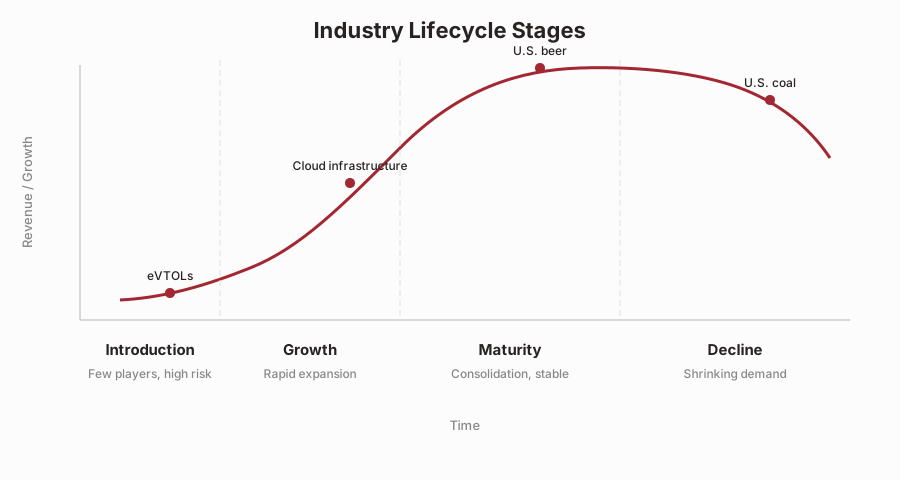
Industries change over time, and the competitive dynamics at each stage are different. The industry lifecycle framework describes four broad phases: introduction, growth, maturity, and decline.
This might seem obvious, but the implications for strategy are real:
- In the introduction phase, the market is small, customer adoption is slow, and the product or business model may still be unproven. Competition is usually about establishing the category, not fighting over share. Think of electric vertical-takeoff-and-landing aircraft (eVTOLs) in 2025: multiple companies are developing products, but there’s no real market yet.
- In the growth phase, demand is expanding fast enough that most competitors can grow without stealing share from each other. The strategic priority shifts to building scale and establishing a strong position before growth slows. Cloud infrastructure services from roughly 2010-2020 fit this pattern, with AWS, Azure, and Google Cloud all growing rapidly.
- In maturity, growth slows and competition intensifies. There’s a shake-out: weaker competitors exit or get acquired, and the survivors compete harder on price and efficiency. The U.S. beer industry, dominated by a few large players with declining volumes, is a textbook example.
- In decline, total industry demand is falling. Strategy becomes about managing contraction, extracting cash, and deciding when to exit. The U.S. coal industry for power generation is in this phase.
The lifecycle stage changes which frameworks matter most. In the growth phase, the BCG growth-share matrix is often the right tool because the question is about allocating capital across a portfolio. In maturity, Five Forces and value chain analysis matter more because competition is about structural advantage, not just riding demand growth.
Where lifecycle analysis gets tricky is that industries don’t always follow the textbook progression. Some mature industries get disrupted back into a growth phase (streaming disrupted mature cable TV). Some industries sit in maturity for decades without declining (waste management, auto repair). And “the industry” itself changes definition over time, which can reset the clock entirely.
How these frameworks work together on a real project
In practice, “industry analysis” is often an early phase: sometimes pre-project (to sell the work or prepare for a kickoff), and almost always early on to get oriented. The point isn’t to run a linear process. It’s to answer a handful of big-picture questions fast enough that the team knows what matters and where uncertainty still sits.
One simple way to think about these frameworks is as key questions to ask:
- What’s changing around this industry, and on what timeline? (PESTEL) Which external forces could actually move the profit pool in the next 12–36 months?
- How does competition work here? (Five Forces) Where is the profit structurally available—or structurally competed away—and why?
- Who really competes with whom? (Strategic groups) What are the meaningful strategic clusters, and where does the client sit on the map?
- Where is value created and captured? (Value chain / value system) Which stages earn excess returns, and who captures them?
- Where are we in the industry’s arc? (Lifecycle) Does the stage change the strategic options enough that we need to factor it in?
If the project is truly high-stakes and unfamiliar—like market entry into a new industry—these questions don’t go away. You just go from a rough orientation to a higher standard of proof: real interviews, bottoms-up sizing, unit economics, segmentation, channel dynamics, capability gaps, competitor cost curves, regulatory diligence, and scenarios.
The output of all this work is usually a synthesis, not a slide for each framework. The best industry analyses tell a story: here’s how this industry works, here’s where the profit is, here’s what’s changing, and here’s what that means for our client. Nobody wants to sit through five separate framework presentations. They want the answer.
What goes wrong
A few patterns that show up when teams turn this into a mechanical exercise:
Running through frameworks mechanically. The worst industry analyses are the ones where a team fills in every box of every framework and produces 80 slides of data without a point of view. Frameworks are tools for generating insight, not templates for organizing information. If your Five Forces analysis ends with “rivalry is high, buyer power is medium, supplier power is low,” you haven’t done analysis. You’ve done labeling.
Defining the industry too broadly or too narrowly. This is the most common analytical error. “Healthcare” is not an industry. “Medical devices for minimally invasive cardiac procedures” is. But go too narrow and you’ll miss the competitive threats that matter most. The definition question matters because every force in Five Forces changes depending on how you draw the boundaries.
Ignoring the value chain. Teams that only do a competitive landscape analysis (who are the competitors, what’s their market share) without understanding how value flows through the industry will miss the most important dynamics. The PC industry example is a case in point: market share analysis of PC makers completely misses the fact that Microsoft and Intel were capturing most of the profit.
Treating industry analysis as a one-time exercise. Industries are not static. The experience curve showed how costs change with cumulative volume. The lifecycle framework shows how competition evolves over time. A good industry analysis isn’t just a snapshot. It includes a view of where the industry is heading and what’s driving that change.
Confusing industry analysis with competitive intelligence. Industry analysis is about understanding the structural forces that determine profitability. Competitive intelligence is about tracking what specific companies are doing: their recent hires, their product launches, their pricing moves. Both are useful. But they answer different questions, and mixing them up produces analysis that’s detailed about competitors but vague about the industry’s economics.
Connecting to MECE thinking
One thing worth noting: a good industry analysis is MECE. The frameworks themselves are designed to be collectively exhaustive, covering the full range of forces and factors that affect an industry. Five Forces covers external competitive pressure from five directions. PESTEL covers six categories of macro forces. The value chain covers all activities from inbound logistics to service.
But making the analysis MECE in practice requires discipline. It’s easy to double-count a factor (listing “technology disruption” under both PESTEL and Five Forces, for example) or to miss a force entirely because it doesn’t fit neatly into a category. The best analysts are conscious about which framework covers which question and avoid redundancy across them.
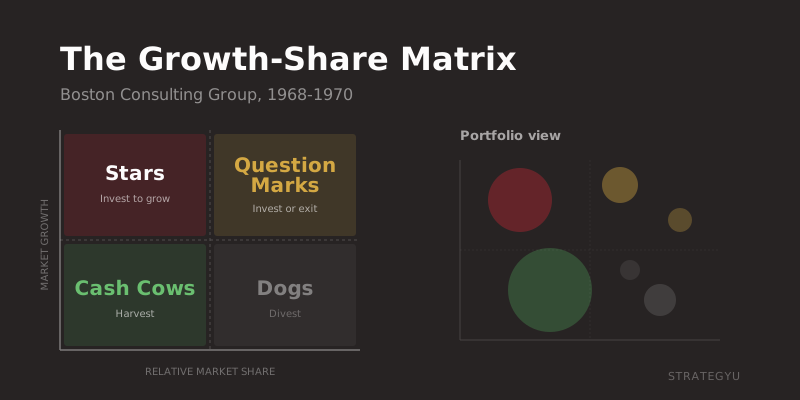
This is also where the Ansoff Matrix and the BCG growth-share matrix connect. Once you’ve done the industry analysis and understand the structure, those frameworks help answer the next question: given what we know about this industry, what should the company do? The Ansoff Matrix maps growth options. The BCG matrix maps portfolio allocation. Both depend on having the industry analysis right first.
The real skill
Knowing these frameworks is table stakes. Every MBA and every first-year analyst at a consulting firm can name them. What separates good industry analysis from great is the ability to synthesize across frameworks and identify the one or two structural factors that actually determine profitability in a specific industry.
In some industries, it’s buyer power (commodity chemicals, where a handful of large industrial buyers set terms). In others, it’s the threat of substitutes (traditional taxis after Uber). In others, it’s regulation shaping the entire competitive structure (banking, insurance, and utilities). The frameworks help you see all the forces at once. But the analysis only becomes useful when you can point to the one or two that actually explain why the industry looks the way it does.