
Marvin Bower: the man who built McKinsey into a profession
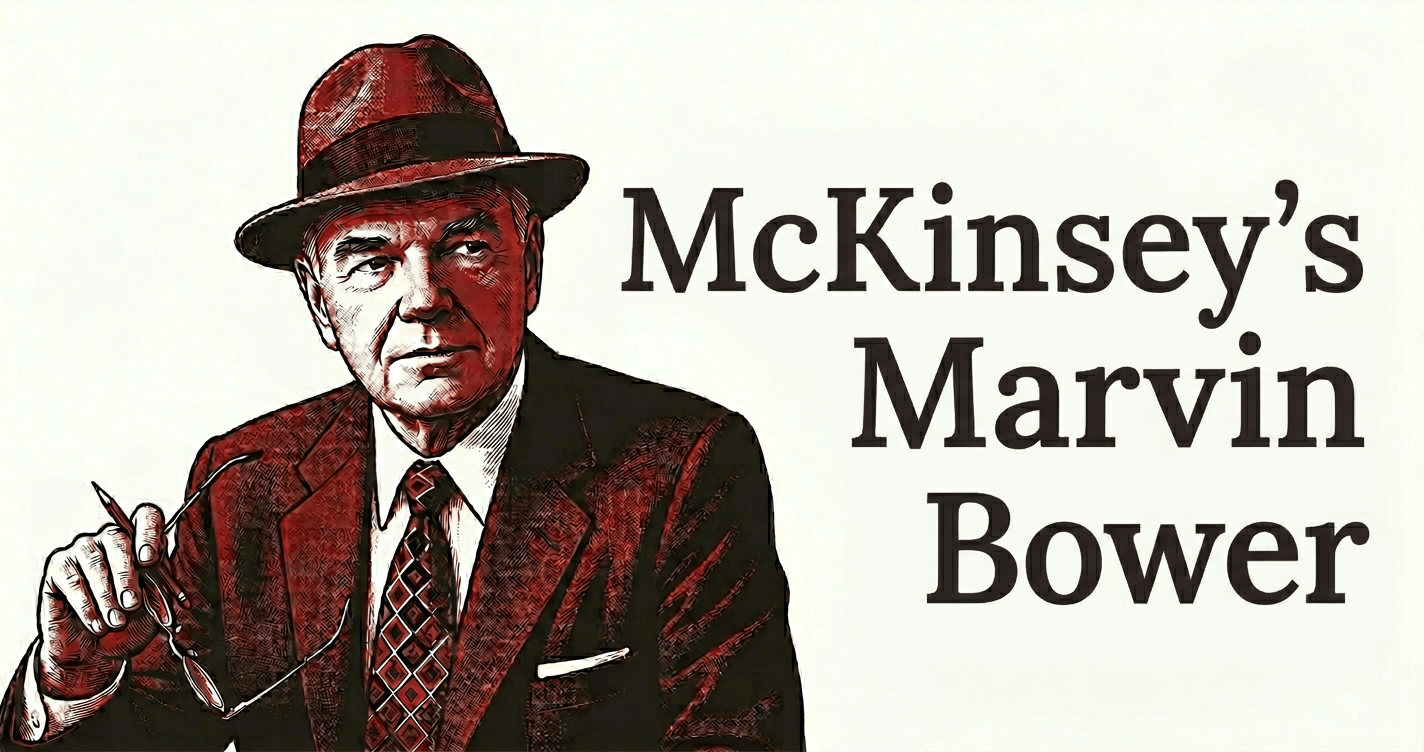
James McKinsey founded the firm, but it was Marvin Bower who decided what it would become.
When McKinsey died in 1937 at forty-eight, the firm was small and had no clear identity. Over the next three decades, Bower would reshape it into what it is today. He did it by having an obsessive vision for how a group of professionals should behave and refusing to compromise on it for sixty years.
Every McKinsey consultant who has been told to call their customers “clients,” been given a copy of Perspective on McKinsey on their first day, or felt the pressure of living up to the firm’s values is experiencing something that traces directly back to Bower. He built a culture so specific that it survived his retirement by decades and continues to shape the firm today.
A Cleveland lawyer with a different idea
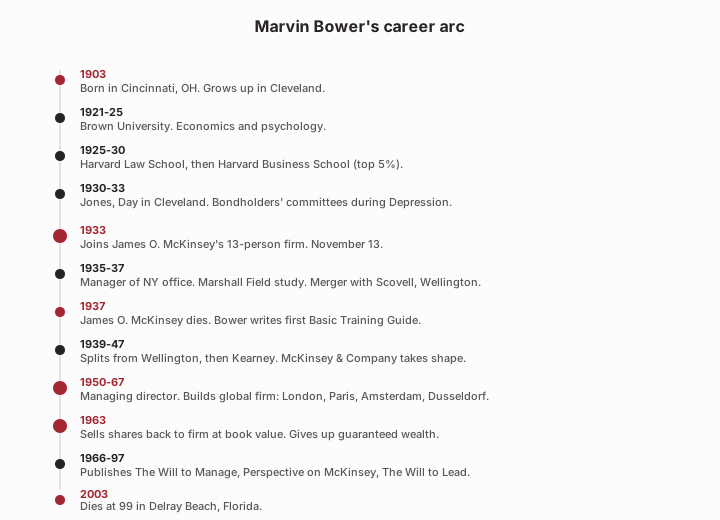
Marvin Bower was born on August 1, 1903, in Cincinnati, Ohio. His family moved to Cleveland when he was young, and it was there that his worldview took shape. His father, William Bower, was the deputy recorder of Cuyahoga County. As Elizabeth Haas Edersheim recounts in McKinsey’s Marvin Bower, William regularly took his sons to tour Cleveland’s factories and pressed them afterward to articulate what they’d observed. The question was always the same: “What did you learn?”
According to Edersheim, he held a different job every summer growing up and studied economics and psychology at Brown before going to Harvard Law School on his father’s advice. He married Helen McLaughlin during law school.
As Duff McDonald recounts in The Firm, Bower’s path was indirect. He wanted to join Jones, Day, the top firm in Cleveland, but his law school grades weren’t good enough. He added an MBA from Harvard Business School, finished near the top of his class, and finally got the job in 1930.
The timing was terrible. The Depression meant most of Bower’s legal work was for troubled companies. He found the restructuring problems interesting and the legal paperwork unbearable. As Edersheim notes, he called the drafting of bond indentures “interminably boring.”1
He started to dream about a different kind of firm. At Jones, Day, he had watched a senior partner named Frank Ginn turn down a lucrative engagement involving a Bethlehem Steel merger. As Edersheim recounts, Ginn was convinced the merger would violate antitrust laws and declined despite the promise of substantial fees. Bower took from it a broader lesson: a professional firm’s judgment was worth more than any single engagement.
By 1932, Bower had an idea forming. As he wrote in Perspective on McKinsey, an internal book he published for the firm in 1978: “don’t you think there is a need for a firm that can work on business and management problems in the same professional and independent way that a law firm works on legal problems?”
McDonald traces the connection to a tip from a Harvard Business School professor who knew of James O. McKinsey’s work in Chicago.
Joining Mac
Bower wrote to McKinsey and traveled to Chicago. As McDonald tells it, McKinsey made a simple pitch: join his team of “accountants and engineers” and do the interesting work full-time, instead of splitting it with legal drudgery.
In Edersheim’s biography, Helen Bower recalled the couple’s circumstances when Jones, Day cut salaries by 25 percent:
We went to a little ice cream parlor right around the corner from Shaker Square — we couldn’t afford a restaurant — and talked about what we could do.
They shared a single Pullman berth to Chicago. As Helen told Edersheim:
Two hours passed. Then four, then six. I was about to go out on the street to look for Marvin’s body when he came back to the room, all smiles. “We got a job!” he shouted.
Steve Walleck, a McKinsey partner who was present when Helen told the story in 1983, wondered what young recruits would think “if they had to pay their own airfare to come for a job interview, and, instead of wining and dining them, we offered them banana splits.”2
Bower started at McKinsey in November 1933. An early engagement at Commercial Solvents, a chemical company, taught him a formative lesson. Bower told the president it was unfair to blame the sales manager when the president controlled pricing. The response, from The Firm:
“Young man,” he roared, “I retained your firm to investigate our sales activities, not my activities. I am going to call Mr. McKinsey and ask him to remove you from the study.”
McKinsey did remove him. But as McDonald recounts, the lesson wasn’t about the substance. It was about judgment: a young consultant had confronted a client executive without consulting his boss first. Bower turned it into a principle the firm still teaches: “deliver the bad news if you must, but deliver it properly.”
The death that changed everything
In 1935, James McKinsey left the firm to run Marshall Field & Company, the giant Chicago retailer, carrying out the restructuring his own firm had recommended.
He told Bower to stay with the firm and promised he would return. He never did. McKinsey caught pneumonia after a tour of Marshall Field’s mills in the fall of 1937 and died on November 30, at forty-eight.
Bower idolized McKinsey. He named his third son James McKinsey Bower. As McDonald recounts, Bower later wrote of his mentor:
“He felt that everyone who sought success wanted criticism, and he really gave it. Most of his criticism was negative. Indeed, his praise was so occasional that it made a deep impression when it was given.”
As McDonald documents, Bower was later asked why he’d never renamed the firm after himself:
“I resolved right then that I would never place my successor in the same position of having to explain why his firm wasn’t named after him. So we kept Mac’s name on the door, and I’ve never regretted it.”
As McDonald recounts, the personal loss was compounded by a business crisis. McKinsey had previously merged the firm with Scovell, Wellington & Company, an accounting and management engineering outfit. The merger was falling apart. The Chicago and New York partners couldn’t agree on anything. Bower described the arrangement as “a dual shotgun marriage” that lacked the essential ingredient for success.3
What followed was a series of splits that would determine the shape of the consulting industry. By October 1938, Wellington had withdrawn from the consulting firm. By 1947, Tom Kearney’s Chicago contingent had split off to form what became A.T. Kearney. Through all of this, as I wrote in the history of strategy consulting, Bower worked to consolidate the New York and Boston offices under the McKinsey & Company name and establish the firm’s identity.
As both McDonald and Edersheim document, Bower and Kearney had three fundamental disagreements. First, Kearney wanted a single Chicago office, while Bower wanted a national firm with multiple offices. Second, Bower had higher standards for staff selection and development than Kearney did. And third, Kearney was indifferent to building a firm that could outlast its founders. Bower was obsessed with it.
The law firm that didn’t practice law
Once McKinsey was dead and the mergers unwound, Bower was free to build the firm he’d envisioned since his days at Jones, Day. His model was simple: an organization run with the professionalism and independence of a top law practice but focused entirely on business problems. McDonald’s shorthand for it in The Firm is “a law firm that didn’t practice law.”
Bower implemented it through specific decisions, most of them small, all of them consistent, and repeated over decades.
Language. As McDonald catalogs in The Firm, Bower created a complete professional vocabulary:
McKinsey had clients, not customers. Its consultants played a role rather than worked at a job. It had a practice and firm members, not a business and employees. The firm did not negotiate with clients. It merely made arrangements.
Bower knew some people found the language rules silly. As he wrote in Perspective on McKinsey:
“Some obviously feel that it makes no real difference. I believe that it does. The terms we use reflect the way we think, and the careful use of professional and not business language will remind us, as well as others, that we do follow a professional approach.”
Appearance. Bower’s dress code was specific: dark suits, long socks (he couldn’t stand “raw flesh” between trouser cuff and sock),4 and hats. Partner Warren Cannon said consultants looked like “moderately well-to-do morticians.”5 A 1962 internal satire called The Consultants’ Coloring Book offered only black and gray as options.6
The hat rule did eventually fall. Three years after JFK went hatless at his inauguration, Bower appeared without one. As McDonald recounts:
“I’d wait six weeks,” one consultant told another. “It may be a trap.”
It wasn’t. But the dark suits stayed until 1995.
Billing. In the early 1940s, Bower shifted McKinsey away from per-diem billing and toward what the firm called “value billing.” As McDonald recounts, the logic was that the firm’s value to a client couldn’t be measured in hours. If the firm ran up hours that weren’t producing value, they shouldn’t charge for them. Some partners resisted. The fear that clients wouldn’t accept it turned out to be unfounded. Value billing became one of McKinsey’s most important competitive advantages, and the practice continues to this day.
One firm. Bower put all consultants into a single compensation pool. The effect was structural: consultants could move freely between offices, and clients knew they were hiring the whole firm, not just a local partner.
Independence. The firm’s mythology is full of stories about partners walking away from clients who wouldn’t take their advice. Bower set the tone. McDonald tells a story about Bower flying to Los Angeles to meet Howard Hughes about consulting for Paramount Pictures. After being kept waiting for a day and a half, Bower gave Hughes an ultimatum through his secretary. Hughes showed up, but Bower ultimately concluded he would never take advice and walked away.
Any one of these decisions could be dismissed as trivia. But repeated and enforced over decades, they accumulated into a culture that no other firm managed to replicate.
The defining act
Ask anyone at McKinsey what defined Bower, and they’ll tell you about what he did with his money.
In 1963, at sixty, Bower could have sold his equity in McKinsey at market value or taken the firm public. As McDonald notes, other firms of the era did exactly that: the founders of George Fry & Associates and Barrington Associates cashed out, and Cresap, McCormick and Paget was sold twice.
Bower sold his shares back to the firm at book value.
The effect was that younger partners could afford to buy in, and the firm would belong to itself rather than to outside investors.
As quoted in McDonald’s The Firm, Bower’s son Dick recalled the moment:
“Let me just say there was shock on people’s faces when he told us that he was selling his shares back to McKinsey at book value. It felt unbelievable, to tell you the truth. But that was Marvin for you.”
Bower gave up a guaranteed fortune. And every subsequent McKinsey partner has been expected to do the same. The practice set McKinsey permanently apart from firms where founding partners cash out and leave the next generation to fend for themselves.
Elizabeth Haas Edersheim, one of McKinsey’s first female partners and Bower’s biographer, wrote in McKinsey’s Marvin Bower that Bower’s decision reflected a core belief: a professional service firm that also had to answer to public shareholders could never consistently put its clients’ interests first. He didn’t believe those incentives could coexist.
The repeater
What set Bower apart, according to McDonald, wasn’t charisma. It was repetition. Lou Gerstner observed that Bower “never deviated from his message.”7 James Gorman put it more directly: “Being a great leader is often less a matter of eloquence and more a matter of repetition and consistency. What a great quality. I wish I had more of it.”8
The obsessiveness extended to everything. As McDonald recounts, David Ogilvy joked: “It is said that if you send an engraved wedding invitation to my friend Marvin Bower, the great man of McKinsey, he will return it to you, with revisions.”
McDonald details Bower’s thoroughness in The Firm: a 1937 Basic Training Guide covered everything from expense reports to client correspondence, and required fifteen books a year with book reports.9
He wrote Perspective on McKinsey in 1978, at the age of seventy-five, as an internal book for McKinsey partners and consultants. He wrote The Will to Manage in 1966, which Edersheim notes became one of McGraw-Hill’s best-selling business books. In 1997, at ninety-four, he published The Will to Lead. The themes across all four works were the same: professionalism, independence, client service, and values.
He spent fifty years saying the same things over and over. By the time he retired, the message was so deeply embedded that new consultants absorbed it without ever meeting him.
As I’ve written about in how to build a culture of excellence, excellence can never be proclaimed from the top. It must be emergent out of a strong process and culture. Bower understood this before anyone was writing about organizational culture. He built the systems, artifacts, and behavioral norms that made the values self-reinforcing.
The firm after Bower
Bower stepped down as managing director in 1967 but continued to work at McKinsey for another quarter century, formally retiring at the age of eighty-nine in 1992. During that time, the firm grew from a few hundred consultants to thousands, opened offices on every continent, and became the institution it is today.
But the firm’s story after Bower is complicated.
McKinsey was Enron’s outside adviser during the Houston energy company’s rise and fall. McKinsey emerged from the scandal largely unscathed while Enron CEO Jeff Skilling, a former McKinsey consultant, went to prison. In the 2009 insider-trading investigation of hedge fund manager Raj Rajaratnam, two figures convicted were ex-McKinsey: former director Anil Kumar and former managing director Rajat Gupta, who was found guilty of passing client secrets.
Bower’s vision was that the firm’s values would act as a self-correcting mechanism. That clients’ interests would always come first. That professionalism meant something higher than ethics, because professionalism encompassed a broader set of responsibilities than merely acting within the bounds of morality.
Whether that vision survived intact is a question that people who care about McKinsey still argue about. What’s clear is that the vision existed in the first place, that one person held it with total conviction for six decades, and that its effects are still visible in how the firm operates.
What Bower got right
And then there was Values Day. Every June, the entire firm takes a full day off from client work to talk about the values. Not a half-day workshop. Not a town hall with a keynote. A full day where teams sit together and discuss what the values mean and whether the firm is living up to them.
What still amazes me is how seriously people took it. Other companies talk about values. At McKinsey, people actually lived them and held themselves to a high standard. You’d look around the room and think: I’ll be part of this, because I know I’ll do the best work of my life here. That feeling traces directly back to Bower.
Bower died on January 22, 2003, at the age of ninety-nine, in Delray Beach, Florida. When he was elected to the Business Hall of Fame, he said: “It must be a mistake. I’m not a businessman. I am a professional.”10
He meant it. That single distinction, the insistence that what McKinsey did was a profession and not a business, shaped everything else. The language, the billing, the dress code, the ownership structure, the values day, the institutional humility, and the expectation that every partner would sell their shares at book value when they left.
Most founders try to build a company. Bower tried to build a profession. McKinsey is still around, still attracting talent, and still arguing about its values ninety years after he walked through the door. Whether you think the firm has lived up to his vision or fallen short of it, the fact that the argument still happens on his terms is the most Bower thing about McKinsey.
Recommended reading
Duff McDonald’s The Firm is the definitive history of McKinsey & Company, and the best source on Bower’s role in shaping the firm. Elizabeth Haas Edersheim’s McKinsey’s Marvin Bower is the only full biography, drawing on interviews with Bower, his family, and dozens of McKinsey partners. Bower’s own The Will to Manage is worth reading for how he thought about leadership, even if the prose is dated.
Footnotes
Elizabeth Haas Edersheim, McKinsey’s Marvin Bower. ↩
Elizabeth Haas Edersheim, McKinsey’s Marvin Bower. ↩
Duff McDonald, The Firm. ↩
Duff McDonald, The Firm. ↩
Duff McDonald, The Firm. ↩
Duff McDonald, The Firm. ↩
Duff McDonald, The Firm. ↩
Duff McDonald, The Firm. ↩
Duff McDonald, The Firm. ↩
Duff McDonald, The Firm. ↩