The McKinsey 7S framework: why organizational alignment matters more than strategy
The 7S framework came out of McKinsey’s San Francisco office in the late 1970s. The Firm was worried. BCG and Bain were winning strategy work with quantitative tools like the experience curve and the growth-share matrix. McKinsey’s managing director Ron Daniel decided the firm needed its own intellectual response, but in a different direction.
Creating the 7S Framework
As Walter Kiechel recounts in The Lords of Strategy, Daniel launched two parallel projects: one on corporate strategy (led by Fred Gluck) and one on organizational effectiveness. The organization project was the one that produced the 7S.
Tom Peters and Bob Waterman led the project. As Duff McDonald recounts, it was two outside professors, Harvard’s Anthony Athos and Stanford’s Richard Pascale, who suggested organizing the findings around alliterative S-words. Before that, Peters and Waterman had been talking about “a range of topics — from people to involvement, trust, listening, and wandering.” The alliteration gave the ideas a shape that stuck.
Together with Julien Phillips, Waterman and Peters published “Structure Is Not Organization” in Business Horizons in 1980. The opening paragraph made the core argument:
“The Belgian surrealist René Magritte painted a series of pipes and titled the series Ceci n’est pas une pipe: this is not a pipe. The picture of the thing is not the thing. In the same way, a structure is not an organization. We all know that, but like as not, when we reorganize what we do is to restructure.”
Their central claim:
“Our assertion is that productive organizational change is not simply a matter of structure, although structure is important. It is not so simple as the interaction between strategy and structure, although strategy is critical too. Our claim is that effective organizational change is really the relationship between structure, strategy, systems, style, skills, staff, and something we call superordinate goals.”
The seven elements
The paper arranges these into what Kiechel describes as “a sort of molecule”:
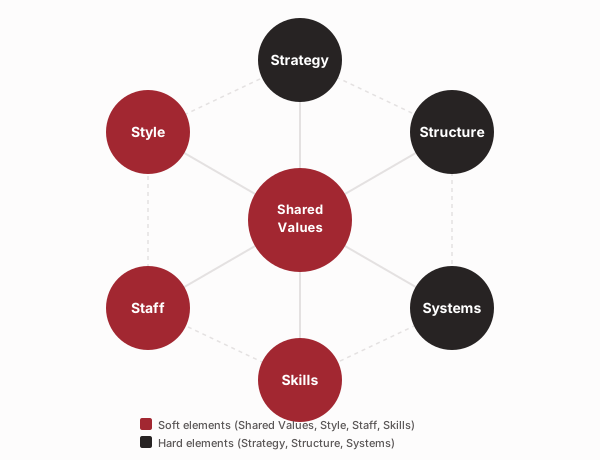
- Strategy. The plan for how the organization will compete and allocate resources.
- Structure. How the organization is arranged: reporting lines, divisions, teams.
- Systems. The formal and informal processes that keep the organization running, from performance reviews to IT infrastructure.
- Shared values. The beliefs and norms at the center of the organization. Originally called “superordinate goals” in the 1980 paper.
- Style. How leadership actually behaves, not what they say in town halls.
- Staff. The people, and how they’re recruited, developed, and promoted.
- Skills. The distinctive capabilities the organization has built over time.
The first three (strategy, structure, systems) are often called the “hard” elements because they’re visible and relatively easy to change on paper. The remaining four (shared values, style, staff, skills) are the “soft” elements, harder to measure but often more important.
Alignment matters
These seven elements are interconnected. When they don’t support each other, it shows up as execution problems that get blamed on the wrong thing.
Microsoft through the 7S lens
An example we can analyze through this framework is Microsoft’s transformation under Satya Nadella. When Nadella became CEO in 2014, the company’s problem wasn’t strategy. Steve Ballmer had already identified cloud computing as the future. The strategy was directionally right. But the organization couldn’t execute it.
Microsoft under Ballmer had a “stack ranking” system where managers ranked employees against each other, which made people hoard information and undercut peers. The systems, style, and shared values were all aligned with each other, but misaligned with the strategy the company needed to pursue.
Nadella changed most of the S’s alongside the strategy:
- Strategy. Shift from Windows-first to cloud and AI.
- Structure. Reorganized divisions around cloud instead of Windows.
- Systems. Killed stack ranking. Changed performance reviews.
- Shared values. Reframed around a “growth mindset.”
- Style. Collaboration over internal competition.
- Staff. Changed who got hired and promoted.
- Skills. Invested in cloud engineering and AI capabilities. Released Office on iOS and Android.
The turnaround is typically attributed to “Nadella’s vision” or “the cloud strategy,” but the 7S lens suggests a more complete reading. The strategy shift only worked because the other six S’s changed with it.
The In Search of Excellence companies: alignment isn’t permanent
The 7S framework’s most famous application was also its most embarrassing.
Peters and Waterman used the framework to identify 43 “excellent” American companies for their 1982 book In Search of Excellence. The book became the most popular business book of the early 1980s. As Peters and Waterman wrote:
“An organization chart is not a company, nor a new strategy an automatic answer to corporate grief.”
The companies they studied had figured out how to align the soft elements with the hard ones.
Two years later, BusinessWeek ran an “Oops” cover story. Kiechel notes in Lords of Strategy that roughly a third of the “excellent” companies had hit significant trouble since the book’s publication. Atari, one of the 43, had essentially collapsed. Others were struggling with the very organizational problems that Peters and Waterman said they’d solved.
The lesson wasn’t that the framework was useless. It was that organizational alignment is dynamic. A company can have all seven S’s working together beautifully and then lose that alignment when the market shifts, leadership changes, or the company grows past the culture that made it successful in the first place.
When I was at GE in the early 2000s, it was fascinating to experience a disconnect between public reputation (people still held GE as a best-in-practice company), and the reality in my day-to-day job (it had clearly lost its fastball). So many people had adopted the idea that GE was world-class, too, in ways that probably held it back from transforming itself for many years after I left.
Using the 7S as a diagnostic tool
The 7S is for finding misalignments, not figuring out what business to be in.
Start with what’s actually happening, not what’s written down
Every organization has a stated strategy, a formal structure, and documented systems. The 7S analysis only works if you assess what’s real. What do people actually do? not What does the org chart say they should do?
The gap between stated and actual is usually widest in the soft elements. A company might say it values innovation (shared values) while promoting people who avoid risk (style and staff). The systems might reward short-term revenue targets while the strategy requires long-term R&D investment.
Look for the misalignment, not the diagnosis
The temptation is to go element by element and write a paragraph about each one. That produces a nice document and no insight.
The useful question is: which elements are pulling against each other? A new strategy that requires cross-functional collaboration won’t work in a structure organized around independent P&L-owning business units with their own performance metrics. That’s a strategy-structure-systems misalignment, and it’s one of the most common ones in large companies.
Systems are the hidden lever
Waterman, Peters, and Phillips made a practical observation in the original paper:
“Do you want to understand how an organization really does (or doesn’t) get things done? Look at the systems. Do you want to change an organization without disruptive restructuring? Try changing the systems.”
The paper is full of examples. A company they called “International Wickets” had management talking for years about becoming more market-oriented. Yet their planning meetings spent almost no time on customers, marketing, or market share. The systems remained internally focused, and the market orientation goal stayed a talking point.
A consumer goods company tried to apply portfolio strategy but couldn’t get started:
“Textbook portfolio theory seemed to apply: Find a good way to segment the business, decide which segments in the total business portfolio are most attractive, invest most heavily in those. The only catch: Reliable cost data by segment were not to be had. The company’s management information system was not adequate to support the segmentation.”
A bank faced a similar problem. It wanted to segment by customer and product, but its costing systems couldn’t handle the complexity of borrowers who are also depositors, varying transaction volumes, and a fast-turning balance sheet. One bank solved it by skipping the strategy question entirely and building systems infrastructure that let account officers negotiate better deals. As the paper put it: “For them the system is the strategy.”
The authors’ broader point:
“To many business managers the word ‘systems’ has a dull, plodding, middle-management sound. Yet it is astonishing how powerfully systems changes can enhance organizational effectiveness — without the disruptive side effects that so often ensue from tinkering with structure.”
Pay attention to the soft elements
Most organizational change efforts focus on the hard elements because they’re easier to control. You can announce a new strategy, draw a new org chart, and implement a new IT system. Those are all real changes, but they’re rarely sufficient.
The soft elements are where change succeeds or fails. If you restructure a team but don’t change how leaders behave (style), who gets hired (staff), or what people believe about how work should be done (shared values), the new structure will just replicate the old patterns with different boxes.
Where the 7S framework breaks down
The 7S has real limitations, and some of them were identified early.
Bill Bain, founder of Bain & Company, offered a pointed critique. As Kiechel reports in Lords of Strategy:
[Bain criticized the framework’s] “lack of quantitative underpinnings, looseness of definition, questionable interrelationship of the factors.”
That critique has teeth. The framework doesn’t tell you how the elements are connected, only that they are. Two consultants can look at the same organization and disagree about whether “shared values” are strong or weak, because there’s no standard way to measure them. The hard elements have the advantage of being observable. The soft elements require judgment, and different people will exercise that judgment differently.
As the original paper put it: “We find too many examples of large, prestigious companies around the world that are replete with strategy and cannot execute any of it.” The framework was built to explain why.
But it’s also static. It describes an organization at a point in time but doesn’t model how change happens. If your systems and style are misaligned with your strategy, the 7S tells you that, but it doesn’t tell you which to change first, how long the change will take, or what sequence will minimize disruption.
There’s also no external lens. Porter’s Five Forces analyzes the industry. The OODA loop accounts for competitors’ moves. The 7S looks entirely inward. An organization can be perfectly aligned internally and still fail because the market shifted or a competitor changed the rules. The framework has nothing to say about that.
C.K. Prahalad and Gary Hamel offered a broader critique of the framework era in their 1989 Harvard Business Review article “Strategic Intent”:
“It’s not very comforting to think that the essence of Western strategic thought can be reduced to eight rules for excellence, seven S’s, five competitive forces, four product life-cycle stages, three generic strategies, and innumerable two-by-two matrices.”
No framework, however elegant, substitutes for the hard work of building competitive advantage over time.
Perhaps the most telling critique comes from the framework’s own creators. Peters, Waterman, and Pascale all largely abandoned the 7S in their subsequent work. You won’t find a mention of it in Peters’ next two books. By 2002, Waterman told Kiechel:
“With a lot of the organizations I’ve written about, in a very important sense the strategy is the organization.”
How to think about it
The 7S framework isn’t a strategy tool. It’s an alignment check.
Its value is in the question it forces you to ask: if we change this one thing, what else needs to change with it? That question is worth more than the diagram.
Most organizational changes fail not because the strategy was wrong but because only the strategy changed. A company announces a new direction, maybe restructures a division or two, and then expects different results from the same people, the same incentive systems, the same leadership behaviors, and the same beliefs about how work gets done. The 7S is a reminder that organizations are systems, and systems resist partial changes.
Use it when your organization has a strategy that isn’t working and you’re not sure why. Go through the seven elements honestly. The misalignment between what the strategy requires and what the organization actually does is usually visible once you look for it.