McKinsey vs BCG vs Bain: how the three firms compare in 2026
In 2019 I wrote a comparison of McKinsey and BCG, having worked at both. That piece was about culture: how McKinsey’s one-firm and values-first approach showed up in daily work and how it compared to BCG’s more academic, nerdy, and decentralized culture, and why, ultimately, both are fantastic workplaces.
I haven’t worked in the industry since 2017. I still talk to a lot of people who do, and I read what the firms publish about themselves. The firms have gone through lots of changes and AI promises to disrupt them even more. Despite that, the firms have grown massively, are still highly profitable, and are positioned well for the future.
I thought it would be fun to revisit the big three, or MBB, as they are often referred to, and see how they compare in 2026.
Quick history recap: McKinsey was first, BCG and Bain came in the 60s and 70s
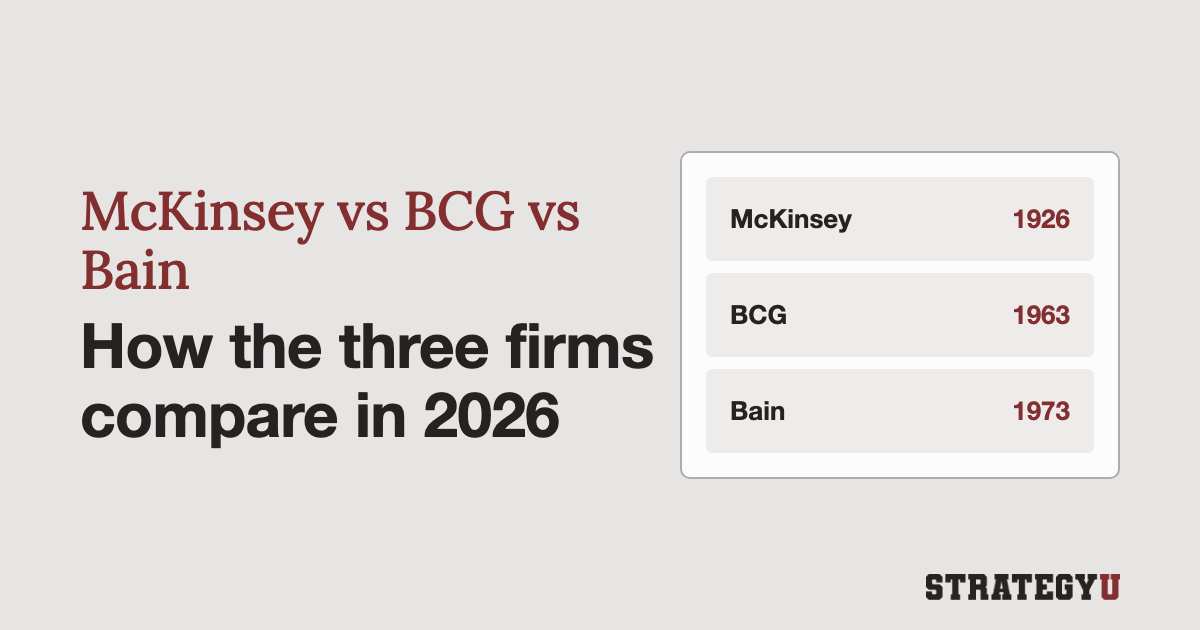
McKinsey was founded in Chicago in 1926. If you want to read more about McKinsey, a good place to start is this piece on Marvin Bower.
BCG was established in 1963 by Bruce Henderson, who came over from Arthur D. Little, where Kiechel notes he had been senior vice president for management services. Walter Kiechel describes the start in The Lords of Strategy:
The Boston Consulting Group opened its doors for business on July 1, 1963, with “one room, a desk, no telephone, and no secretary,” according to the firm’s official history of its early years. Bruce Henderson, founder of what was then known as the Management Consulting Division of the Boston Safe Deposit and Trust Company, was its sole employee.
Bain then came out of BCG. As Kiechel puts it, “A few months later, in 1973, Bain left to form Bain & Company, taking most of the senior members of the blue team with him.”
Through this lens, McKinsey has always been the clear top firm. It’s always been bigger, made more money, had more global offices, and commanded the most prestige.
But recently, it’s been the firm that’s faced the biggest headwinds, mostly because it hired so aggressively post-Covid.
McKinsey is still (probably) the biggest firm, but BCG is still growing and may eventually become the largest
BCG’s own overview page lists “$14.4B annual revenue,” “33.5K global employees,” “100+ cities with BCG offices, in more than 50 countries,” and “40% of revenue from tech and AI.”
McKinsey used to publish the same kind of thing and stopped. Its 2023 ESG report put the numbers on page four of the executive summary: 45,100 colleagues, 68 countries, 4,100 clients served, and $16B revenue. The 2022 edition had done the same, with “$15B+ in revenue” and “45,000+ colleagues globally.” Then the disclosure ended. Reporting the FT published in May 2025 notes that the report covering 2024 “did not include staff numbers” and “did not include a figure for 2024 revenue, unlike in previous years.”
The famous $16 billion is McKinsey’s own number for 2023, not an outside estimate, and the firm has published nothing since. Forbes still lists $16 billion and 40,000 employees as of August 2026, sourced to FactSet and Forbes.
Bain publishes less. Its about page offers “Across 67 cities in 40 countries, we operate as one global team” and “Since 1973, we’ve partnered with clients,” and that’s the extent of it: no revenue figure and no headcount.
Except that it does publish a headcount, in its sustainability filing, and the number is not the one in its press releases.
Bain’s press boilerplate says 19,000. When Christophe De Vusser took over as worldwide managing partner, the firm’s own announcement in July 2024 quoted him on “our extraordinary team of 19,000 Bainies around the world.” Forbes repeats 19,000 too.
Bain’s GRI index, the externally assured sustainability report it files each year, gives a different series: 12,234 in 2020, 14,193 in 2021, 18,385 in 2022, 18,254 in 2023, 17,266 in 2024, and 17,519 in 2025. Those are point-in-time headcounts with a stated methodology, restated year over year, and checked by an outside assurer.
The 2024 report explains that “The net number of employees has decreased by 5% (from 18,254 to 17,266) in 2024 due to Bain’s hiring freeze and increase in turnover in 2024.”
The one number Bain volunteers freely is the AI one. That same De Vusser release says “Tech and AI enabled revenue is already driving 30% of the firm’s business in 2024 and Bain expects that this will reach half of revenue in the coming years.” Set that next to BCG’s over-40% in 2025. For revenue you are still stuck with estimates: Forbes carries $7.5 billion as of August 2026, credited to FactSet and Forbes rather than to Bain.
Wikipedia’s infobox currently lists Bain’s revenue as “$14 billion (2025)” and cites the Forbes profile for it. That Forbes profile says $7.5 billion. The citation doesn’t support the number, and it has been copied into other comparison articles. If you see a confident Bain revenue figure anywhere, open the source it points at.
| McKinsey | BCG | Bain | |
|---|---|---|---|
| Publishes revenue | Did until 2023, then stopped | Yes ($14.4B, 2025) | No |
| Publishes headcount | Did until 2023 (45,100) | Yes (33,500) | Yes, but only in its GRI index (17,519) |
| Last revenue figure available | $16B, self-disclosed for 2023, none since | $14.4B, current | $7.5B (Forbes/FactSet estimate) |
BCG is still growing, but growing more slowly
For 2024, BCG’s own announcement reported “10% global revenue growth, rising to $13.5 billion in 2024 from $12.3 billion in 2023,” with “global headcount rising to 33,000 by the end of 2024.” AI-related services were running at roughly 20% of revenue at that point.
For 2025, City AM reported on 23 April 2026 that “BCG reported seven per cent global revenue growth, rising to $14.4bn in 2025 from $13.5bn in 2024,” “marking its 22nd consecutive year of growth.” The firm “grew its headcount by 500 to 33,500, with a heavy focus on technical roles, including AI engineers and data scientists,” and its “AI-and tech-focused services now represent over 40 per cent of BCG’s total revenue, driven by 25 per cent year-over-year growth in AI services.”
Between those two years revenue growth fell from 10% to 7%, net hiring halved from 1,000 people to 500, and the AI and tech share of revenue roughly doubled, from about 20% to over 40%.
McKinsey shed 5,000 people through performance reviews, not layoffs
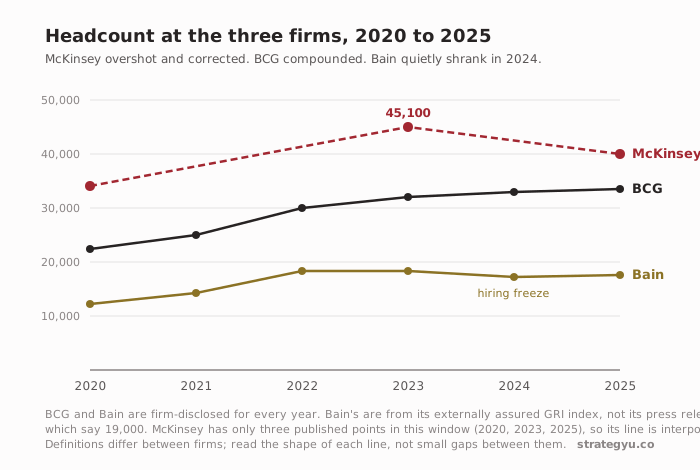
Fortune reported on 29 May 2025 that McKinsey’s headcount had dropped by more than 10% in eighteen months, which it called the largest decline in the firm’s history. The firm went from about 34,000 people in 2020 to roughly 45,100 at the end of 2023, then back down to about 40,000. McKinsey’s position, per Fortune, is that “the decrease is due to normal attrition and performance review firings” rather than layoffs.
I wouldn’t read 40,000 against BCG’s 33,500 as a league table, since the definitions differ across firms and reports. McKinsey added roughly 11,000 people in three years and then gave back about 5,000 in eighteen months, while BCG added 1,500 across 2024 and 2025 with no reversal.
In March 2024, Consulting.us reported, citing Bloomberg’s reporting on internal memos, that engagement managers and associate partners in North America were told “the average time to gain a promotion in their roles is two-and-a-half years,” and that roughly 3,000 consultants globally had been given “concerns” ratings. The firm’s statement in that reporting was that “We have always maintained a high bar for performance. We routinely refine our approach to development and performance to ensure we continue to meet these goals, and we continue to recruit and hire robustly.”
Up or out is how McKinsey has always worked, and a “concerns” rating has always been a signal to start taking recruiter calls.
Ezra Gershanok, a business analyst at McKinsey from 2021 to 2023, gave Business Insider his account of being on the wrong end of that in 2024:
At the meeting, they complained about my performance, even though it was clear that the real reason they wanted me out was because the firm had over-hired.
That is one person’s version of events and the firm would presumably describe it differently. But he was blunt about the work: “My work output was always a PowerPoint deck, and its biggest impact was making whoever paid for us to be there look good.” And on the way out: “The irony of my time at McKinsey is that they’re constantly giving right-sizing advice to their clients but completely miss the mark themselves.”
Only one in five MBB job postings is a consulting job
On 31 August 2026 I analyzed the roles that each firm had posted on LinkedIn worldwide, deduplicated them, and sorted the titles into two buckets: anything naming AI, data, analytics, or engineering, and anything starting with a classic consulting-ladder title. That gave 1,388 unique postings.
One fascinating thing: Only 13-37% of posted roles are for classic consulting-ladder roles. This is notable because if you went back 30 years ago, consulting roles would have been the core job at the firm. While I was there, McKinsey and BCG were both expanding knowledge and analytics roles, but in the last ten years, this has accelerated and shifted beyond knowledge roles, to AI, analytics, engineering, and other tracks. These firms have come to resemble the big 4 Accounting firms more than themselves from 30 years ago.
Every one of the three is at least 22% AI, data, or engineering by title. McKinsey 22%, BCG 31%, Bain 42%.
| McKinsey | BCG | Bain | |
|---|---|---|---|
| Postings returned | 462 | 1,000+ | 383 |
| Unique title and location | 349 | 754 | 285 |
| AI, data, or engineering in title | 77 (22%) | 232 (31%) | 121 (43%) |
| Classic consulting ladder title | 130 (37%) | 127 (17%) | 36 (13%) |
I was capped at 1,000 results from LinkedIn so the BCG numbers may be a bit different, but it feels directionally right. They also post different subsets on LinkedIn than on their own boards: McKinsey’s careers site showed more than 500 jobs the same day, bundling single roles across many cities.
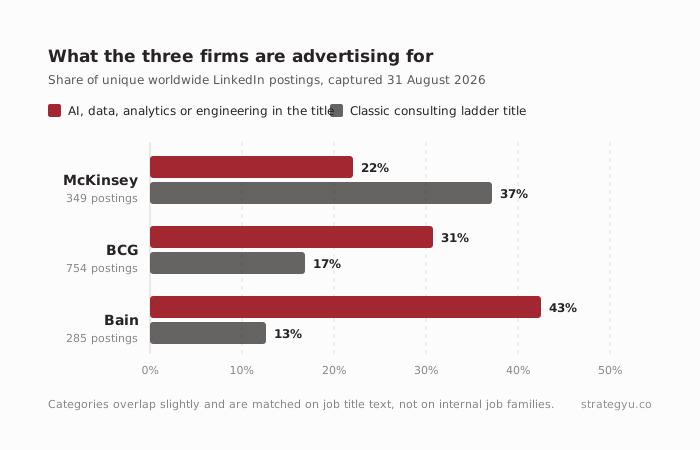
Bain is the one that surprised me. Of 285 unique postings, only 36 start with a title from the classic ladder. The three most repeated titles on its list are “Senior Director, Customer Practice Digital Solutions (CXT),” “Expert Senior Manager, AI Engineering,” and “Director, Celerity.” What Bain is running on LinkedIn is a large software and AI engineering recruiting operation, and consultant hiring is a small part of what it posts there.
With BCG, 27% of the board is a single sub-brand. Of the 754 unique postings, 203 of them, 27%, are BCG Platinion roles, and a single title, “BCG Platinion | Lead AI Tech Architect - AI Platforms,” is open in 16 locations at once. Add BCG Vantage’s 74 postings and BCG X’s 27 and those three account for 304 of the 754, or 40% of everything BCG is advertising.
Then there’s McKinsey, which has the most conventional-looking board of the three by some distance. Its most repeated postings are “Experienced Consultant - Procurement,” “Experienced Consultant - Manufacturing,” and “Consultant - Operations Excellence Program.” If you want the firm that still looks like the firm in the recruiting deck, on this evidence it’s McKinsey.
The CEOs disagree about what’s happening to junior consultants
McKinsey and BCG were asked versions of the same two questions in 2026, and their answers do not match.
Bob Sternfels described what McKinsey sells now on Harvard Business Review’s IdeaCast in January:
We’re on a change journey of moving, quite frankly, from a model that was advisory to one that underwrites outcomes. And today, Adi, about a third of our revenues total are underwriting outcomes. So it’s not, “Hey, you handed me a PowerPoint. Great.” It’s, “We collectively signed up for this outcome together and we’re tied on this journey all the way through until that impact is delivered.” My hope is that that crosses a majority of the revenues by the time I’m done being the global managing partner.
Christoph Schweizer got the same question in a Wall Street Journal interview that BCG republished in May. Three quarters of BCG’s largest AI cases now carry a variable fee. Asked what share of the firm’s overall work is priced that way, he said: “It’s significantly less than a third.”
Both firms have since put money behind the implementation side. In May 2026 Bain and McKinsey each took a stake in the OpenAI Deployment Company, a $4 billion venture OpenAI set up to deploy AI inside large companies, whose first acquisition was Tomoro, a 150-person applied-AI consultancy. BCG is not among the named investors.
Here is Sternfels on the junior job:
I’m now considered a dinosaur in our firm because I’m a little over 30 years with us, but the stuff that I did when I joined as an associate 32 years ago, we wouldn’t consider even doing right now. Why? Because clients do that stuff themselves and we are solving much more complicated interconnected questions with our clients.
And here is Schweizer, four months later:
We are blown away about the junior talent we can hire. They are so AI native, they use these tools as if the world had never existed without them. So perhaps a bit counter to many narratives out there, we have not reduced our junior intake, and we are very happy with that.
McKinsey does not agree with itself either. In June 2025 Kate Smaje, the firm’s global leader of technology and AI, told Bloomberg: “Do we need armies of business analysts creating PowerPoints? No, the technology could do that. Is that a bad thing? No, that’s a great thing. It’s not necessarily that I’m going to have fewer of them, but they’re going to be doing the things that are more valuable to our clients.” That September, Eric Kutcher, chair of McKinsey North America, told reporters the firm would hire 12% more people in North America in 2026 than in 2025, and that “What we will work on will still require the same level of intellect, the same level of pace, and it will be doing the things that you can’t do with machines.” Three months after that, Bloomberg reported leadership had discussed cutting about 10% of headcount across non-client-facing departments.
In June 2026 Clare Gordon, its UK managing partner, told The Times, as reported by City AM, that Bain’s graduate hiring would be 25% higher than the year before, “well above pre-pandemic levels,” running to “triple-digit numbers of graduates and junior hires up to consultant grade.” She gave the reason plainly: Bain “needs juniors working alongside more senior experts, so they can develop the judgment, the expertise, the pattern knowledge of how you drive change through organisations.” BCG told the same reporter it plans to hire consistent if not slightly increased numbers.
Sternfels went further on the economics at a live All-In taping at CES on 7 January, reported by Business Insider:
Our model has always been synonymous that growth only occurs with total head count growth. Now it’s actually splitting. We can grow in this part, the client-facing side, and we can shrink in this part and have aggregate growth in total.
The numbers he attached: client-facing roles up 25%, non-client-facing down about 25% while producing 10% more, and 1.5 million hours saved on search and synthesis in a year.
On the HBR episode he put the firm at 40,000 humans and 20,000 agents. At CES the next day he said 25,000. There is some variance in the count, but the numbers are close enough to be directionally accurate.
Consulting is now one of several career tracks at each firm, each with their own pay trajectory
I worked in the knowledge network at both firms, as an Analyst in the Operations Practice at McKinsey and a Knowledge Expert in the Transformation practice at BCG. In 2019 I wrote about how differently the two firms ran those teams: McKinsey’s knowledge network sat physically apart from the consultants but was held to a similar bar, while BCG’s researchers shared space with case teams in local offices. Since then the research side of both firms has acquired a brand, a published career track, and job descriptions with clear tracks similar to the consulting ones.
BCG has since renamed “Knowledge Network” to BCG Vantage, which to me signals a shift from seeing it as a backoffice function, toward something you can sell and position to clients. A live Senior Analyst posting in the People and Organization practice (POP as they used to call it when I was there) puts it this way:
In a Client Focus role within BCG’s People and Organization (POP) Practice Area, you will work in a growing global team, with a focus in China, delivering value to clients via individual expertise and/or institutionalized BCG Vantage assets (products, tools, data, workshops, frameworks, surveys, domain-specific data and related expertise, etc.).
BCG Platinion, the technology build arm, describes its job as combining “BCG’s strategic perspectives with our tech know-how to implement and secure large-scale tech programs,” and BCG X, its tech and design unit, describes itself as “nearly 3000 experts” across “80 cities.” Bain has Celerity, a pricing and commercial strategy business that shows up repeatedly in its job postings, and the Bain Capability Network, which comes up again below.
BCG invites you to “Find Your Team” and lists fourteen of them, with Consulting sitting in an alphabetical run alongside Careers in AI, Data Science and Analytics, and Technology and Engineering. Bain does the same across eight areas. McKinsey files its openings under Consulting, Tech & AI, Research, Transformation & Turnaround, and People & HR, and its consulting descriptions still lead with the old promise: as an associate “you will join a client service team and take ownership of a workstream to solve some of the toughest challenges our clients face.”
There are now several distinct ways into each of these firms, and only one of them is the consulting role people picture when they say the word.
The tracks also pay differently, and Glassdoor has enough US data to see it.
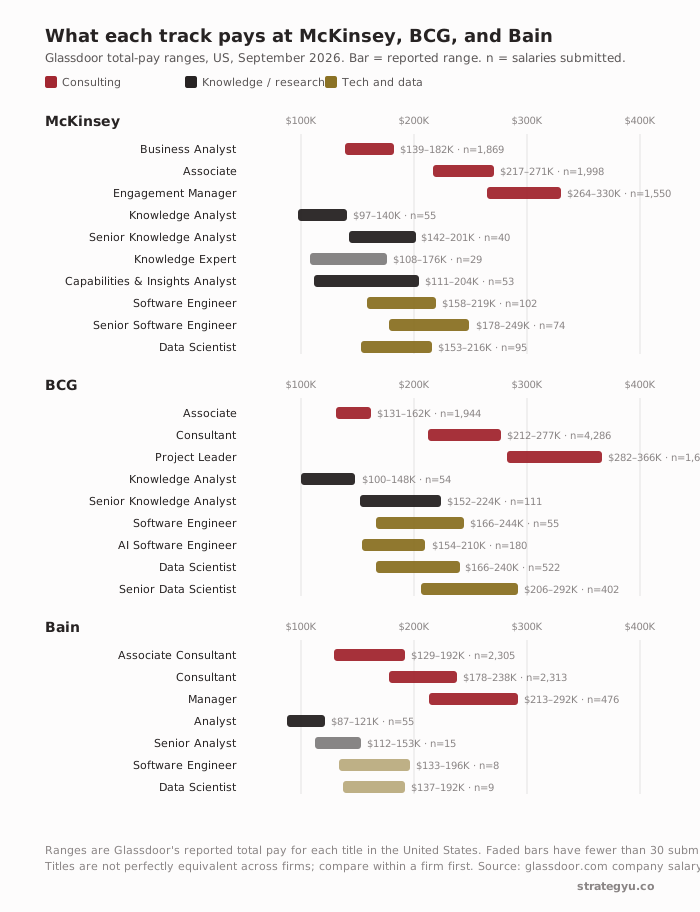
At McKinsey a Business Analyst reports $139K to $182K in total pay and an Associate $217K to $271K, each on about 1,900 submissions. The knowledge titles sit below that: Knowledge Analyst $97K to $140K, Senior Knowledge Analyst $142K to $201K, and Knowledge Expert $108K to $176K, on 29 to 55 submissions each. Software engineers land between the two at $158K to $219K, senior software engineers at $178K to $249K, and data scientists at $153K to $216K. BCG has the same shape: Associates $131K to $162K and Consultants $212K to $277K on the consulting side, Knowledge Analysts $100K to $148K and Senior Knowledge Analysts $152K to $224K, and Data Scientists $166K to $240K. At Bain, Associate Consultants report $129K to $192K and Consultants $178K to $238K, Analysts $87K to $121K, and the engineering samples are in single digits.
These are self-reported US figures, and the knowledge and tech samples are small next to the consulting ones. Within each firm the ordering is the same: consulting pays most at equivalent seniority, tech next, knowledge least.
This pay gap was definitely there when I was at both firms and many people did try to switch tracks. But it was rarely for the money. Bigger incentives were faster-paced growth (you worked a ton more), future opportunities after leaving the firm, travel perks, and perceived prestige. For many people, however, non-consulting track roles are ideal. They still have challenging jobs and work, without needing to travel every week or be on-call on weekends.
Bain’s biggest hiring city is Gurugram, not Boston
One thing that I found interesting is that Bain’s two largest single posting locations worldwide are Gurugram with 36 and Mexico City with 29. Boston, where the firm was founded and still has its head office, has 22. BCG’s largest are London with 53 and Gurgaon with 46, ahead of Boston with 32. McKinsey’s list is flatter, with Tokyo at 22 and Munich at 19 on top.
At McKinsey I worked with people in India, Poland, and Costa Rica, and the firm was investing heavily in all three. I never thought of those hires as outsourced talent. The people I worked with were very talented, some of the smartest people in their countries, and I’m not surprised a firm like Bain is investing more in these regions.
And so firms like McKinsey’s have hubs everywhere, with Client Capabilities Network hubs in Atlanta, Dallas, Washington DC, Brussels, and Dubai alongside the ones in Gurugram and Wroclaw. BCG is the same: a Senior Analyst posting for BCG Vantage, the knowledge track, lists its locations as Dallas, Chicago, Washington, Los Angeles, San Francisco, Brooklyn, and Atlanta.
Bain is the exception. Its capability network nodes are New Delhi, Bengaluru, Mexico City, and Warsaw, all lower-cost, which lines up with a job board where Gurugram and Mexico City out-hire Boston.
Bain now tops the employee surveys, BCG is slipping, and McKinsey now opts out
When I wrote the original comparison in 2019, McKinsey and BCG were both sitting inside Glassdoor’s top 20 Best Places to Work.
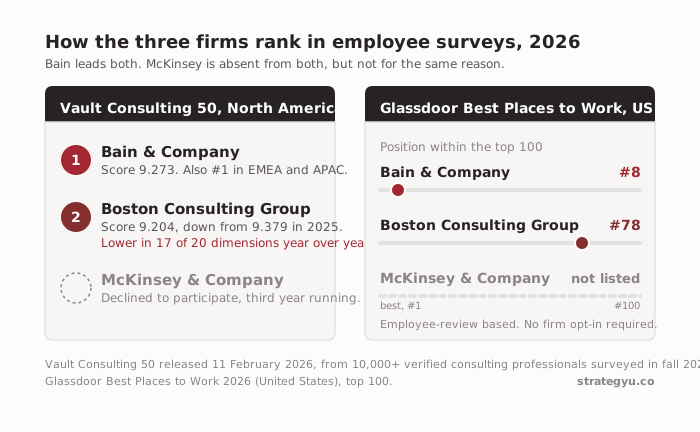
On Glassdoor’s Best Places to Work 2026 list, Bain & Company is number 8 and Boston Consulting Group is number 78. McKinsey doesn’t appear in the top 100. Glassdoor’s own summary of what Bain employees emphasize is “Global opportunities for career growth,” “Mentorship and professional development focus,” and “People-first culture with supportive teamwork.” For BCG it’s “Thrive in a culture of growth and learning,” “Unmatched career growth with industry leaders,” and “Collaborate with inspiring, strategic minds.”
Vault’s Consulting 50, reported by Poets&Quants in February 2026 and built on responses from more than 10,000 verified consulting professionals surveyed in the fall of 2025, put Bain first in North America with a score of 9.273. BCG came second at 9.204, down from 9.379 the year before. Bain also took the top spot in EMEA and APAC, so this isn’t a US artifact.
Bain led on 6 of 20 quality-of-work-and-life dimensions, including Compensation, Culture, Formal Training, Informal Training, Promotion Policies, and Selectivity. BCG led on 5: Benefits, Health & Wellness, Innovation, Interactions with Clients, and Relationships with Supervisors. BCG still wins on the day-to-day experience of the work and the people above you, while Bain wins on the things that determine whether you get better and get promoted.
Poets&Quants also reports that “In the end, BCG produced lower survey scores in 17 out of 20 dimensions against the previous year.” Two independent surveys have BCG moving the wrong way in the same year its revenue growth slowed and its net hiring halved.
Poets&Quants reports that McKinsey “declined to participate in the Consulting 50” for the third consecutive year. This makes sense given the firm’s culture. It has always eschewed pursuing marketing and press.
BCG’s own experiment: AI made its consultants faster, and more often wrong
In 2023 BCG let academic researchers run a pre-registered randomized trial on its own staff. The paper covers 758 consultants, “about 7% of the individual contributor-level consultants at the company,” randomly assigned to work with no AI, with GPT-4, or with GPT-4 plus prompt-engineering training. One of the authors, Karim Lakhani, discloses in the paper that he advises BCG on AI strategy.
On eighteen tasks inside what the authors call the “jagged technological frontier,” AI was a clear win. Consultants using it “completed 12.2% more tasks on average, and completed tasks 25.1% more quickly,” and produced “more than 40% higher quality” work. The weakest consultants gained the most, improving 43% against their own baseline.
Then the researchers set one task deliberately outside the frontier: a business case where the spreadsheet looked comprehensive and the interview notes pointed to a different answer, which is the kind of problem a real client brings.
For a task selected to be outside the frontier, however, consultants using AI were 19 percentage points less likely to produce correct solutions compared to those without AI.
The control group got it right 84.5% of the time. The two AI groups managed 60% and 70%. Prompt-engineering training made the drop worse rather than better: 24 points versus 13.
Quality scores for AI-assisted work were higher “regardless of the correctness of their answer.” Wrong answers came back faster and scored higher on quality. The authors explain why: “Professionals who had a negative performance when using AI tended to blindly adopt its output and interrogate it less.”
A current McKinsey employee has described the same failure from the inside. A Capabilities and Insights analyst, the knowledge-network job I used to do, wrote this anonymously on Glassdoor in June 2026:
The Capabilities and Insights roles will likely be reduced due to AI. This is a shame, as the Firm risks losing institutional knowledge and insights that shape decision making. While consultants excel at making pages, structuring data, and building models, they lack the industrial expertise that helps them discern high versus low-quality AI-generated outputs.
A BCG managing director and senior partner, writing in September 2025 under the heading “Going downhill on values in the age of disruption,” listed among the firm’s problems that “AI will significantly reduce development opportunities for junior staff.” That is a BCG partner saying junior development will shrink, eight months before his chief executive told the Wall Street Journal that junior intake had not been cut.
Another BCG managing director, in October 2025, called it the “Best place I’ve worked in consulting” and named “AI depth” as a reason.
Which track you join now matters more than which firm
The culture differences I wrote about in 2019 mostly still hold, and I’d still tell you they matter less than which specific team you land on and who your manager is.
A BCG Platinion architect, a Bain AI engineer, and a McKinsey business analyst have very little in common beyond working in a similar industry, and only the last one is the job most people have in mind when they decide to become a strategy consultant.
The same goes for pay. The Glassdoor ranges above have the consulting track paying more than the technical track and the knowledge track paying least at all three firms.
The one number I’d put in front of anyone weighing an MBB offer this year is BCG’s: over 40% of revenue from AI and tech, up from about 20% the year before. Ask whichever firm you’re talking to what their version of that number is, and see whether they’ll give it to you.