McKinsey's three horizons of growth: a practical guide
There are two kinds of growth. One comes from doing more of what already works. The other comes from building something new while the old business is still paying the bills, and while the people running the old business have reasons to protect it.
McKinsey’s three horizons framework splits the second kind in two and asks a company to run all three at once. Its authors wrote in 1996 that managing the tensions of attending to all three “is easy to advocate, hard to do.”
McKinsey published it in 1996, from a study of 40 fast-growing companies
Three McKinsey consultants, Mehrdad Baghai, Stephen Coley, and David White, built their 1999 book The Alchemy of Growth around the framework. Baghai has written that they published it “in various forms during the 1995-1997 period.” One of those is “Staircases to growth,” a 1996 McKinsey Quarterly article they wrote with Charles Conn and Robert McLean. They had built case studies of 40 companies whose sales grew an average of 25% a year, and concluded that “Growth leaders manage concurrently across three time horizons.”
Among the older growth strategy frameworks, the closest thing to it is the BCG growth-share matrix, which sorts a company’s businesses by relative market share and market growth. The three horizons let a research project and a billion-dollar division sit on the same page and be judged by different standards.
The 1996 article drew the horizons as a staircase of S-curves, each starting from the previous one’s plateau and climbing to a higher value. This diagram is redrawn from Exhibit C of that article:
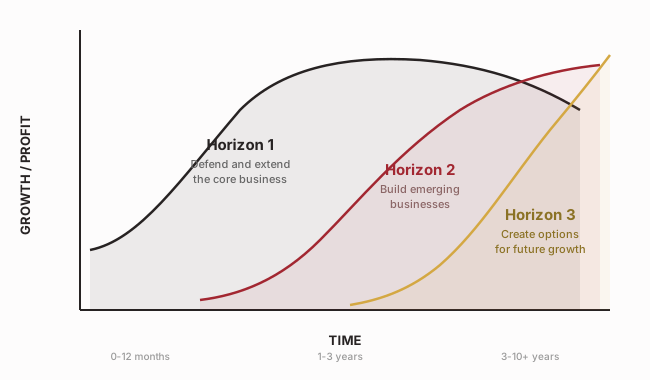
McKinsey’s 2009 “Enduring Ideas” summary, in which Coley walks through the framework, gives the working definitions:
- Horizon 1 (H1) is the core businesses, the ones that “provide the greatest profits and cash flow.” The job is “improving performance to maximize the remaining value.”
- Horizon 2 (H2) “encompasses emerging opportunities, including rising entrepreneurial ventures likely to generate substantial profits in the future but that could require considerable investment.”
- Horizon 3 (H3) is the options on future growth, which McKinsey lists as “research projects, pilot programs, or minority stakes in new businesses.”
The 1996 article’s own example was Disney’s turnaround from 1984 to 1988. Its exhibit puts raising theme park admission prices 45% and building new attractions in Horizon 1, rebuilding the animation and movie groups in Horizon 2, and the first Disney Store, direct mail experiments, and the purchase of the K-CAL television station in Horizon 3. By the time the article ran, the exhibit reports, Disney had over 500 stores worldwide and its consumer products group earned over $500 million in operating income.
Some online guides attach a 70/20/10 budget split to the horizons. Creately’s tells readers to “Implement the 70/20/10 rule as suggested in the Three Horizons Framework.” Neither the 1996 article nor the 2009 summary gives any split; the 1996 article says the right balance “depends on the industry and the company’s starting position.”
The numbers match a 2012 Harvard Business Review article by Bansi Nagji and Geoff Tuff, then at Monitor Group, which was about innovation portfolios rather than horizons. Its summary reports that outperforming firms “typically allocate about 70% of their innovation resources to core offerings, 20% to adjacent efforts, and 10% to transformational initiatives.” Use the split as a prompt for checking your own allocation, not as part of the framework.
The horizons are stages a business moves through, not permanent labels
McKinsey’s 2009 summary says the time axis shows “the cycle by which businesses and ventures move, over time, from horizon two to horizon one, or from horizon three to horizon two.” Amazon, Microsoft, and Apple each have a business that made that move, or one that didn’t.
AWS started as Amazon’s internal infrastructure and now earns most of its operating profit
In a 2016 talk written up by TechCrunch, Andy Jassy, then AWS’s CEO, traced AWS back to around 2000, when Amazon rebuilt its internal systems so its teams could use each other’s services. At a 2003 executive retreat, he said, an exercise to list the company’s core competencies turned up running infrastructure like compute, storage, and databases. “In retrospect it seems fairly obvious,” Jassy said, “but at the time I don’t think we had ever really internalized that.” Amazon announced EC2, its compute service, in August 2006.
In 2025, AWS was 18% of Amazon’s $716.9 billion in net sales and earned $45.6 billion of its $80.0 billion in operating income, according to the company’s fourth-quarter release. The two retail segments, North America and International, earned $34.4 billion between them.
Microsoft’s cloud business was already in Horizon 2 when Nadella took over
When Satya Nadella became CEO in February 2014, he had been running Microsoft’s Cloud and Enterprise group. The company’s fiscal 2014 10-K shows what he inherited. Consumer licensing revenue, mostly Windows and Office, fell for the second year in a row. Commercial Cloud, which covered Office 365 for businesses, Azure, Dynamics CRM Online, and other online Office products, brought in $2.8 billion, up from $0.7 billion two years earlier, in a company with $86.8 billion of revenue.
Office 365 had launched under Steve Ballmer in June 2011. Seven weeks into Nadella’s tenure, on March 27, 2014, Microsoft released Office for the iPad and described the day’s announcements as part of its “mobile first, cloud first approach.” Reading documents on the iPad was free, but editing them required an Office 365 subscription.
Xbox, by contrast, never became a core business. It went on sale in November 2001. Thirteen years later, in fiscal 2014, Microsoft reported Xbox Platform revenue up “$1.7 billion or 34%,” mainly on sales of the new Xbox One, which works out to roughly $6.7 billion, under 8% of the company’s revenue. Its cost of revenue rose 72% that year, about twice as fast as its revenue.
Apple’s Services grew to 42% of gross margin, while a ten-year car project never appeared in its accounts
In fiscal 2025 the iPhone brought in $209.6 billion of Apple’s $416.2 billion in net sales, according to Apple’s year-end statements. Services brought in $109.2 billion, and with cost of sales of $26.8 billion it produced $82.3 billion of Apple’s $195.2 billion in gross margin. By that measure, Services is no longer an emerging business.
Project Titan, Apple’s car effort, ran from 2014 until Apple canceled it in February 2024, and at one point had around 5,000 people working on it, according to TechCrunch. None of that showed up as a line in Apple’s financial statements, which report sales by product category and region.
Label the horizons honestly, then fund each by different rules
Label each business by its business model, not by its revenue
A company may call something H2 because it has a few customers and some revenue, when it is still an H3 experiment. Or it may describe an aging H1 business as still growing to avoid a conversation about moving capital out of it.
A practical test, which isn’t part of McKinsey’s definitions, is the business model. An H1 business has proven unit economics and generates cash; an H2 has a model that works but needs capital to scale; an H3 is still finding out whether a viable model exists at all.
When the people running a business choose its label, they have a reason to pick the generous one. Sandy Moose of BCG described the same problem from the corporate side, before the growth-share matrix gave executives a way to check: “Top management knew that the plans that were coming up from each unit seemed unrealistic, but they didn’t know how to push back,” she says in Walter Kiechel’s The Lords of Strategy.
When you label an H3 bet, also say what kind of new it is. The Ansoff matrix separates new products from new markets, and risk rises with each step away from what the company already knows. If every H3 bet in a portfolio is a new product for a new market, the whole portfolio sits in the matrix’s riskiest box.
Each horizon needs different metrics and different managers
The 1996 article describes the conflict:
The types of targets, strategies, people, performance metrics, and incentive systems appropriate to creating medium- or long-term options are often at odds with those needed to drive short-term performance.
Run the core for efficiency and cash, measure it on margins, market share, and return on invested capital, and put operators rather than entrepreneurs in charge of it.
An emerging business is past the experimental phase but nowhere near the scale where those measures apply. If it is held to core-business margins, it won’t qualify for the capital it needs to scale. Customer growth, the direction of its unit economics, and its position against whoever else is chasing the same opening tell you more.
Options need small amounts of capital, a tolerance for failure, and a budget line that H1 managers can’t raid, because in a bad quarter they are the easiest spending to cut.
Fixed timelines are the weak part, and the 1996 original said years vary by industry
The 1996 article handled time this way:
The number of years in each horizon will vary among industries. In slowly evolving, capital-intensive basic materials sectors such as pulp and paper or chemicals, the tail of the first horizon may be five or ten years out. Hyper-evolutionary software, electronics, or Internet businesses may see their third horizon as close as five years away.
McKinsey’s 2009 summary adds that time on the chart “should not be interpreted as a prompt for when to pay attention—now, later, or much later.” Some organizations turned it into a schedule anyway. Steve Blank, who developed the customer development model for startups, described the practice in 2019:
In the past we assigned relative delivery time to each of the Horizons. For example, some organizations defined Horizon 1 as new features that could be delivered in 3-12 months; Horizon 2 as business/mission model extensions 24-36 months out; and Horizon 3 as creating new disruptive products/business/mission models 36-72 months out.
Think Insights puts the same three horizons at 0-2, 2-5, and 5-10 years instead.
Blank called the clock a fatal flaw, and Baghai replied that it was never fixed
Blank’s argument was that “Today, disruption – Horizon 3 ideas – can be delivered as fast as Horizon 1 ideas.” His examples are businesses built quickly from existing technology: “In the commercial space AirBnB, Uber, Craigslist, Tesla, and the explosion of machine learning solutions … are examples of radical disruption using existing technologies in extremely short periods of time.”
Baghai answered in the comments under Blank’s post on January 14, 2019. He wrote that “we created the Three Horizons as a growth strategy framework, not an innovation framework,” and on timing:
In the book, we pointed out that every company needs to decide what the right timing for each Horizon should be. For example, we believed some forest product companies we [sic] looking at Horizon 3 being 10-20 years away while semi-conductor companies looked at Horizon 3 being 18 months away. The way to address your observation is by adjusting the timing of the Horizons. They were never intended to be fixed as your post appears to suggest.
Blank replied the same day that “over the years time have become associated with each of the horizons” and that he “was trying to send a message that it was detrimental to do so.” He kept the framework, calling it “still very useful as a shorthand for prioritizing innovation initiatives,” and his prescription was that organizations “need to focus on speed of delivery and deployment across all three horizons.”
The chart tracks only your own businesses, not a challenger’s Horizon 3
Blank argues that rapid Horizon 3 disruption “is most often used not by the market leaders but by the challengers/new entrants,” which leaves incumbents facing “a new competitor/threat that obsoletes their existing product line/infrastructure/business/mission model.” His four responses for incumbents are to “incentivize external resources,” “acquire external innovators,” “rapidly copy,” or “innovate better than the disrupters.”
Porter’s five forces covers that ground through the threat of new entrants and the threat of substitutes.
The test is whether the budget matches the strategy
The framework won’t tell you which H3 bets will work or when your H1 business will roll over. What it asks is what you are doing today to build the business you’ll need when the current one slows.
To answer it, list the specific initiatives in each horizon and put the actual budget next to each one. Two results mean the strategy isn’t funded: no H3 initiative with its own budget, or an H2 list made up of projects that have never had a customer.
Recommended reading
Baghai, Coley, and White’s “Staircases to growth” (1996) is the article version, with the Disney example and the original staircase exhibit. Their book, The Alchemy of Growth (1999), is the full treatment, and it is what to read if you plan to use the three horizons seriously, rather than another summary of it, mine included. Steve Blank’s 2019 critique of the time-horizon flaw is the best short argument against applying it literally; read it with Baghai’s reply in the comments. For how McKinsey and its competitors came to build frameworks like this one, Walter Kiechel’s The Lords of Strategy is the history, though it doesn’t cover the three horizons.
The course
Think Like a Strategy Consultant
Structured problem solving, MECE, the Pyramid Principle, and slides that make a point, in one self-paced video course. 1,400+ students in 65 countries.
Or 2 payments of $398.
Watch a free lesson from Think Like A Strategy Consultant →Free
Start with the email course
Six short lessons on consulting fundamentals, one a day.