
Michael Porter: the academic who rewired how business thinks about competition

Michael Porter is the most cited scholar in economics and business. His first book, Competitive Strategy, is in its 60th printing. Half the MBAs at Harvard were taking his course by the mid-1980s. And he didn’t start in business at all.
Porter’s career is worth understanding not because of the accolades but because of how many times he applied the same style of thinking to completely different problems. He started with industry competition, moved to national economic development, then healthcare, then inner-city poverty, then political dysfunction. Each time the pattern was the same: take a messy problem, find the structural forces driving it, and build a framework that practitioners can use. Whether that pattern actually works in every domain is a fair question, and one his critics have been asking for decades.
The unlikely path to strategy
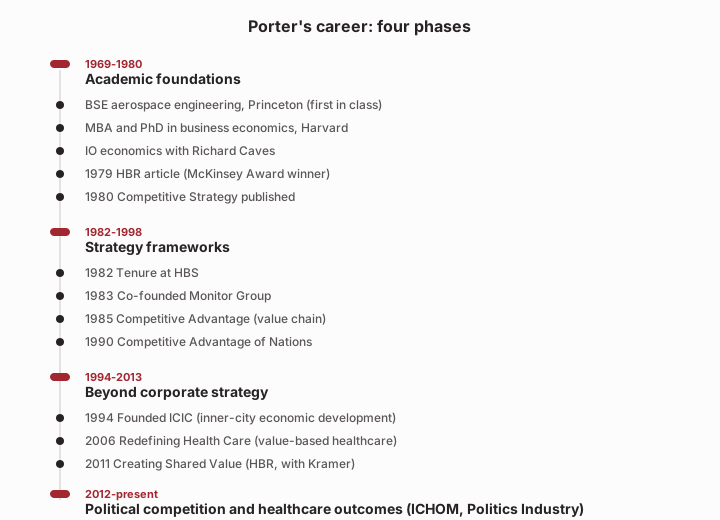
Porter grew up an army brat. His father was a civil engineer and military officer, and the family moved constantly. His defining activity growing up was sports: football, baseball, basketball, and eventually golf. He was good enough at golf to make the NCAA All-American team at Princeton, where he studied aerospace and mechanical engineering and finished first in his class.
A Princeton economics professor, Burton Malkiel, told him to go to Harvard Business School. Porter did, earned his MBA with high distinction, and then made an unusual choice. Instead of the standard Doctor of Business Administration track, he enrolled in the PhD program in business economics, housed in Harvard’s economics department. That put him in contact with a different set of ideas than most business school faculty ever encounter.
The one that mattered most was industrial organization economics. Porter took a course with Richard Caves, and later described it as a “surreal experience.”1 IO economics, developed by Harvard’s Edward Mason in the 1930s and extended by Joe Bain in the 1950s, studied a question that most business professors weren’t asking: why are some industries structurally more profitable than others?
But IO economists studied this from a regulator’s perspective. High profits were a sign of market failure, something to fix through antitrust policy. Porter saw it from the opposite direction. If industry structure determines profitability, then companies should understand that structure and position themselves where the forces are most favorable. As Walter Kiechel puts it in Lords of Strategy, Porter’s move was to “turn it on its head.”
Five forces and the fight for recognition
Porter’s 1975 research paper laying out the five forces framework was called “a noble experiment that failed” by a senior business school professor.2 When he came up for associate professor, all but one of the Business Policy faculty voted against him. The Harvard economics department respected his work. The business school mostly didn’t.
His career was saved by John McArthur, who would later become dean. McArthur moved Porter into nondegree executive education programs, where his ideas connected immediately with practicing managers. His Industry and Competitive Analysis course launched in 1978 and was oversubscribed from day one. By 1986, nearly 2,700 students, about half the graduating MBAs, were taking it.
The 1979 Harvard Business Review article “How Competitive Forces Shape Strategy” won the McKinsey Award as the best article of the year. Competitive Strategy was published in 1980. Porter got tenure in 1982. The faculty who voted against him had to watch their students line up for his class.
What made the five forces framework different from other strategy tools at the time was that it came from economics, not from consulting practice. BCG had the growth-share matrix and the experience curve. McKinsey had the 7S framework. These were useful but they came out of client work and pattern recognition. Porter’s framework came out of a 50-year academic tradition in industrial organization, which gave it a theoretical foundation that the consulting frameworks lacked.
Porter himself acknowledged the limitation of that first book. He later admitted that Competitive Strategy is “basically a book about industries, because that’s what I’d worked with.”3 The question it couldn’t answer was how an individual company should position itself within an industry. That came five years later with Competitive Advantage in 1985, which introduced the value chain and the distinction between cost leadership and differentiation strategies.
Beyond industries: nations, cities, healthcare
What’s unusual about Porter’s career is how far he pushed the same analytical method beyond corporate strategy.
National competitiveness. The Competitive Advantage of Nations (1990) asked why certain countries dominate certain industries. Why is Italy strong in leather goods? Why does Germany lead in printing presses? Porter’s answer, the “diamond model,” identified four structural factors: factor conditions, demand conditions, related industries, and firm strategy/rivalry. The book made him a public intellectual in a way that Competitive Strategy hadn’t.
Inner cities. In 1994, Porter founded the Initiative for a Competitive Inner City (ICIC), arguing that urban economic development should be driven by competitive advantages, not charity. He applied the same logic: what structural factors make inner-city locations viable for business? The initiative still operates and Porter still chairs it.
Healthcare. This became his biggest project outside of corporate strategy. Redefining Health Care (2006, with Elizabeth Teisberg) argued that healthcare delivery is broken because providers compete on the wrong things. Instead of competing on value, meaning patient outcomes relative to cost, they compete on access to patients, bargaining leverage with payers, and cost shifting. Porter proposed reorganizing healthcare around integrated practice units that measure and compete on outcomes.
In 2012, he co-founded the International Consortium for Health Outcomes Measurement (ICHOM) to build global standards for measuring what actually matters in healthcare. The value-based healthcare framework has been adopted by health systems in multiple countries. It’s the same pattern as five forces: find the structural problem, build a framework, get practitioners to use it.
Creating shared value. In 2011, Porter and Mark Kramer published “Creating Shared Value” in Harvard Business Review, arguing that companies can generate economic value by addressing social problems. Not philanthropy or CSR, but rethinking products and supply chains to serve social needs profitably. Nestle, for example, worked with small farmers to improve agricultural practices, which reduced procurement costs while raising farmer incomes.
Political competition. His most recent book, The Politics Industry (2020, with Katherine Gehl), applies five forces to American politics. The argument: the political system is a duopoly where the two parties have co-created rules (closed primaries, plurality voting, gerrymandering) that protect incumbents and block new competition. Gehl and Porter proposed “Final Five Voting,” which combines open primaries with ranked-choice general elections. Alaska adopted it. Several other states are considering it.
Monitor Group: the theory meets reality
The Monitor Group story is the obvious counterargument to Porter’s entire body of work.
Porter co-founded Monitor in 1983 to bring his frameworks directly to corporate clients. The firm grew to about $300 million in revenue and operated in dozens of countries. Then it collapsed.
In 2011, Monitor admitted that the Libyan government under Muammar Gaddafi had paid the firm roughly $250,000 a month from 2006 to 2008. The contracts were for a campaign to, as a Monitor memo to Libya’s intelligence chief put it, “enhance international understanding and appreciation of Libya” and “introduce Muammar Gaddafi as a thinker and intellectual.”4
The Libya work wasn’t the sole cause of the bankruptcy. Monitor had been losing money since 2009, had borrowed at high interest rates, and by late 2012 was struggling to make payroll. But the Libya story destroyed the firm’s reputation. In November 2012, Monitor filed for Chapter 11 bankruptcy and was acquired by Deloitte in January 2013. It now operates as Monitor Deloitte.
The irony was noted widely at the time. The man who built the most cited framework for analyzing competitive forces co-founded a firm that couldn’t survive its own competitive environment. Steve Denning wrote a piece in Forbes asking what killed Monitor, arguing that the one force Porter missed was the force of managerial hubris.5
I think this critique is a bit harsh. Around the same time, a number of mid-size boutique firms either got acquired or had a similar fate. As I wrote in my history of strategy consulting, the industry has gone through many waves of consolidation and innovation. Parthenon, Booz & Co, and PRTM were all absorbed by big four accounting firms in the same period. Consulting is simply a hard business because it relies on a steady matching of growth, high payroll costs, and client inflows. Monitor’s collapse was real, and the Libya work was indefensible, but the narrative that it proved Porter’s frameworks wrong is too neat.
The critics
Porter has attracted serious critics because he made serious claims.
Henry Mintzberg argued for decades that Porter’s approach, which Mintzberg called the “positioning school,” was too analytical and too disconnected from the messy reality of how strategy actually gets made. Strategy, in Mintzberg’s view, is an emergent process that comes from doing and learning, not from analyzing industry structure in a conference room. Porter’s response was blunt: “I completely reject the premise of his argument.”6
Gary Hamel and C.K. Prahalad challenged Porter from a different angle with their “core competence” concept in 1990. They argued that competitive advantage comes from inside the company, from unique capabilities built over time, not from positioning within an external industry structure. A company like Honda wasn’t successful because of industry positioning. It was successful because of its deep competence in engines, which it deployed across motorcycles, cars, lawnmowers, and generators.
Adam Brandenburger and Barry Nalebuff at Yale pointed out that five forces treats all relationships as competitive and misses the cooperative dimension. Their “co-opetition” framework added complements as a sixth force. Intel and Microsoft are competitors in some respects but complements in a more important one: each makes the other’s product more valuable.
Porter resisted all of these modifications. He argued that complements aren’t a separate force, that core competencies without positioning are meaningless, and that emergent strategy is what you end up with when you haven’t done the analytical work. Whether you find this principled or stubborn depends on your view of how strategy works.
What he actually changed
The thing that’s easy to miss about Porter’s influence is how much of it is now invisible because it’s been absorbed. Before Competitive Strategy, the standard tools for strategic analysis were SWOT and whatever frameworks individual consulting firms had developed for their own use. There was no widely shared, analytically grounded vocabulary for talking about competition.
Porter gave business a common language: barriers to entry, switching costs, buyer power, supplier power, substitute threats, value chain, cost leadership, differentiation. As he described his own mission in Lords of Strategy, he wanted to make strategic thinking accessible to people “who weren’t geniuses and hadn’t been doing it all their lives.”
The history of strategy consulting shows that most of the big ideas came from practitioners, not academics. BCG’s growth-share matrix, the experience curve, Bain’s long-term partnership model. Porter is the exception: an academic whose ideas became the industry’s operating vocabulary. His frameworks appear in the five forces bullet point on the consulting history timeline almost as an afterthought, but they reshaped how an entire profession thinks about competition.
Whether the analytical approach to strategy is sufficient is a genuine debate. But the debate itself happens in the language Porter created.
Footnotes
Walter Kiechel, Lords of Strategy. ↩
Walter Kiechel, Lords of Strategy. ↩
Walter Kiechel, Lords of Strategy. ↩
Reported by Farah Stockman, Boston Globe, based on Monitor’s Foreign Agents Registration Act filings. ↩
Steve Denning, “What Killed Michael Porter’s Monitor Group?”, Forbes, November 2012. ↩
Walter Kiechel, Lords of Strategy. ↩