The OODA Loop: a practical guide to Boyd's decision-making framework
The OODA Loop is a decision-making framework developed by Air Force Colonel John Boyd. It stands for Observe, Orient, Decide, Act, and it’s usually presented as a simple four-step cycle. But Boyd’s actual model is richer than that: it has feedback loops running in multiple directions, a phase that can be skipped entirely, and one element, Orientation, that shapes everything else.
Boyd never published a book. He spread his ideas through briefings, some of them six hours long, delivered to military officers, Pentagon officials, and anyone else who would listen. The only diagram he ever drew of the OODA Loop appeared in a 1995 briefing titled “The Essence of Winning and Losing.” It’s worth understanding the full version, because the parts that usually get left out are the parts that make it useful.
The origin and the idea
John Boyd was born in Erie, Pennsylvania, in 1927. He enlisted in the Army Air Forces in 1944, served briefly in occupied Japan, and graduated from the University of Iowa in 1951 with an economics degree and an Air Force commission through ROTC.
His Korean War service was short. Boyd arrived at the 51st Fighter Interceptor Wing on March 27, 1953, flew 22 missions in F-86 Sabres, and never encountered enemy aircraft in aerial combat before the armistice took effect four months later. His reputation as a fighter pilot came later, not from combat, but from teaching.
From 1956 to 1960, Boyd served as an instructor at the Fighter Weapons School at Nellis Air Force Base. He earned the nickname “Forty-Second Boyd” from a standing bet: starting from a position of disadvantage, he could defeat any opposing pilot in simulated air combat in under 40 seconds. As Robert Coram recounts in Boyd: The Fighter Pilot Who Changed the Art of War, no one ever collected.
What made Boyd unusual among fighter pilots was that he wanted to understand why he kept winning. In the early 1960s, working with mathematician Thomas Christie at Eglin Air Force Base, Boyd developed Energy-Maneuverability (E-M) theory, a mathematical framework for comparing aircraft performance. E-M theory used specific energy states to explain why certain aircraft could outmaneuver others in combat, and it directly influenced the design of the F-15 Eagle and F-16 Fighting Falcon.
Boyd retired from the Air Force in 1975 as a Colonel, then spent the next two decades as a Pentagon civilian consultant, at one point refusing his salary for about five years because he didn’t want to be called a “double dipper.” He died of cancer in 1997 and was buried at Arlington National Cemetery.
The briefings, not the book
Boyd’s body of work, which he titled “A Discourse on Winning and Losing” in the late 1980s, consists entirely of briefings and one short essay:
- “Destruction and Creation” (1976) — his only written essay, seven pages drawing on Godel’s Incompleteness Theorems and the Second Law of Thermodynamics to argue that we must continually destroy old mental models and build new ones to cope with a changing environment.
- “Patterns of Conflict” (first presented 1976) — a six-hour, 196-slide briefing tracing the history of conflict from Sun Tzu through blitzkrieg to modern warfare. This was the briefing that changed how the U.S. Marine Corps thought about war.
- “The Essence of Winning and Losing” (1995) — his final briefing, which contains the only diagram Boyd ever drew of the OODA Loop.
These were published posthumously as a collected volume by Air University Press in 2018, edited by Grant Hammond. Boyd’s ideas spread the old-fashioned way: person to person, briefing room to briefing room.
The framework
The textbook version of the OODA Loop is four steps in a circle: Observe, Orient, Decide, Act, repeat. Boyd’s actual model is different in three ways that matter.
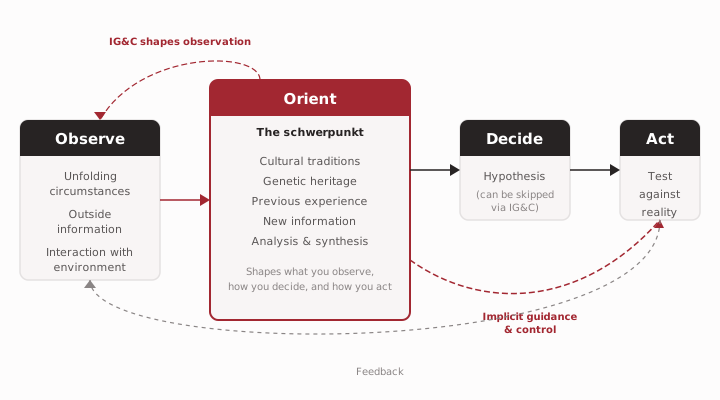
Observe. Take in information from the environment: unfolding circumstances, outside information, and your interaction with the world around you. This sounds passive, but it isn’t. What you notice is shaped by your orientation, which means two people looking at the same situation can observe very different things.
Orient. This is what Boyd called the schwerpunkt (focal point) of the entire loop. In Boyd’s diagram, every feedback loop flows through Orientation. It’s not just one step in a sequence; it’s the center of gravity of the whole system.
Boyd broke Orientation into five interconnected elements:
- Cultural traditions — the shared assumptions of your organization, industry, or society
- Genetic heritage — your innate cognitive tendencies and temperament
- Previous experience — what you’ve seen work and fail before
- New information — data coming in from the current situation
- Analysis and synthesis — the process of breaking apart old mental models and constructing new ones (the subject of his 1976 essay “Destruction and Creation”)
The quality of your orientation determines the quality of everything else. Two analysts looking at the same industry data will reach different conclusions depending on their experience, their assumptions, and how willing they are to update their mental models. This is the same principle behind critical thinking as a deliberate practice: creating space to examine and revise how you interpret what you see.
Decide. Develop a hypothesis or plan of action. But here’s the part most summaries leave out: in Boyd’s diagram, there is a line going directly from Orient to Act, bypassing Decide entirely. Boyd called this “Implicit Guidance and Control” (IG&C). When someone has deep expertise in a domain, they can recognize a pattern and act on it without conscious deliberation. This isn’t recklessness. It’s trained intuition flowing from deep orientation.
This connects to something observable in high-performing consulting teams. When team members share mental models and have built trust through iteration and feedback, they can coordinate without stopping to discuss every decision. The “Decide” step collapses because orientation is already shared.
Act. Test your hypothesis against reality. Action generates new information, which feeds back into Observation, and the loop continues.
What makes it a loop (and not a cycle)
The popular version implies a clean sequence: observe, then orient, then decide, then act, then start over. Boyd’s version has feedback running in multiple directions simultaneously. Orientation shapes what you observe. Action generates new observations. Orientation can bypass the decision step entirely. The system is continuous and overlapping, not sequential.
Boyd argued that competitive advantage comes from better orientation: seeing things your opponent misses, acting on patterns they haven’t recognized, and generating confusion by behaving in ways their mental models can’t predict.
Why this matters (with examples)
The Gulf War left hook
In 1990, after Iraq’s invasion of Kuwait, Secretary of Defense Dick Cheney called Boyd back as a special advisor. Cheney had first heard Boyd’s “Patterns of Conflict” briefing in 1981, when he was a member of Congress.
The initial plan for Operation Desert Storm was a direct thrust into Iraqi-held Kuwait. According to accounts in Coram’s biography, Boyd influenced the shift to what became the “left hook” strategy: a Marine feint of an amphibious assault on Kuwait as a diversion, while U.S. Army ground forces made a 150-mile sweep west into Iraq, then swung north to cut off supply lines and retreat routes for Republican Guard troops.
The ground war lasted 100 hours. The strategy worked in part because Iraq’s command structure couldn’t reorient fast enough. By the time Iraqi commanders understood what was happening on one front, the situation had already changed on another. Boyd’s exact role in the planning is debated, but the strategy itself is a textbook case of operating inside an adversary’s decision cycle.
Marine Corps doctrine
Boyd’s most concrete institutional impact was on the U.S. Marine Corps. General Alfred M. Gray, after hearing Boyd’s briefings, made maneuver warfare the official doctrinal foundation of the Corps. In 1989, the Marines published FMFM-1 “Warfighting,” drafted by Captain John Schmitt under Gray’s direction and heavily influenced by Boyd’s ideas.
The doctrine emphasized Auftragstaktik (mission-type orders), one of four German military concepts Boyd identified as foundations for high-tempo operations. The idea: commanders communicate intent, and subordinates decide how to achieve it. This pushes decision-making down to the people closest to the action, which compresses the loop by eliminating the delay of waiting for orders from above.
Zara: 15 days from design to store
Zara, the Spanish fast-fashion retailer, is the clearest business example of OODA thinking in action, even though the company never explicitly cites Boyd.
Traditional fashion retailers operate on a 4-6 month design-to-store cycle. Zara compresses this to as little as 15 days. Store managers report what’s selling and what isn’t twice per week, and that data drives factory scheduling directly. The company manufactures over 450 million products per year, selecting from about 12,000 new designs.
Zara turns inventory 12 times per year versus 3-4 for competitors. It sells 85% of items at full price versus an industry average of 60%. The speed matters, but the orientation matters more. Zara’s system is designed so that information about what customers actually want flows back into design decisions faster than competitors can process it. The observe-orient cycle is compressed, and the company acts on what it learns before competitors have even noticed the signal.
Boyd’s associate Chet Richards, who helped construct the first graphics of the OODA Loop, made this connection explicitly in Certain to Win. Richards argued that Toyota, Dell, and Southwest Airlines all operated on principles similar to Boyd’s, using time as their principal strategic device and building organizational cultures around trust, initiative, and shared understanding.
Bezos and the 70% rule
Jeff Bezos articulated something parallel to OODA thinking in his annual letters to Amazon shareholders, though without citing Boyd directly. In his 2016 letter, Bezos wrote that most decisions should be made with approximately 70% of the information you wish you had. “If you wait for 90%, in most cases, you’re probably being slow.”
In his 2015 letter, Bezos distinguished between what he called Type 1 decisions (irreversible, one-way doors that require careful deliberation) and Type 2 decisions (reversible, two-way doors that should be made quickly by small groups). This maps onto Boyd’s framework: for Type 2 decisions, you orient on the available information, act, observe the results, and adjust. Waiting for complete information means your competitors have already moved.
Amazon’s “two-pizza teams,” small enough to be fed with two pizzas, are an organizational structure built for this kind of rapid cycling. Small teams with clear ownership can observe, orient, and act without the delays of large-group consensus.
Where the framework breaks down
The OODA Loop was born from air combat, where milliseconds matter and the feedback from action is immediate. Not every situation works that way.
Aviation historian Michael Hankins, writing on his blog From Balloons to Drones, has pointed out that the framework “is vague enough that its defenders and attackers can each see what they want to see in it.” Hankins also challenged one of the foundational claims used to support Boyd’s theories: the supposedly 10:1 kill ratio of F-86 Sabres against MiG-15s in Korea. The actual ratio was almost certainly lower, though still in the U.S.’s favor. This matters because the Sabre-versus-MiG example was the most prominent piece of evidence Boyd used to argue that the pilot’s ability to transition between maneuvers (a form of faster orientation) mattered more than raw aircraft performance.
Venkatesh Rao, who has written about Boyd extensively across Contraptions and Ribbonfarm, calls the OODA Loop “probably the most misunderstood and misused diagram of practical significance in decision making.” He identifies three common misreadings:
Those who can, do. Those who can’t, diagram the situation.
That’s the “bureaucratic misreading”:
The bureaucratic way to read the diagram is to fussily fetishize all its arrows and annotations, in an effort to force-fit all situations to it. … As with all bureaucratic misreadings, this is a case of fetishizing the map to the point that you become blind to the territory.
The second is “mystical”: mining Boyd’s cryptic pronouncements to divine “What Would Boyd Do?”
And the third, most common in business, is what Rao calls “agility bookkeeping”:
This kind of misreading is most common in Silicon Valley, where you view a simplified version of the diagram, shorn of all its rich interconnections, parallelism (O, O, D, A all happening in parallel all the time, with varying intensities) and nonlinearities as a sort of circular stage-clock to replace the phase-gate roadmaps of waterfall planning.
What time is it? It is Orient o’clock. Let’s meet for dinner at Decide o’clock.
Once OODA becomes a stage-clock, speed becomes the metric. Rao flags where that leads:
This error most often arises from the book-keeping misreading. It results from optimizing for the metric of “iteration rate” or more subtly, “learning rate,” in a context-blind way. And as we know from Goodhart’s Law, once a measure becomes a metric, it ceases to be a good measure.
You should aim to operate at a faster tempo in some situations all of the time, all situations some of the time, but not all the situations, all the time.
Counterinsurgency, diplomacy, and long-term organizational strategy all involve time horizons where “cycling faster” isn’t the right goal. Rao argues that OODA is better understood as a diagnostic tool than a process framework. In his Ribbonfarm workshop on Boyd, he describes it as “a sort of mandala/mindfulness aid to keep your decision-making creatively and imaginatively aware,” and warns against reducing it to a cookbook formula. “OODA thinking is a skilled activity for prepared live players,” he writes. “It takes imagination and actual work to use.”
Frans Osinga, a Dutch Air Force officer who wrote the most rigorous academic treatment of Boyd’s work in Science, Strategy and War, argues that most critiques hit the simplified version of OODA, not Boyd’s actual theory. Osinga’s central claim is that Boyd’s work is “much more comprehensive, richer and deeper than is generally thought,” drawing on thermodynamics, information theory, evolutionary biology, and complexity science. The popular version, four boxes in a circle, strips out most of what made Boyd’s thinking original.
How to think about it
Boyd’s priority hierarchy was “people, ideas, hardware, in that order.” The OODA Loop follows the same logic. The Orient phase is where the real work happens, and it’s a function of the people involved: their experience, their assumptions, and how willing they are to revise what they think they know. Two analysts with the same data and the same consulting frameworks will reach different conclusions depending on how they orient.
In consulting terms, this is the difference between jumping straight to a solution and spending time on problem definition and scoping. Teams that invest in orientation, examining assumptions, updating mental models, tend to outperform teams that just move fast. The experience curve applies here too: the more cycles a team runs together, the more shared context they build, and the faster the loop gets without anyone trying to speed it up.
The practical question the OODA Loop poses is simple: when was the last time you or your team revisited the assumptions behind what you’re doing? If the answer is “not recently,” that’s the part of the loop worth attention.
Recommended reading
Robert Coram’s Boyd: The Fighter Pilot Who Changed the Art of War is the best entry point, a biography that reads like a novel. Grant Hammond’s The Mind of War is better on the ideas themselves. Chet Richards’ Certain to Win translates Boyd’s concepts for business. For the academic deep-dive, Frans Osinga’s Science, Strategy and War is the most thorough treatment of what Boyd actually said and why it matters.
Boyd’s own briefings are available through the Colonel Boyd Digital Archive and were collected in A Discourse on Winning and Losing, published by Air University Press in 2018.