PESTEL analysis: how to scan the forces outside an industry
On September 3, 2026, Volkswagen’s supervisory board approved what the company calls “the most comprehensive and far-reaching transformation program in the Group’s history.” The Future Plan 2030 cuts the model lineup by up to half, adds around 50,000 job cuts to programs already agreed, and says four German plants have no guaranteed follow-on production from 2031 to 2034. Under the question “Why is a new plan necessary now?”, Volkswagen gives this answer:
Geopolitical tensions, rising costs – driven primarily by tariffs – growing regulatory requirements, and an increasingly intense global competitive environment have compounded the challenges facing the automotive industry in an already far-reaching phase of transformation.
Only the last of those four is about competitors. The other three come from outside the industry, and no carmaker controls them.
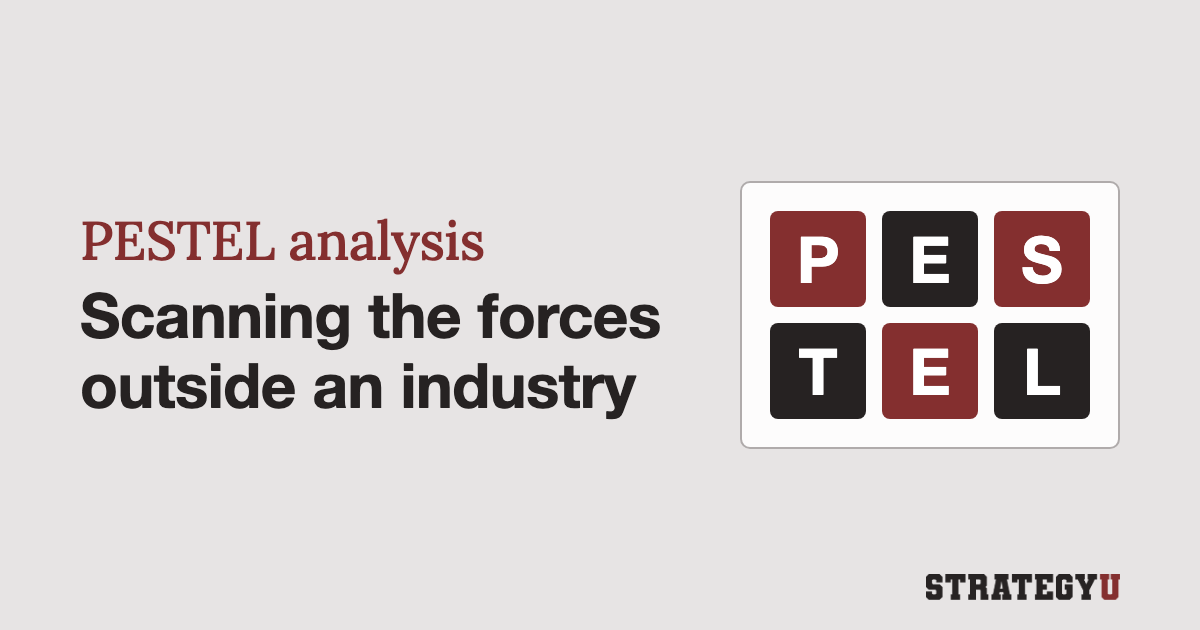
PESTEL is a checklist for that second kind of force. It asks what political, economic, social, technological, environmental, and legal changes could alter an industry’s economics.
PESTEL is credited to Aguilar’s 1967 study of how managers scan the world outside the company
Francis J. Aguilar joined the Harvard Business School faculty in 1964 and published Scanning the Business Environment in 1967. The school’s obituary for him describes the book as a study of how companies “acquire and use information about external events and trends to aid in strategic planning.”
Chun Wei Choo, whose model of organizational scanning extends Aguilar’s work and later research by Daft and Weick, writes that Aguilar “identified four modes of managerial scanning based on his field research,” and credits him with the terms “undirected viewing” and “conditioned viewing” for the more passive ones.
Wikipedia’s entry credits Aguilar with developing PEST in 1967 and says it has also been called ETPS. Environmental and Legal were added at some point after that, and I haven’t found where they originated from, but they do seem to be accepted now.
The framework closest to it is Porter’s Five Forces, which Porter published in the Harvard Business Review in 1979, and the two work at different levels. Five Forces looks at competition inside an industry: rivalry, suppliers, buyers, substitutes, and new entrants. PESTEL looks at the conditions around the industry, which no competitor controls and all of them have to deal with.
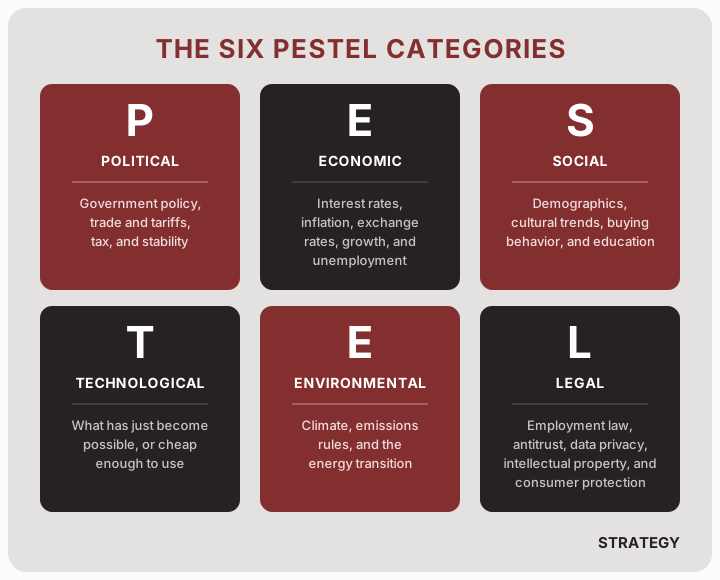
Political covers government policy, trade and tariffs, tax, and stability. Economic covers interest rates, inflation, exchange rates, growth, and unemployment. Social covers demographics, cultural trends, buying behavior, and education. Technological covers what has just become possible, or cheap enough to use. Environmental covers climate, emissions rules, and the energy transition. Legal covers employment law, antitrust, data privacy, intellectual property, and consumer protection.
An emissions rule is environmental and legal, and a tariff is political and economic. The categories are there to stop you from missing something, so where a factor gets filed matters less than whether it shows up at all.
The forces PESTEL catches apply to a whole industry, whoever is winning inside it
EU car rules put a price on every gram of CO2, and the 2035 target is still moving
The EU made fleet-average CO2 targets for new cars binding in Regulation 443/2009, replacing voluntary commitments by the carmakers: 130 grams per kilometer, with penalties from 2012, and 95 grams from 2020. Under the current rules, Regulation 2019/631, a carmaker whose fleet average comes in above its target pays an excess emissions premium of 95 euros for each gram per kilometer over, multiplied by every new car it registered that year. For a company registering two million cars, one gram over would cost 190 million euros.
A 2023 revision set a 100% cut in new-car CO2 emissions by 2035 against 2021 levels, which only electric and hydrogen-powered cars can meet. According to the European Parliament’s research briefing, the EU agreed in June 2025 to let carmakers average their 2025, 2026, and 2027 results rather than meet each year’s target separately. In October 2025 Germany and Italy sent the Commission a joint letter calling for efficient combustion engines to be allowed after 2035, and in December 2025 the Commission proposed cutting the 2035 requirement to 90%, with the remaining 10% offset by credits for EU-made low-carbon steel and renewable fuels.
As of October 2026 that proposal is still in Parliament’s environment committee, with a first-reading plenary vote penciled in for November 23, according to the Legislative Observatory. Whether any combustion or hybrid cars can be sold in the EU after 2035 is now up to Parliament and the Council.
Dieselgate changed how every diesel maker in the U.S. was tested
On September 18, 2015, the EPA issued Volkswagen a notice of violation over software in 2.0-liter diesel cars from model years 2009 to 2015 that recognized when the car was being tested and ran the full emissions controls only then. In normal driving, the EPA said, the cars emitted nitrogen oxides at “levels up to 40 times the standard.” Volkswagen’s 2020 annual report says gaps between test and road figures were found in about 11 million cars worldwide that used its EA 189 diesel engine.
The U.S. settlements covered about 590,000 diesel vehicles from model years 2009 to 2016. Volkswagen had to buy back or fix the 2.0-liter cars, fund a $2.7 billion mitigation trust, invest $2 billion in zero-emission vehicle charging and promotion, and pay a $1.45 billion civil penalty, alongside a criminal plea agreement with the Justice Department. By March 2020 Volkswagen said the scandal had cost it 31.3 billion euros in fines and settlements, Reuters reported.
A week after the first notice, on September 25, 2015, the EPA said defeat-device screening would be part of its compliance oversight from then on. With the California Air Resources Board and Environment Canada, it also began testing all current model-year 2015 and 2016 light-duty diesel vehicles for defeat devices. No new law was involved, since the Clean Air Act already prohibited defeat devices; the change was in how the EPA checked every manufacturer’s compliance.
Meta’s 1.2 billion euro GDPR fine was pushed by regulators outside Ireland
The General Data Protection Regulation has applied since May 25, 2018. It covers companies established in the EU and, under Article 3, companies outside the EU that offer goods or services to people in the EU or monitor their behavior there. Under Article 83, fines for the most serious breaches go up to 20 million euros or 4% of worldwide annual turnover, whichever is higher.
In May 2023 Ireland’s Data Protection Commission fined Meta 1.2 billion euros for continuing to transfer Facebook users’ personal data from the EU to the U.S. The commission’s own announcement shows that its draft decision proposed suspending the transfers without a fine, and that the fine followed a ruling by the European Data Protection Board after four of the 47 other European regulators reviewing the draft objected. GDPR’s cooperation and dispute procedures, in Articles 60 and 65, mean a cross-border case is not decided by the home regulator alone. For any company handling Europeans’ data, the legal risk depends on how other European regulators read the law, not only the one in the country where it is based.
A PESTEL that could describe ten industries is not an analysis
Name what is changing, and what it does to this industry’s economics
Go through each letter, write the obvious thing under each heading, and you get a document that is complete and says nothing:
- Political: the regulatory environment is complex.
- Economic: interest rates are rising.
- Social: consumers are more health-conscious.
Every line of that is true of pharmaceuticals, airlines, and grocery retail at the same time.
The environmental line for European carmakers, written from the case above, gives a finance team something to model: each gram per kilometer over a fleet target costs 95 euros a car, the 2025 to 2027 targets can be averaged, and the 2035 target may drop from 100% to 90% with credits for steel and fuels.
Only the factors that are both large and fast need attention now
After listing the factors, rank each one on two questions: how much could it change the industry’s economics, and how fast is it arriving? The factors that score high on both get worked on now. One with high impact that is arriving slowly needs someone watching it, and everything else gets noted and set aside.
A macro factor matters once you can trace it to the profit pool
A new regulation can raise barriers to entry, a new technology can create a substitute, and a recession makes buyers more sensitive to price, so each of those shows up as a change in one of Porter’s five forces. In Walter Kiechel’s The Lords of Strategy, Porter describes “industry, technology, and consumer forces and all these outside forces” as “always acting on the five.”
For each factor worth keeping, write down the chain from the outside change to the force it moves to the effect on industry profits. That chain is how PESTEL connects to the other industry analysis frameworks.
A one-year scan and a ten-year scan surface different factors
Set the period before you start. Interest rate moves matter over the next twelve months, while demographic shifts play out over decades. A SWOT analysis done after a PESTEL scan is better grounded, because its threats and opportunities come from named outside forces rather than general mentions of market trends.
Six filled boxes create a false sense of coverage
If the team doesn’t know what it’s looking for, six categories and their subcategories turn PESTEL into a data collection exercise that never reaches a conclusion.
It is also static, like SWOT. It records conditions at one point in time and doesn’t model how they interact or change. The EU’s car CO2 rules are a PESTEL finding, and the fact that they have been loosened once since 2023 and are being renegotiated again is what a snapshot misses. In a 2006 paper on the limitations of PEST and its derivatives, George Burt and four co-authors wrote that the literature and textbooks on a company’s wider environment “lack unequivocal conceptual and practical guidance for managers,” and proposed scenario planning as the alternative.
Ranking the factors does not fix this, because the ranking is a judgment made at the same moment as the list. The World Economic Forum’s Global Risks Report 2020, released in January 2020, two months before the World Health Organization declared COVID-19 a pandemic, and built on a perception survey of about 800 members of the Forum’s communities, had infectious diseases on its list. It ranked them tenth of its top ten risks by impact and left them out of the top ten by likelihood.
One or two forces you can name beat an exhaustive scan of all six
Next time you’re handed a six-box PESTEL, ask of each box what is changing, by how much, and which line of the P&L it hits for companies in this industry. Keep the one or two that can answer, note how fast each is arriving, and cut the rest.
The course
Think Like a Strategy Consultant
Structured problem solving, MECE, the Pyramid Principle, and slides that make a point, in one self-paced video course. 1,400+ students in 65 countries.
Or 2 payments of $398.
Watch a free lesson from Think Like A Strategy Consultant →Free
Start with the email course
Six short lessons on consulting fundamentals, one a day.