Porter's five forces: a practical guide for actually using the framework
Porter’s Five Forces is one of those frameworks that almost everyone learns in business school or a case interview prep book but very few people actually use on the job. I think that’s a missed opportunity because when you understand it well, it changes how you think about competition entirely.
When I started consulting projects, we would often do our own internal deep dive to get up to speed on the industry. The five forces is something I’d mentally go through as a sort of self-quiz on my understanding of the industry and thinking about it from a 30,000-foot view.
The origin and the idea
Michael Porter published “How Competitive Forces Shape Strategy” in the Harvard Business Review in 1979. The intellectual roots were in industrial organization economics, which studied why some industries are more profitable than others. As Walter Kiechel writes in Lords of Strategy, IO economists like Edward Mason and Joe Bain did this work to inform regulation. Porter took the same structural analysis and applied it to corporate strategy, what Kiechel calls turning it “on its head.”
Porter was specific about the label: he called it a framework, not a model. The distinction mattered because he wanted people to apply it to actual industries, not treat it as academic theory.
His core argument was that competition is not just about your direct rivals. It’s a fight for profits that happens on five fronts simultaneously. Your customers want to pay less. Your suppliers want to charge more. New companies want to enter your market. Substitute products threaten to make yours irrelevant. And yes, your existing competitors are trying to take your share. All five forces determine how much profit is available in an industry.
Joan Magretta, who worked closely with Porter at Harvard, put it well in her book Understanding Michael Porter: the five forces framework explains the industry’s average prices and costs, and therefore the average profitability you’re trying to beat. It’s not about any one company. It’s about the structure of the playing field.
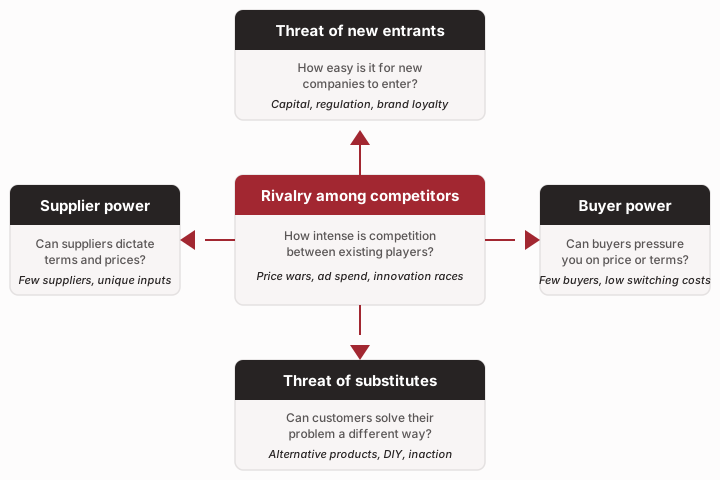
The five forces are:
- Threat of new entrants. How easy is it for new companies to enter this industry?
- Bargaining power of suppliers. Can the companies that supply your inputs dictate terms?
- Bargaining power of buyers. Can customers pressure you on price, quality, or service?
- Threat of substitutes. Can customers solve their problem in an entirely different way?
- Rivalry among existing competitors. How intense is competition between the companies already here?
Why industry structure matters more than you think
Magretta illustrates this with data in Understanding Michael Porter: from 1992 to 2006, U.S. airlines averaged about 5.9% return on invested capital, while pharmaceuticals averaged above 30%. The difference isn’t management talent. It’s industry structure.
Airlines: when four of five forces work against you
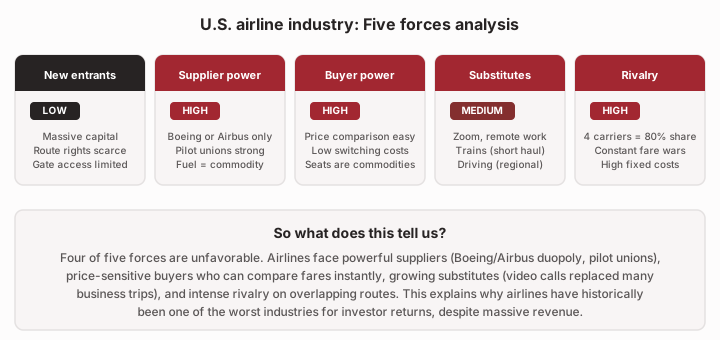
Warren Buffett called airlines the worst industry for investors in the 20th century. Here’s why the structure is so unfavorable:
Airlines can only buy planes from Boeing or Airbus, giving those two companies enormous leverage. Pilot unions have real bargaining power, especially post-COVID when experienced pilots became scarce. Jet fuel is a commodity tied to global oil prices. Supplier power across the board is high.
On the buyer side, a seat from New York to Chicago on United is basically the same product as on Delta or American. Customers compare prices in seconds on Google Flights. Loyalty programs help somewhat, but most leisure travelers buy the cheapest ticket they can find.
Substitutes have gotten worse since 2020. Video conferencing replaced a real chunk of business travel, which was the most profitable segment for airlines. Much of that demand isn’t coming back.
Four carriers control about 80% of U.S. domestic capacity and they compete on overlapping routes with similar planes and similar service levels. Fixed costs are enormous (planes, gates, and crews), which means airlines will fill seats at almost any price rather than fly empty.
The only favorable force is barriers to entry. Starting an airline requires billions in capital, scarce gate space, and regulatory approval. Without those barriers, the industry would be even worse.
Paccar: finding a position where the forces are weaker
Magretta highlights Paccar (the company behind Peterbilt and Kenworth) in Understanding Michael Porter as an example of five forces thinking applied well. The heavy-truck industry is brutal: commoditized products, powerful fleet buyers, and constant price competition.
Paccar’s insight was about buyer power. Large fleet operators can squeeze manufacturers on price, but independent owner-operators can’t. An owner-operator who drives and lives in their truck cares about different things than a fleet purchasing manager. Paccar built its business around that difference: extensive customization, a 10% price premium, and 68 consecutive profitable years in an industry where most competitors struggle to earn their cost of capital.
This is a concept Magretta emphasizes in Understanding Michael Porter: the framework isn’t just for declaring an industry “attractive” or “unattractive.” It should lead directly to decisions about where and how to compete.
The PC industry: squeezed from both sides
Magretta uses the personal computer industry in Understanding Michael Porter as a good example of how supplier power can destroy profitability even in a massive market. PC manufacturers sell hundreds of millions of units per year, but their margins have been thin for decades.
The reason: two suppliers captured most of the industry’s value. Microsoft controlled the operating system and Intel controlled the processor. As Magretta puts it, PC makers like Dell, HP, and Lenovo were “squeezed in the middle” between powerful suppliers and price-sensitive buyers who could comparison-shop online.
This is a case where looking only at rivalry between PC makers would miss the real story. The structural problem wasn’t that Dell and HP competed too aggressively with each other (though they did). It was that the most profitable parts of the value chain were controlled by suppliers.
How to run the analysis
Here’s what makes the analysis actually useful.
Define the industry precisely
“The tech industry” is not an industry. “Cloud infrastructure services” is. “Retail” is not an industry. “Off-price apparel retail in the U.S.” is.
The boundaries matter because each force changes depending on how you define the competitive space. Walmart’s supplier power analysis looks completely different if you define its industry as “general merchandise retail” versus “grocery retail.” Magretta uses CEMEX, the Mexican cement company, as an example: it earns higher returns in markets where 85% of its customers are small independent builders (low buyer power) compared to markets dominated by large construction firms that can negotiate aggressively.
A good test: which companies are competing for the same customer dollar?
Rate each force, but explain why
“Buyer power: high” is not useful on its own. “Buyer power: high, because our top 3 customers represent 60% of revenue and could switch to a competitor within one contract cycle” is useful. The rating itself isn’t the point. The reasoning behind it is.
For each force, identify the 2-3 specific factors driving it. Be concrete. Name companies, percentages, and specific dynamics.
Find the dominant force
In most industries, one or two forces drive everything. In airlines, it’s rivalry and buyer power. In pharmaceuticals, it’s the threat of substitutes (generics after patent cliffs) and new entrants (or lack thereof, while patents hold). In enterprise software, it’s switching costs that suppress buyer power.
The dominant force is where the strategic insight lives. If buyer power is the main issue, your strategy needs to address switching costs or differentiation. If supplier power is the problem, you need to find alternative sources or vertically integrate. This is the same principle behind consulting frameworks in general. Completing the framework isn’t the point. The quality of thinking it produces is.
Compare two industries
Five forces is most useful as a comparison tool. Pick two industries and ask why is this one profitable and this one isn’t?
Magretta’s soft drinks-versus-airlines comparison in Understanding Michael Porter is the clearest illustration. Coca-Cola has earned returns above 20% for decades. The average U.S. airline barely covers its cost of capital. Both are massive consumer industries with famous brands, but the structural forces point in opposite directions.
Where the framework breaks down
Porter’s original 1979 model has real limitations, and several smart people have identified them.
Andy Grove at Intel argued that complements, the companies that make your product more attractive, should count as a sixth force. Intel and Microsoft were complements to PC manufacturers. App developers are complements to Apple. Adam Brandenburger at Harvard and Barry Nalebuff at Yale formalized this idea in their work on “co-opetition.” Porter resisted adding a sixth force, but the critique has merit. In many tech ecosystems, the complement dynamic is more important than traditional supplier or buyer power.
The framework also assumes clear industry boundaries. When Amazon competes in retail, cloud computing, advertising, streaming, logistics, and grocery delivery all at the same time, which industry are you analyzing? The framework works best for clearly defined, relatively stable industries. Many of the most interesting strategic questions today involve companies that refuse to stay inside those boundaries.
And five forces is a snapshot. It describes structure at a point in time but doesn’t tell you the direction or speed of change. The U.S. airline industry looked structurally identical in 2019 and 2021, but the competitive dynamics changed completely when business travel collapsed.
How to think about it
The real value of five forces isn’t the diagram. It’s the shift in how you think about competition.
Most people default to thinking about competition as a rivalry between companies in the same industry. Porter’s insight was that this is only one of five forces that determine profitability, and often not the most important one. The PC makers obsessed over competing with each other while Microsoft and Intel captured most of the value. Airlines invested billions in service improvements that customers didn’t pay for because buyer power and rivalry compressed margins regardless.
When someone says “we need to differentiate” or “this is a great market,” five forces gives you a way to pressure test that claim. Differentiate against which competitive pressure? A great market for whom? Those are the questions that lead to better strategic thinking.
You probably won’t draw the five forces diagram every time you think about an industry. But the habit of asking “what are the structural forces here, and which one actually matters?” is something worth building.
Recommended reading
Joan Magretta’s Understanding Michael Porter is the clearest explanation of Porter’s ideas I’ve come across. Magretta worked closely with Porter at Harvard and wrote the book specifically to make his frameworks accessible to practitioners. The industry examples (airlines, Paccar, soft drinks) are worth the price alone. Walter Kiechel’s The Lords of Strategy covers the broader history of how Porter’s work fit into the strategy consulting revolution of the 1970s and 80s.