A freelance consulting course on finding, scoping, and pricing client work

The Art of Strategic Freelancing covers the business around the work: landing projects, writing proposals, setting fixed fees, signing contracts, and running check-ins. I spent nearly a decade in strategy consulting, including at McKinsey and BCG, and I've worked on my own since 2017.

  • 51 lessons in 7 sections
  • About 6 hours of video
  • Proposal, contract, and check-in templates
  • 30-day money-back guarantee
  1. Time

    You sell your hours

    Hourly and daily rates

  2. Project

    You sell an outcome

    Fixed price or monthly rate

    $5,000 for up to 10 days a month

  3. Product

    You sell a package

    Fixed price and retainer

    A $20,000 package that takes three months

When you go out on your own, you become the whole firm

At McKinsey and BCG there was a team for everything, even graphic design. I never sent an invoice, and I rarely pitched a senior client on a call. When I went freelance in 2017, my consulting instincts were good, but every decision was suddenly mine: what to charge, which projects to take, and what kind of work I wanted to keep doing.

On your own, you're also the salesperson, the bookkeeper, the person chasing late invoices, and the one setting strategy. The easy response is to stay busy and say yes to every project at the same rate, and that's how burnout starts. This course is about the longer game: building your skills, shaping the projects you take, and earning client trust that lasts.

How do I raise my rates?

If your rate never moves, your work doesn't either. Fixed fees let you price the client's problem instead of your hours.

When do I send a proposal?

Later than you think. Agree on the problem with the client first, in writing, and the proposal becomes the easy part.

How do I deliver value?

Clients hire you to help them decide. Regular check-ins keep them involved and end with a plan they own.

Seven sections take you from deciding to go out on your own to the final deliverable

51 lessons and about 6 hours of video, at your own pace. You can watch the seven linked lessons before you enroll.

  1. 1

    Welcome 3 lessons

    The fundamental goal: offer higher-value services. Then download the full freelance templates and an AI skill that drafts documents, proposals, and check-ins with you.

  2. 2

    Before you become a freelancer 8 lessons

    What I wish I knew before quitting strategy consulting. Freelance identity versus wanting freedom, five questions for every freelancer, an exercise to tame your fears, and how to find a test or pro bono client, with my own example.

  3. 3

    Early stages: mindset and the basics 11 lessons

    Personal name or brand name, how much free work to do, why pricing at your full-time wage fails, your ideal client list and red flags, and your credential materials. Pricing strategies with McKinsey pricing examples, the math of fixed-fee pricing, and the pricing calculator.

  4. 4

    Landing projects, proposals, and contracts 10 lessons

    Finding clients through your network, content, and communities. Three types of work: time, project, and product based. Why not to send a proposal too quickly, a law firm case study, three goals before you sign, and a walkthrough of a project contract, with a template for each.

  5. 5

    Navigating the client relationship 8 lessons

    Scoping as ongoing relationship building. The three typical stages of a project, the check-in meeting, three check-in case studies from my projects, and getting paid with Stripe.

  6. 6

    Doing the work 5 lessons

    Synthesizing information with the Pyramid Principle, a live synthesis example, creating your own frameworks, and two final deliverables from real projects.

  7. 7

    Bonus and resources 6 lessons

    Interviews with freelancers who have done this for years: Sean McCabe, Venkatesh Rao, Austin Church, Will Bachman, and Tom Critchlow. Plus a recorded Q&A on pricing, hooks, getting clients, types of projects, and branding.

You see real proposals from my own projects, including one that ended in a no-go

This one took two calls, two proposals, and a final pitch to the client's full team over eight weeks before they said no. I walk through proposals like it from my work, so you know how many conversations to expect, what to send at each step, and how long it takes to get to a signed contract.
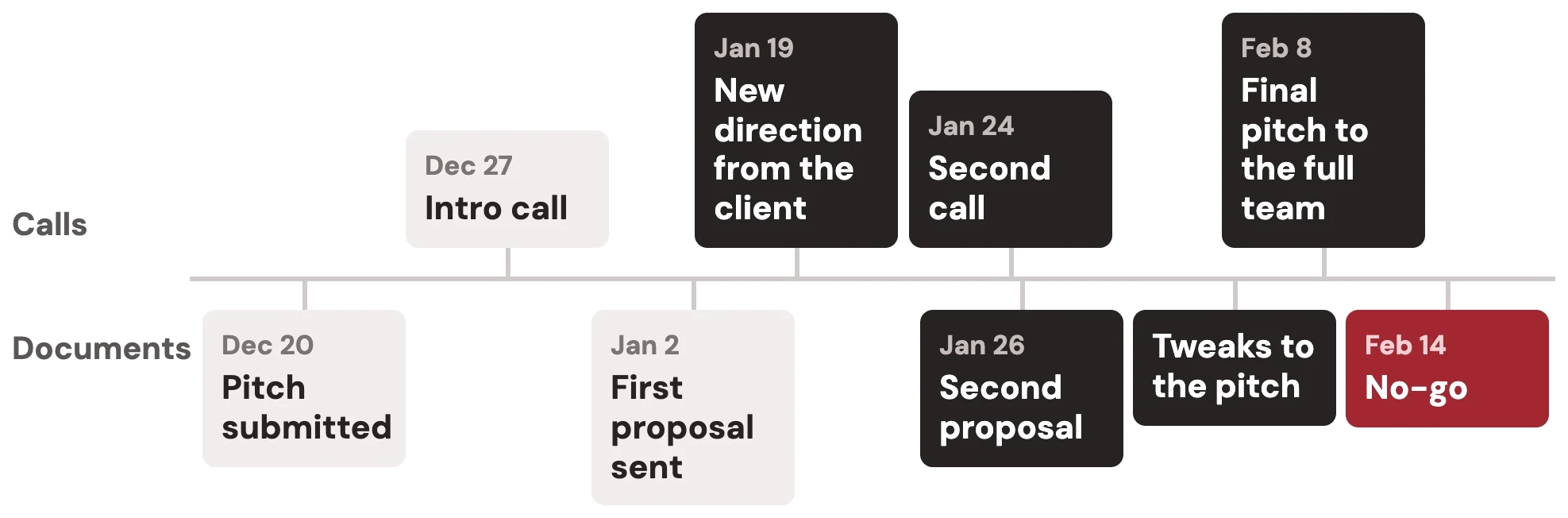
Timeline of one proposal that ran eight weeks and ended in a no-go. Calls: Dec 27 intro call, Jan 19 new direction from the client, Jan 24 second call, Feb 8 final pitch to the full team. Documents: Dec 20 pitch submitted, Jan 2 first proposal sent, Jan 26 second proposal, tweaks to the pitch, Feb 14 no-go.

Know what a fixed fee pays per hour before you quote it

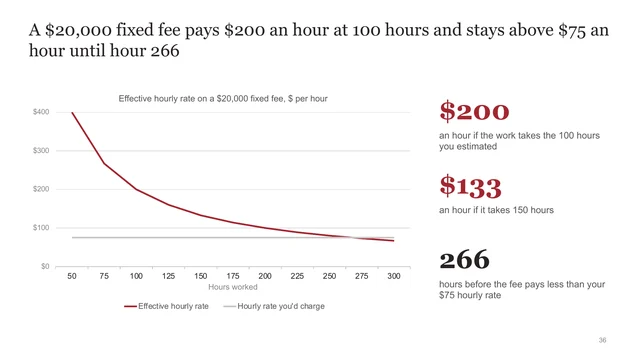
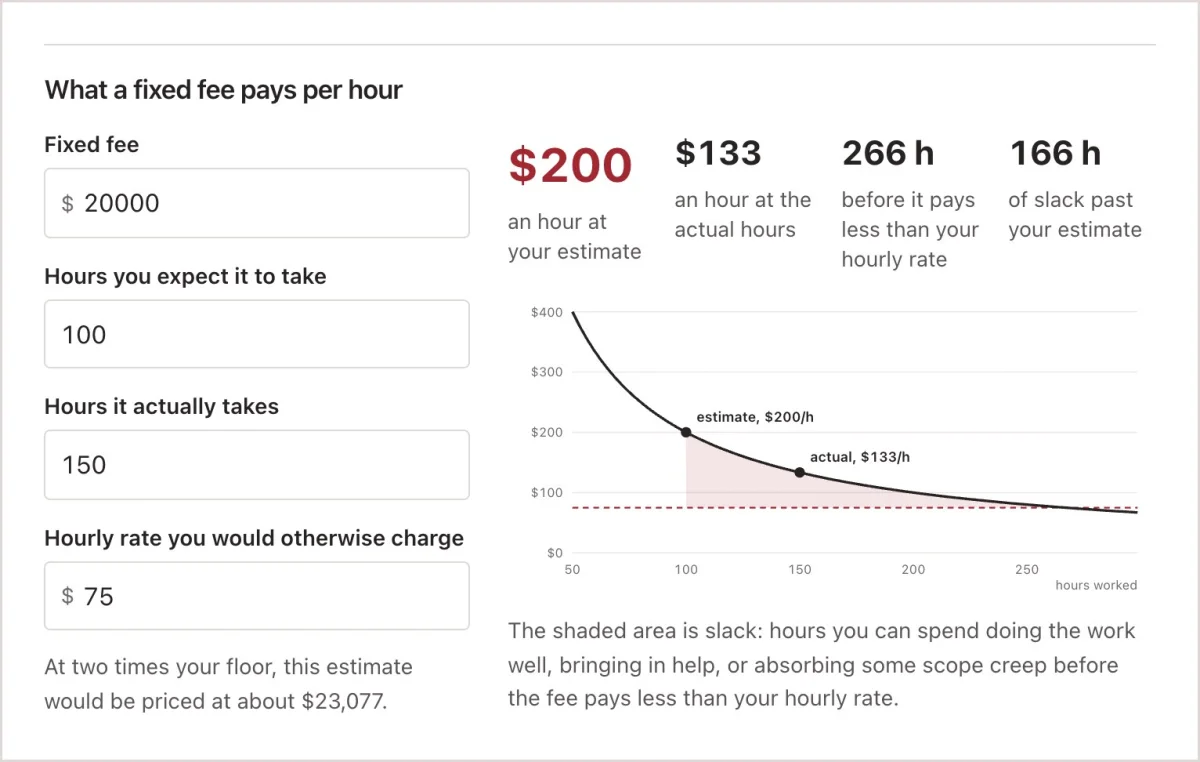
The pricing calculator lesson works out what you need to earn, your floor rate, and what a fixed fee pays per hour when a project runs long. A $20,000 fee for 100 hours pays $200 an hour, and it still beats a $75 hourly rate until hour 266.

Run your own numbers in the lesson
The pricing calculator: a $20,000 fixed fee for a 100-hour project pays $200 an hour at the estimate, $133 an hour at 150 hours, and stays above a $75 hourly rate until hour 266 Open the pricing calculator lesson

Templates for everything you send a client, from the first call to the final deliverable

Each template is filled in for one sample project, a nine-week engagement with a made-up search firm, so you see a finished example before you swap in your own work. The slides come in four PowerPoint styles, and every part has instructions for what goes in it.

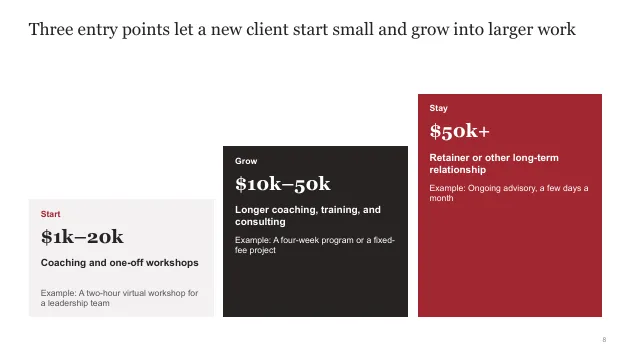
  1. Sample slide: three entry points, from a $1,000 to $20,000 workshop to a $50,000-plus retainer

    01 Plan your practice

    • Five questions to answer before you go independent
    • A fear-setting exercise for the decision to leave your job
    • Your ideal client list and the red flags to avoid
    • Three entry points, from a small workshop to a long-term retainer
    • The ways you work: on site, remote, with a small team, or as an advisor
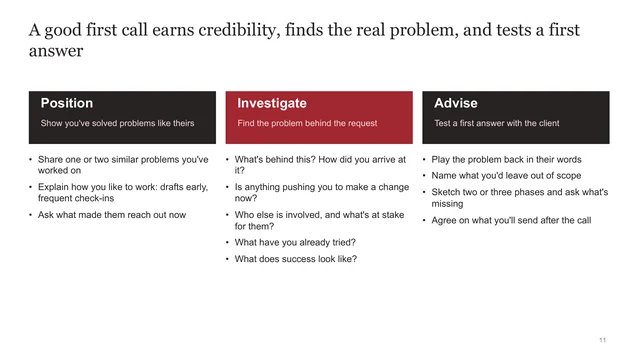
  2. Sample slide: a first-call guide in three steps, position, investigate, and advise

    02 Scope the problem

    • A guide for the first call: show credibility, find the real problem, and test a first answer
    • How to find the problem behind the request
    • A problem statement to send back to the client, with a filled-in example
    • A map of who hired you, who you work with every day, and who wins or loses
    • A check for when it’s time to send a proposal
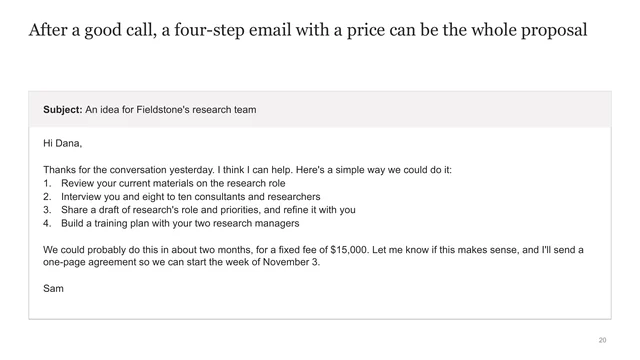
  3. Sample slide: a four-step proposal written as a short email with a fixed fee

    03 Write the proposal

    • A checklist for every proposal: why, who, how, when, and what the client gets
    • The same proposal three ways: a four-step email with a price, a three-slide version, and a full proposal
    • Pages for the situation, approach, timeline, client time needed, check-in schedule, fee and payment terms, three options, and next steps
  4. Sample slide: a chart of what a $20,000 fixed fee pays per hour as the hours grow

    04 Price the work

    • What a fixed fee pays per hour when a project runs long
    • Your freelance floor rate, worked out from your old salary
    • Moving from time-based work to project and product work
    • Pricing from the client’s problem and urgency
    • A tracker for your effective hourly rate on every project
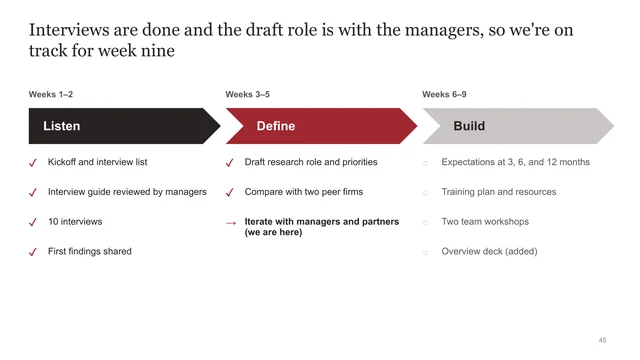
  5. Sample slide: check-in progress across three phases, with done and upcoming items

    05 Check in with the client

    • A complete check-in document: what you need from the client today, whether the problem has changed, progress against the plan, early findings, decisions needed, and next steps
    • A page for related problems that could become the next project
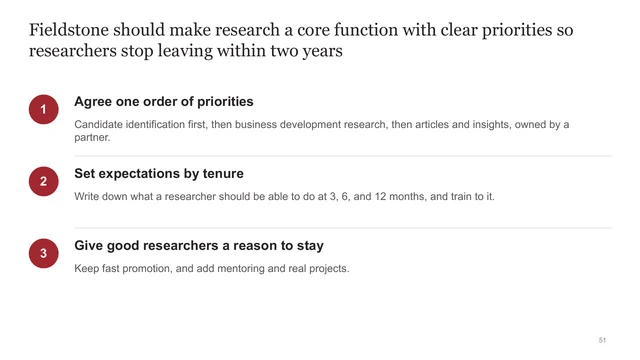
  6. Sample slide: a final executive summary with three recommendations

    06 Deliver and follow on

    • A final executive summary
    • Expectations for the client’s team as the change takes hold
    • An action plan with one owner for each action
    • A closing page that hands the plan to the client
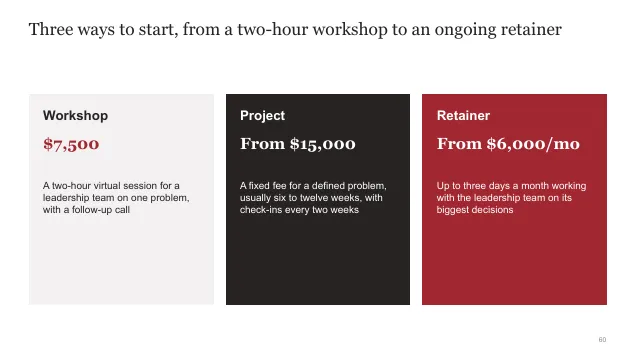
  7. Sample slide: three ways to start, a workshop, a project, and a retainer, with prices

    07 Credentials and offerings deck

    • What you help with and who you work with
    • How you work, and three ways to start, with prices
    • Recent projects, and one project told in depth
    • Your background, what clients say, and answers to common questions
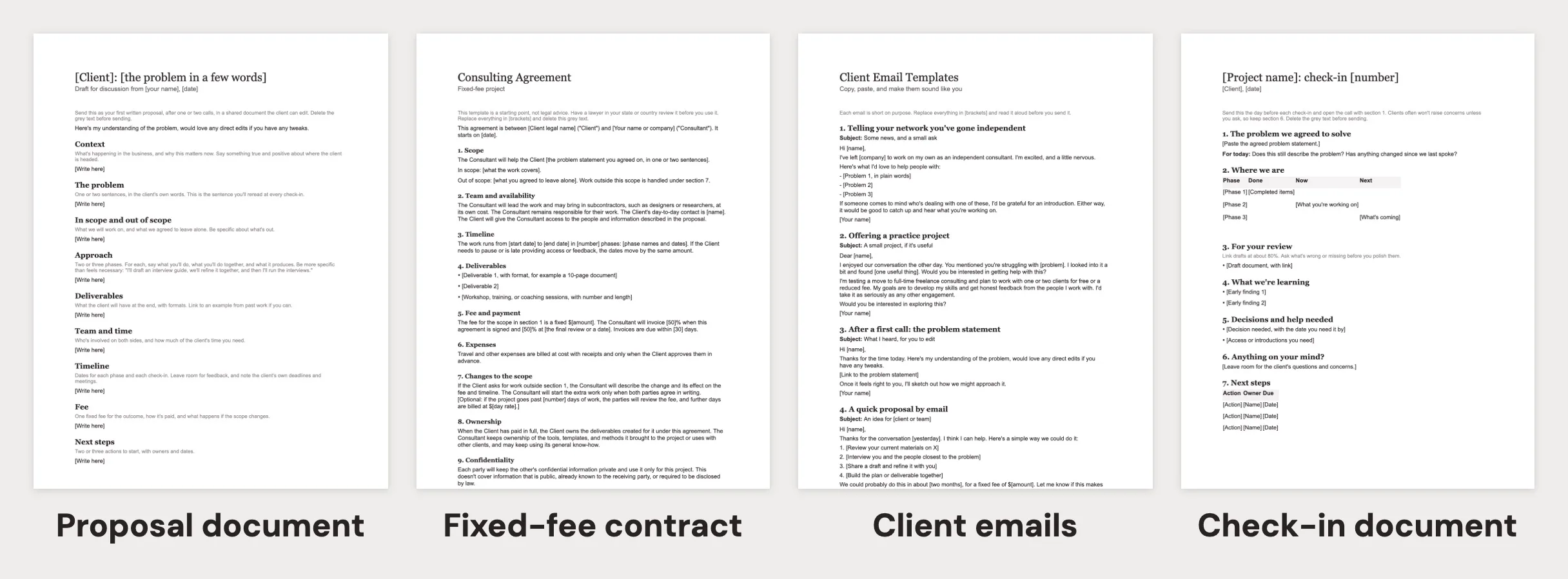
  8. First pages of four Word templates: a proposal document, a fixed-fee contract, client emails, and a check-in document

    Word documents

    • A problem statement and proposal
    • A fixed-fee contract and a monthly retainer contract
    • Client emails, from telling your network you've gone independent to a quick proposal after a first call
    • A check-in document to send before each meeting
  9. Worksheets and tools in the lessons

    • The pricing calculator: target income, floor rate, and what a fixed fee pays per hour
    • Worksheets for drafting a problem statement, an email proposal, and an offer ladder
    • An AI skill that drafts documents, proposals, and check-ins with you

Starting out or just launched your practice? Build your credentials deck first

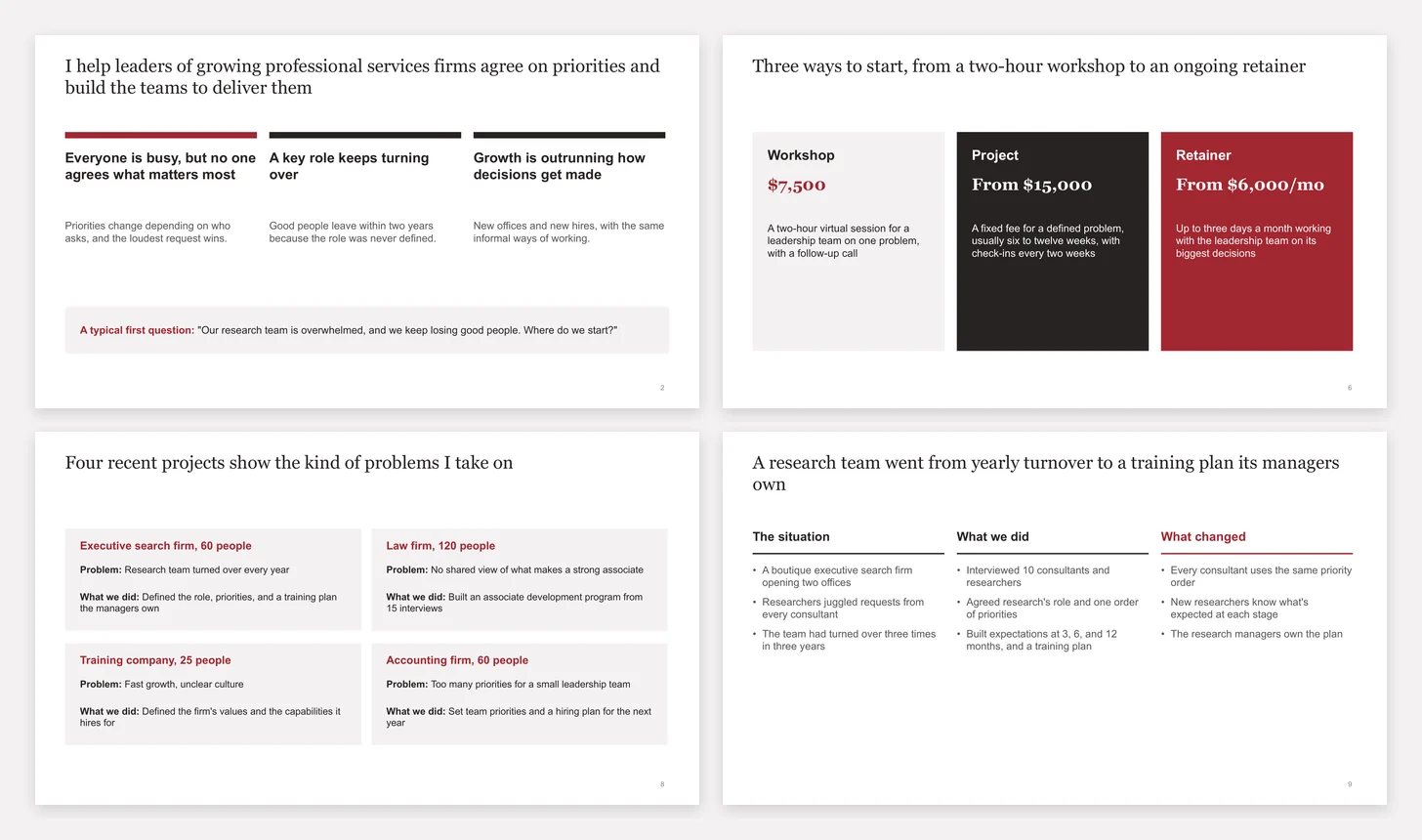
Before a first call, clients want to see what you do, how you work, and where they can start. My credentials and offerings deck template covers all of it, and an AI prompt interviews you and fills it in, so you can have a basic deck ready this week.

Build your credentials deck
Four slides from the credentials and offerings deck: what the consultant helps with, three ways to start with prices, four recent projects, and one project in depth

Think Like a Strategy Consultant teaches the thinking, and this course covers the business around it

ComparedThink Like a Strategy ConsultantThe Art of Strategic Freelancing
What you learnHow consultants frame problems, structure answers, and put them on slidesHow to find clients, scope projects, write proposals, set prices, sign contracts, and run check-ins
Typical lessonsMECE, issue trees, hypotheses, the Pyramid Principle, slide designFixed-fee math, proposal walkthroughs, contracts, check-in meetings
What you getAssignments with sample solutions, plus consulting slide templatesTemplates for proposals, pricing, contracts, check-ins, client emails, and a credentials deck
Price$797$347

If you already work with clients, the Consultant's Bundle has both courses, 131 lessons in all, for $997, which saves $147. If you haven't left your job yet, start with this course.

The course is for anyone building a consulting practice, whether you've quit your job or not

  • You're thinking about consulting on your own. The second section helps you decide, and a test or pro bono client lets you try it before you quit.
  • You've just started and you take every project. The pricing and proposal lessons help you choose the work you want and charge for it.
  • You've freelanced for years. Use the course to move from hourly rates to fixed fees, raise your prices, and make your proposals and check-ins look like a firm's.

Everything included for $347

The lessons

  • 51 video lessons in seven sections, about six hours
  • Real proposals and check-ins from my own projects
  • A walkthrough of a fixed-fee contract
  • Interviews with five freelancers who have done this for years
  • A recorded Q&A on pricing, hooks, and getting clients

The templates

  • A practice plan: five questions, fear setting, ideal clients, and entry points
  • A first-call guide and a problem statement to send back
  • The same proposal three ways: email, three slides, and full
  • Pricing pages and an effective hourly rate tracker
  • A complete check-in document
  • A final executive summary and action plan
  • A credentials and offerings deck
  • Word files: a proposal, two contracts, client emails, and a check-in

Tools and access

  • The pricing calculator
  • Worksheets for a problem statement, an email proposal, and an offer ladder
  • An AI skill that drafts documents, proposals, and check-ins with you
  • Every slide in four PowerPoint styles
  • Lifetime access, with new lessons and templates as I add them
  • 30-day money-back guarantee

If the course isn't for you, contact me within 30 days for a full refund. Read the refund policy.

Questions people ask before enrolling

How long does the course take?

There are about six hours of video across 51 lessons. Watch them in order, or jump to the section you need, like pricing or proposals, and come back when a new client situation comes up.

Is this right for me if I'm not a consultant yet?

Yes. The second section helps you decide whether freelancing fits you and how to test it with a pro bono or trial client. The rest of the course is there when you start taking on work.

How is it different from Think Like a Strategy Consultant?

Think Like a Strategy Consultant teaches how consultants solve problems and communicate: MECE, issue trees, the Pyramid Principle, and slides. The Art of Strategic Freelancing covers the business around the work: clients, proposals, pricing, contracts, and check-ins. The Consultant’s Bundle has both for $997.

Can I see some of the course before I buy?

Yes. Seven lessons are open to everyone, including the pricing calculator and the lesson on fixed-fee math, and you can download the credentials and offerings deck from the same template set.

Do I get lifetime access?

Yes, and that includes new lessons and templates as I add them. The templates, worksheets, and pricing calculator were all added in October 2026.

Is there a refund policy?

Yes. If the course isn't for you, contact me within 30 days and I'll refund you in full.

More on freelance consulting