
What strategy consultants actually earn in 2026
I left strategy consulting in 2017. At the time, I was at a point in my career where I could have moved into director-level roles, either by staying at a firm or taking an exit opportunity. Instead, I walked away.
What I didn’t know was that I was leaving right before the biggest compensation boom in strategy consulting history. The eight years since have been very good to the people who stayed.
What consultants make today
The most comprehensive public data on strategy consulting compensation comes from Charles Aris, an international executive search firm founded in 1969. Their Strategy & Go-to-Market Practice was founded in 2003 by CEO Chad Oakley, a former Bain consultant. The 16th annual 2026 Strategy Consulting Compensation Study, published in January 2026, is based on 795 usable survey responses from current consultants at 13 firms. The data was collected between August and December 2025 via an anonymous, voluntary survey. About 64.9% of respondents came from the Big Three: McKinsey, BCG, and Bain.
Here’s what average total compensation looks like by level, according to the 2026 study:
- Analyst (1-2 years, pre-MBA): $150,547
- Associate (1-2 years post-MBA or 3+ years pre): $230,302
- Manager (3-4 years post-MBA): $309,162
- Principal (5-7 years post-MBA): $446,247
- Partner (8+ years post-MBA): $1,181,615
Those figures include base salary, annual bonus, retirement contributions, and long-term incentives like profit sharing. The partner number is the one that jumps off the page: $1.18 million in average total compensation, up 18.6% from the prior year’s study.
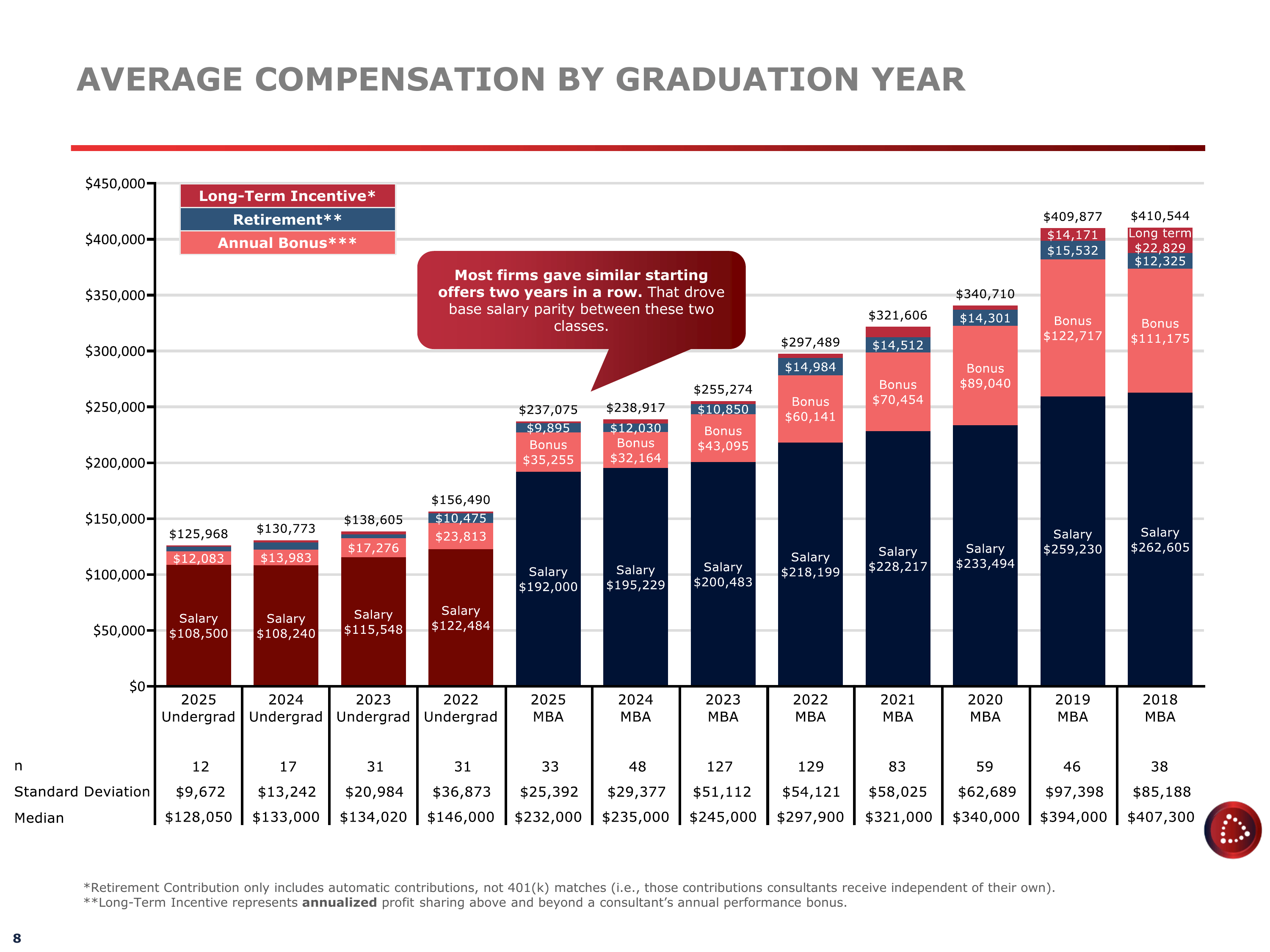
For people at the early career stages, a first-year MBA joining a strategy consulting firm in 2025 earned an average base salary of $192,000 with a bonus of about $35,265, for roughly $237,000 in total compensation. The median is $232,000. The study notes that most firms gave similar starting offers two years in a row, creating near-parity between the 2024 and 2025 MBA classes.
Entry-level undergrad hires in 2025 averaged about $126,000 in total compensation, with a base salary around $108,500 and a bonus near $12,000.
If you want to see how titles translate across the Big Three firms, the generic labels (analyst, associate, manager, principal, partner) map roughly onto each firm’s specific titles, though the naming conventions differ.
The boom I missed
Here’s where it gets personal. The Charles Aris study tracks year-over-year compensation increases going back a decade. The 10-year average annual increase for post-MBA strategy consultants is 12%.
But the increases weren’t evenly distributed. The year-over-year increases for post-MBA consultants (base salary plus annual bonus) looked like this:
- 2016: 11.0%
- 2017: 9.4%
- 2018: 17.0%
- 2019: 7.1%
- 2020: 11.4%
- 2021: 23.6%
- 2022: 12.6%
- 2023: 7.0%
- 2024: 9.8%
- 2025: 7.6%
In 2017, the year I left, compensation grew 9.4%. The following year it jumped to 17%. Then in 2021, after COVID-era demand for consulting services surged, it hit 23.6%, the highest single-year increase in the study’s history.
The pre-MBA numbers are even more dramatic. The 10-year average annual increase for pre-MBA consultants is 23%, and in 2019 the average increase was 58.6%. It’s still shocking hearing from first year analysts who are making close to what I was making when I quit after 9 years in the industry.
What drove the 2021 spike was a war for talent. Firms were competing at a pace not seen in decades. As Fiona Czerniawska, chief executive of Source Global Research, told the Financial Times in 2022, the salary inflation was comparable to the dot-com boom of 1999-2000. MBB firms raised their MBA starting base from $165,000 (where it had been frozen during 2020-2021) to $175,000 in 2022, and then to $190,000-$192,000 shortly after. Fortune reported that new MBA grads at the Big Three could land base salaries approaching $200,000. By 2025, the starting base for new MBAs at the Big Three had held at $192,000 for two consecutive recruiting classes.
The 2025 post-MBA increase of 7.6% is below the 10-year average of 12%, and the 2025 pre-MBA increase of 5.6% is the lowest in a decade. The study notes that this is partially driven by a methodological change: one-time bonuses were removed from this year’s survey, which makes the 2025 number look lower than it might otherwise be. The Charles Aris projection for 2026 is that compensation will increase again as firms ramp up promotion frequency.
I think the crazy thing about all this is that the reason these firms are still growing is that they are in massive demand. Somehow, these billion dollar firms have continued to grow (and increase pay) almost 10% a year for more than a decade.
What the senior numbers look like
The money really changes at the principal and partner levels (and is probably why some people think I was rich when I quit).
The 2018 MBA class (about seven years of post-MBA experience, at the boundary between principal and early partner) now earns an average of $410,544 in total compensation. For the 2019 MBA class it’s $409,877. At these levels, base salary is only part of the picture: a 2018 MBA averages a base of $262,605 with bonuses and long-term incentives making up the rest. The median for that cohort is $407,300.
The real jump happens at partner. Average total compensation for partners is $1,181,615, a figure that includes base salary, annual bonus, retirement contributions, and annualized profit sharing. That’s more than 2.6 times the average principal compensation of $446,247. The gap reflects how much of partner pay comes from performance bonuses, profit sharing, and long-term incentives rather than base salary.
These numbers come with variation. The standard deviation for the 2018 MBA cohort is $85,188, meaning there’s meaningful spread depending on firm, office, practice area, and individual performance. But even at the lower end, consultants with seven years of post-MBA experience are earning well into the mid-six figures.
The jump from manager to principal is also significant: from $309,162 to $446,247, a 44% increase. That’s because the role changes fundamentally. Managers run projects and deliver work. Principals own client relationships and sell new engagements. What consultants actually do shifts considerably at each level, and the compensation follows.
What happens when you leave
For many consultants, the question isn’t “how much can I earn if I stay?” It’s “what can I earn if I leave?”
The Charles Aris study includes a sample of 2025 exit offers accepted by candidates from Tier 1 strategy firms. The range is wide, but the pattern is consistent: former consultants with MBB backgrounds command premiums in the corporate and private equity markets.
A few examples from the 2025 data:
- A 2018 Big Three MBA took a VP of Strategic Initiatives role at a PE-backed corporation: $275,000 base, 40% bonus, $1.5 million in equity, and a $25,000 sign-on. Total first-year cash: $385,000.
- A 2019 Tier 1 MBA took a VP role at a private equity firm: $275,000 base, 65% bonus, and $750,000 in carried interest. Total first-year cash: $453,750.
- A 2021 Big Three MBA became a Director at a private equity firm: $250,000 base, 110% bonus, and $1.3 million in carried interest. Total first-year cash: $525,000.
- A 2022 Tier 1 MBA took an AI Transformation role at a corporation: $240,000 base, 20% bonus, and $150,000 in equity. Total first-year cash: $288,000.
- A 2005 former Big Three MBA became Chief Strategy Officer at a corporation: $450,000 base, 60% bonus, $800,000 in equity, and a $300,000 sign-on. Total first-year cash: $720,000.
The AI Transformation role is worth noting. It didn’t exist in prior years’ exit data. Charles Aris has since added a Senior Associate Practice Leader dedicated to Artificial Intelligence searches on their own team.
The study also provides 2026 corporate offer forecasts by MBA year. For a 2019 MBA leaving consulting at the principal level, the forecast ranges look like this:
- 25th percentile: VP title, $250,000 base, 35% bonus, $90,000 equity. Total: $427,500.
- 50th percentile: VP title, $265,000 base, 40% bonus, $110,000 equity. Total: $481,000.
- 75th percentile: SVP title, $280,000 base, 45% bonus, $130,000 equity. Total: $536,000.
For anyone considering private equity, the numbers are steeper. At the Vice President level (2-6 years post-MBA), total cash ranges from $350,000 to $500,000, plus carried interest. At the Principal level (6+ years), it’s $450,000 to $650,000 in total cash with carry. Operating Partners (10+ years) earn $700,000 or more in total cash, with carry on top.
What the money doesn’t tell you
The compensation data is real, and the numbers are high. But the Charles Aris study includes other data that tells a different story.
The 2026 study found that 25.6% of post-MBA consultants say they’re “highly likely” to leave consulting in the next six months. That’s actually down from 34.6% in last year’s study. But the deeper number is more telling: 62.8% of 2020-2023 post-MBA respondents are either likely or highly likely to leave, and on average they’re willing to earn less than they currently make to do it.
When consultants who are likely to leave were asked which industries they’d target, the top answers were private equity operations, technology, and venture capital. Energy jumped seven spots from the prior year, moving from 14th to 7th most popular, which the study attributes to increased demand from the AI and datacenter boom. Traditional corporate strategy roles, the path I took, didn’t crack the top five.
On vacation time, the most common response across all levels (37% of respondents) was 16-20 days of PTO per year. Another 27% took only 11-15 days. At the partner level, 44% took 16-20 days, and 24% took more than 26 days. Only 1% of all respondents took zero days of PTO in 2025.
Although these firms have a reputation for crazy work hours, I was always impressed that people took a lot of vacation too. I always took at least 20 days.
The math doesn’t do the math
On paper, if I had stayed in consulting through 2025, the Charles Aris data suggests I’d be earning somewhere around $1.18 million in total compensation as a partner, or around $446,000 as a principal if I hadn’t quite made it. If I’d left for a corporate role at the principal level, the median offer for someone with my approximate tenure would be around $481,000, with equity on top.
Those are real numbers. I know people in those jobs earning those amounts.
But compensation studies can only measure what they measure. They count the money. And I am well aware of all the money I’ve left on the table. In fact, I wrote about it in my second book, Good Work, talking about how I get “compensated” in other things:
I’ve left tons of money on the table, but I’ve been compensated generously with space to think and grow as a person, time with my wife and daughter, new friends who are willing to spend time with me, and an overall psychological richness that I would never give up. Many of the costs of this path, like uncertainty, have become a small price to pay for the sense of abundance and expanded sense of agency I feel on a day-to-day basis.
Where the data comes from
All compensation figures in this article come from the 2026 Charles Aris Strategy Consulting Compensation Study, their 16th annual edition, based on 795 responses from current consultants at 13 firms, collected August through December 2025. The data is self-reported and anonymously collected via the survey tool Sogolytics. Respondents came from 28 states plus Washington, DC, with the largest concentrations in New York City (175), Chicago (100), and Boston (81). Of the 795 total responses, 672 came from post-MBA consultants and 123 from pre-MBA or undergraduate consultants.
Year-over-year comparisons should be read with one caveat: the 2026 study removed the question about one-time bonuses from its survey, which makes direct comparison to prior years imperfect, particularly at junior levels where signing bonuses are a meaningful portion of first-year compensation.
Charles Aris also publishes an annual Former Strategy Consultant Compensation Study focused on exit compensation. The 2026 edition is scheduled for publication on March 30, 2026. The corporate offer forecasts and private equity ranges cited above are Charles Aris projections for 2026, based on 2025 compensation trends and current demand.
For more context on the firms and career paths referenced here, see the strategy consulting industry overview and the guide to consulting career paths and titles at McKinsey, BCG, and Bain.