SWOT analysis: why it's everywhere, and how to make it actually useful
SWOT analysis might be the most popular strategy framework in the world and also the most frequently wasted. Almost everyone has sat in a meeting where someone draws a 2x2 grid on a whiteboard, labels the quadrants Strengths, Weaknesses, Opportunities, and Threats, and then the room spends an hour generating a list that never gets referenced again. I filled out many of these 2x2s in college and in grad school just to check the box on various assignments, too
The problem isn’t the framework. It’s that SWOT is probably more valuable as a sanity check and high-level assessment than a deep dive tool. A SWOT analysis done well produces a clear picture of where a company stands and helps to add context to the existing situation.
The origin and the idea
Albert Humphrey, a management consultant at the Stanford Research Institute, is commonly credited with developing the approach in the 1960s and 1970s, though the exact history is disputed. Other researchers, including Harvard’s Kenneth Andrews and his colleagues who developed the design school of strategy, were working with similar internal/external analysis frameworks around the same time.
Henry Mintzberg, in The Rise and Fall of Strategic Planning, identifies SWOT-style analysis as the foundation of what he calls the “design school” of strategy, where strategy formation is treated as a process of achieving a fit between internal capabilities and external possibilities. The framework endured because the basic question it asks is genuinely useful: where do you stand, and what should you do about it?
The core structure of the framework is simple. There are four areas to assess:
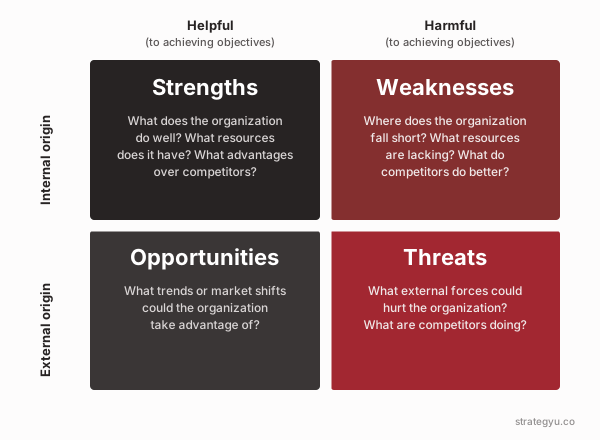
- Strengths are internal and helpful. What does the organization do well? What resources or advantages does it have that competitors don’t?
- Weaknesses are internal and harmful. Where does the organization fall short? What capabilities are missing?
- Opportunities are external and helpful. What trends, market shifts, or changes in the competitive environment could the organization take advantage of?
- Threats are external and harmful. What external forces could damage the organization? What are competitors doing?
The two axes are what make the framework work: internal vs. external and helpful vs. harmful. When people confuse an internal weakness with an external threat, or list an opportunity that’s really just a vague aspiration, the analysis falls apart.
SWOT In Practice: Company Examples
The framework’s real contribution isn’t the four categories themselves. It forces you to distinguish between things you can control (strengths and weaknesses) and things you can’t (opportunities and threats), and then to think about how they interact.
A useful SWOT: Netflix around 2022
An example we can analyze through the SWOT lens would be Netflix around 2022, when its strategy was under real pressure after its first subscriber decline in a decade.
Strengths. The largest streaming service in the world by subscribers, with a recommendation algorithm that kept engagement high and a content library built over more than a decade of investment. Global distribution infrastructure already built out across 190+ countries.
Weaknesses. Heavy reliance on content spending with limited ability to guarantee hits. Subscriber growth had stalled in North America. No advertising revenue at the time, meaning the only lever for increasing revenue per user was price increases, and customers were already pushing back.
Opportunities. An ad-supported tier could open up a price-sensitive market segment. Cracking down on password sharing could convert non-paying households into subscribers. Live events like sports and comedy specials could drive appointment viewing in a way that on-demand content doesn’t.
Threats. Disney+, Amazon Prime Video, Apple TV+, and HBO Max were all spending aggressively on content, some willing to operate at a loss. Consumers were showing signs of subscription fatigue, canceling services they used less frequently.
The analysis points toward real decisions. The password-sharing weakness paired with the cheaper-tier opportunity led directly to Netflix’s ad-supported plan in late 2022. The content spending weakness paired with competitor spending threats suggested Netflix couldn’t win a volume war, which is why they shifted toward fewer, bigger bets and live events. That’s what a useful SWOT does: it connects the boxes to each other and produces options you can act on.
Garbage In, Garbage Out
The reason SWOT gets a bad reputation is that most SWOTs don’t go deep enough. Teams stay at the surface level, like this:
Strengths: Strong brand. Experienced leadership team. Loyal customer base. Weaknesses: Limited budget. Need to innovate more. Employee retention challenges. Opportunities: Growing market. Digital transformation. New partnerships. Threats: Increased competition. Economic uncertainty. Regulatory changes.
Every item on that list could apply to thousands of companies. None of it leads to a strategic decision. The problem isn’t that the items are wrong. It’s that they’re not specific enough to be useful. “Strong brand” tells you nothing about how the brand is strong, relative to whom, or in what markets. “Economic uncertainty” is always true and therefore never actionable.
A good test for whether your SWOT is useful: could a competitor put the same items on their list? If yes, go deeper.
How to make the analysis actually work
Be specific and comparative
Every item should be specific enough that it points to a decision. Not “strong supply chain” but “three-day delivery to 95% of the U.S., which Competitor X cannot match.” Not “regulatory risk” but “pending EU legislation on data privacy that would require redesigning our ad-targeting system by 2025.”
Strengths and weaknesses only matter relative to competitors. A capability that every company in your industry has isn’t a strength. It’s table stakes.
Cross the quadrants
The most useful part of a SWOT isn’t filling in the four boxes. It’s asking what happens between them. Heinz Weihrich formalized this in 1982 with what he called the TOWS matrix, which systematically pairs internal and external factors.
This was a deeper analysis that was part of a nine-step strategic planning process, as shown by this graphic in his article:
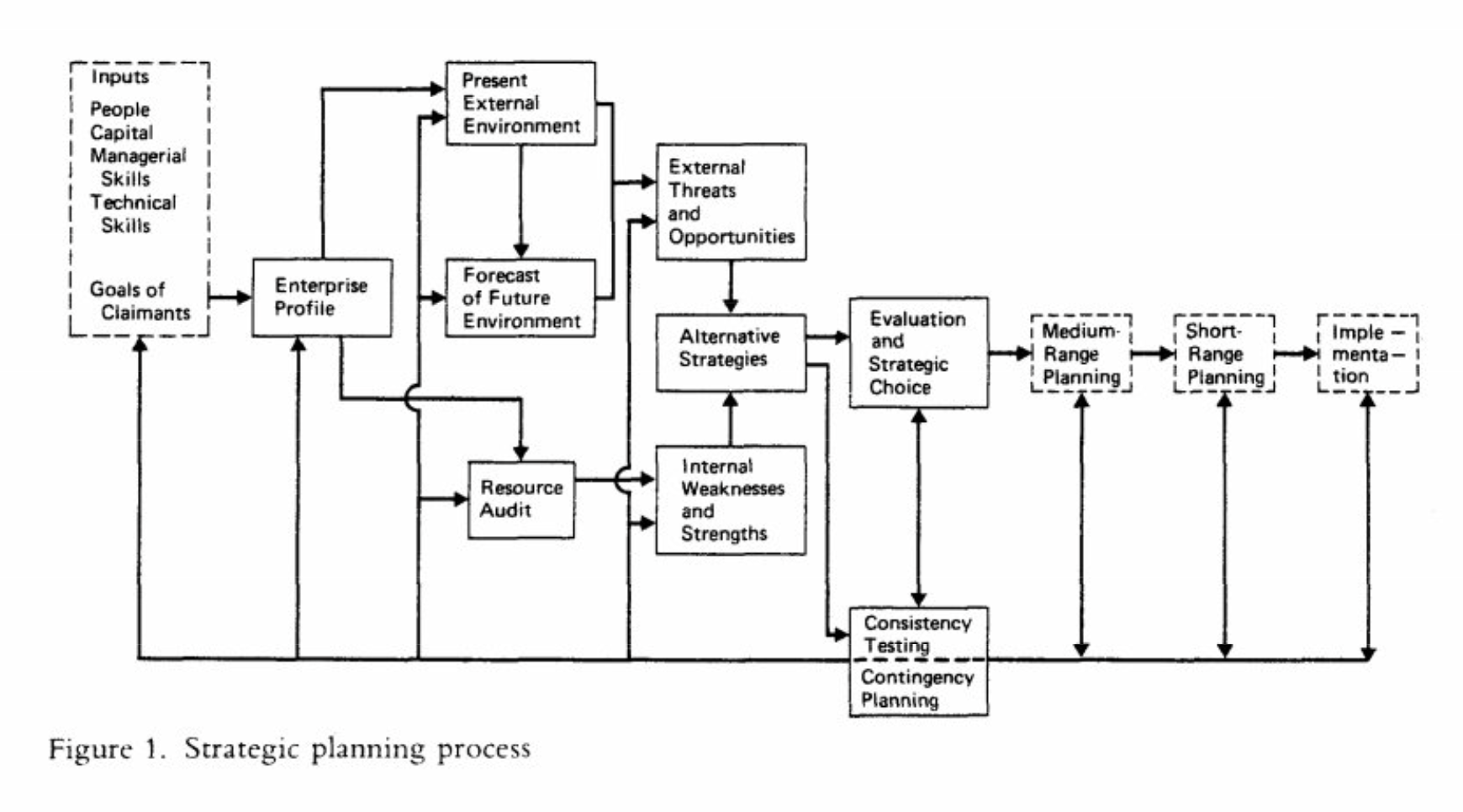
From there the key improvement over regular SWOT was that you paired each combo to get four more data points:
- Strength + Opportunity: How can you use this strength to capture that opportunity? (Netflix’s global infrastructure + growing international streaming demand = aggressive international content investment.)
- Weakness + Threat: Where is your vulnerability compounded by an external threat? (High content costs + competitors willing to spend at a loss = a spending war Netflix can’t win on volume alone.)
- Strength + Threat: Can a strength neutralize a threat? (Netflix’s recommendation algorithm + subscription fatigue = keeping engagement high enough to survive cancellation decisions.)
- Weakness + Opportunity: Does an opportunity address a weakness? (No ad revenue + consumer demand for a cheaper tier = the ad-supported plan launched in late 2022.)
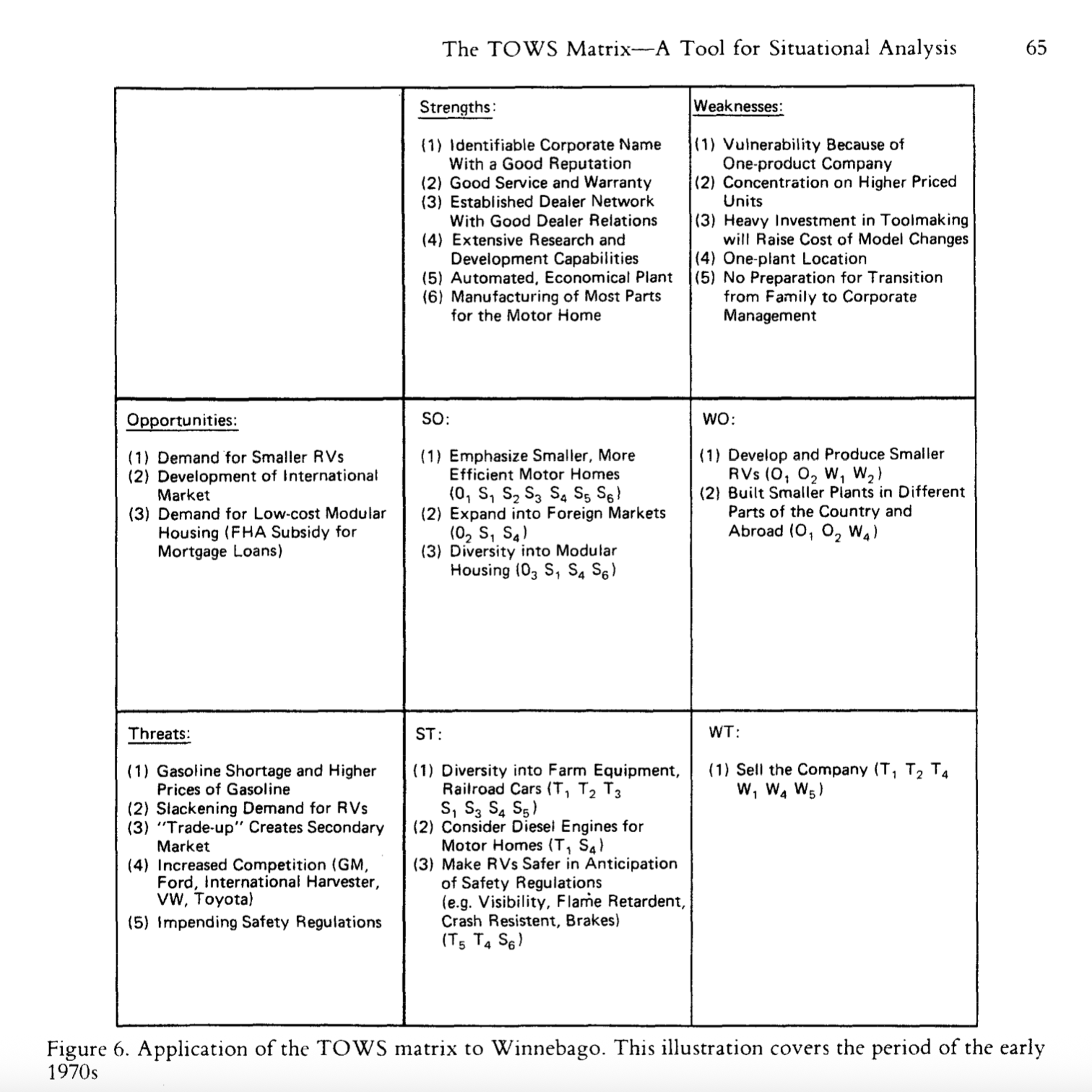
You can read the full paper, but here is an example Weihrich included of Winnebago:
Distinguish facts from assumptions
Many items that end up on a SWOT are assumptions disguised as analysis. “Our brand is strong” is an assumption unless you have data (NPS scores, unaided brand awareness, pricing power relative to competitors). “The market is growing” is an assumption unless you can cite a specific growth rate from a specific source.
Be ruthless about labeling which items are verified and which are beliefs. The beliefs need testing before they inform decisions. This is the same principle behind hypothesis-driven problem solving: state what you believe, then go find out if it’s true.
Where the framework breaks down
The most fundamental critique comes from Mintzberg and the emergent strategy school: SWOT assumes you can neatly separate internal from external, present from future, and then plan accordingly. In practice, these boundaries blur. A competitor’s new product (external threat) might reveal a capability gap (internal weakness) that you didn’t know you had.
The framework is also static. It captures a moment in time but doesn’t model how the factors interact or change. Porter’s Five Forces gives you a structural analysis of why an industry is profitable or not. The OODA loop gives you a framework for adapting to changing conditions. SWOT gives you a snapshot, and snapshots can be outdated as soon as you make them.
The biggest practical problem is what I’d call “list-making as strategy.” The exercise of filling in four quadrants feels productive. Teams leave the room thinking they’ve done strategic planning. But a list of factors isn’t a strategy. A strategy is a set of decisions about where to compete and how to win. If the SWOT doesn’t lead directly to those decisions, it was a brainstorming exercise, not strategic analysis.
How to think about it
SWOT is a starting point. If your SWOT session ends when the four boxes are full, you stopped too early. The work begins when you start crossing quadrants, naming specific competitors, and asking “so what do we do about this?”
Next time you’re in a room where someone pulls out the SWOT grid, try this: after every item someone suggests, ask “compared to whom?” and “so what should we do about it?” If the team can answer both questions with specifics, you’re doing real work. If they can’t, you’re making lists.
Recommended reading
Henry Mintzberg’s The Rise and Fall of Strategic Planning places SWOT within the broader history of strategic planning and offers a clear-eyed critique of its assumptions. For a practical improvement on the basic SWOT, look up Heinz Weihrich’s 1982 article “The TOWS Matrix: A Tool for Situational Analysis” (linked here) in Long Range Planning, which adds the cross-quadrant matching that turns the analysis into strategic options.