How to use AI in knowledge work and consulting work without shipping slop
Since Opus 4.6, I’ve been seeing if AI could do the consulting work I used to grind through in my twenties: writing out problem statements, turning information into clear synthesized points, drafting decks, reviewing decks, formatting decks, and so on. At first, I was a bit blown away. On some tasks, like cleaning Excel sheets, and organizing information, it’s literally perfect. One-shot excellence.
On other tasks, it blew me away…at first. But then I’d take a second look and see so many small things it gets wrong. Then you get in the loop with the model and the models start inserting slop in every turn. You are constantly trying to push it in the right direction as you iterate and make improvements. It gets frustrating and you wonder, “why work with these models at all?”
However, for others, the outputs these models create look perfect. They get polished, pretty slides, which look a lot nicer than the average slide they’ve seen in big organization. But what’s really happening is that the task of synthesis has been abdicated to the model and to other people in the organization. When this person has to defend their work or present it to other people in the organization, they will have a hard time backing it up. In some cases this is fine, the work really was a check the box exercise. But when the organization and its leadership needs to gain an understanding of what, how, and why they are doing something, someone will eventually need to be able to decode the underlying thinking behind the analysis. Thus, what I’m seeing in most organizations is that companies are not yet saving time with using Claude for memos, emails, and presentations. They are just creating more material that eventually needs to be decoded or reabsorbed into another person’s synthesis process.
The bottom line here is simple: AI dramatically cheapens producing the work, and it raises the value of judgment, taste, and understanding. It also raises the value of having a real process: shared frameworks, shared logic, and shared terms your team keeps iterating on.
How to think about model outputs

To work with AI, you need to have a good understanding of how these models work. They operate in a fundamentally different way than how most work is done in organizations today and this can take a while to get a grip on.
At a high level, three things that are notable:
- A model will keep working as long as you keep asking it to: It doesn’t have a fixed bar of excellence or “done,” that once reached, it will stop. You are the driver. So it’s up to you to decide when you’ve reached a reasonable stopping point.
- Different Answer Each Time: You can prompt the same model the same thing and get a slightly different answer each time. I think the implication of this is that you should do multiple turns of the same prompt (e.g. ask it to review slide titles three separate times)
- It ships “pretty slides” that trick a lot of non-experts. This has always been a problem, something I deemed “Pretty Slide Syndrome” but gets more acute because more people attempt synthesis without having a strong strategic mindset
This last point is a challenge that I’ve seen through all the clients I’ve been talking to (at least in 2026, so far…)
AI isn’t more productive if you can’t synthesize or challenge the output
AI has clearly “solved” a lot of work that people like me used to spend hours on: Things like cleaning models, organizing information, fixing document formatting. But it still doesn’t quite deliver the goods on A+ level synthesis. This is partly because the models aren’t there yet and also because human judgement and discernment of what’s good, what should be shown in what order, and the importance of various frames and perspective is still more art than science. A model can generate a list of 50 different titles for a slide but you still need to decide what is the right one for presenting to very specific people in a certain kind of meeting and a specific medium or presentation form.
Despite being a consultant for over ten years and teaching these skills to people around the world for almost as long, there is still a certain part of hard-to-explain-ness to the art of synthesis. Some people seem to have a knack for it while others struggle to discern good from bad no matter how much feedback they get. But if someone doesn’t have reps in improving the strength of ideas and structuring how information is presented, they will see the output of AI models and think “oh that’s clever” lets go with that. They produce good enough but not quite right answers.
Right now, there are two reasons for this:
- The models accept the user inquiry as correct and so if there is not good scoping or narrowing down of what you are actually trying to solve for first. Said in a simpler way, the problem is not correctly scoped.
- The worker does not have the discernment or experience to get “in the loop” with the model and start aggressively steering it in a better direction via iteration. There is a certain feel for process driven knowledge work that people gain from putting in the reps over the years that is hard to quickly learn.
For a couple of examples, I gave Codex (on 5.5xhigh) the following prompt:
“please create one slide synthesizing real estate trends in the us in 2026”
It output this:
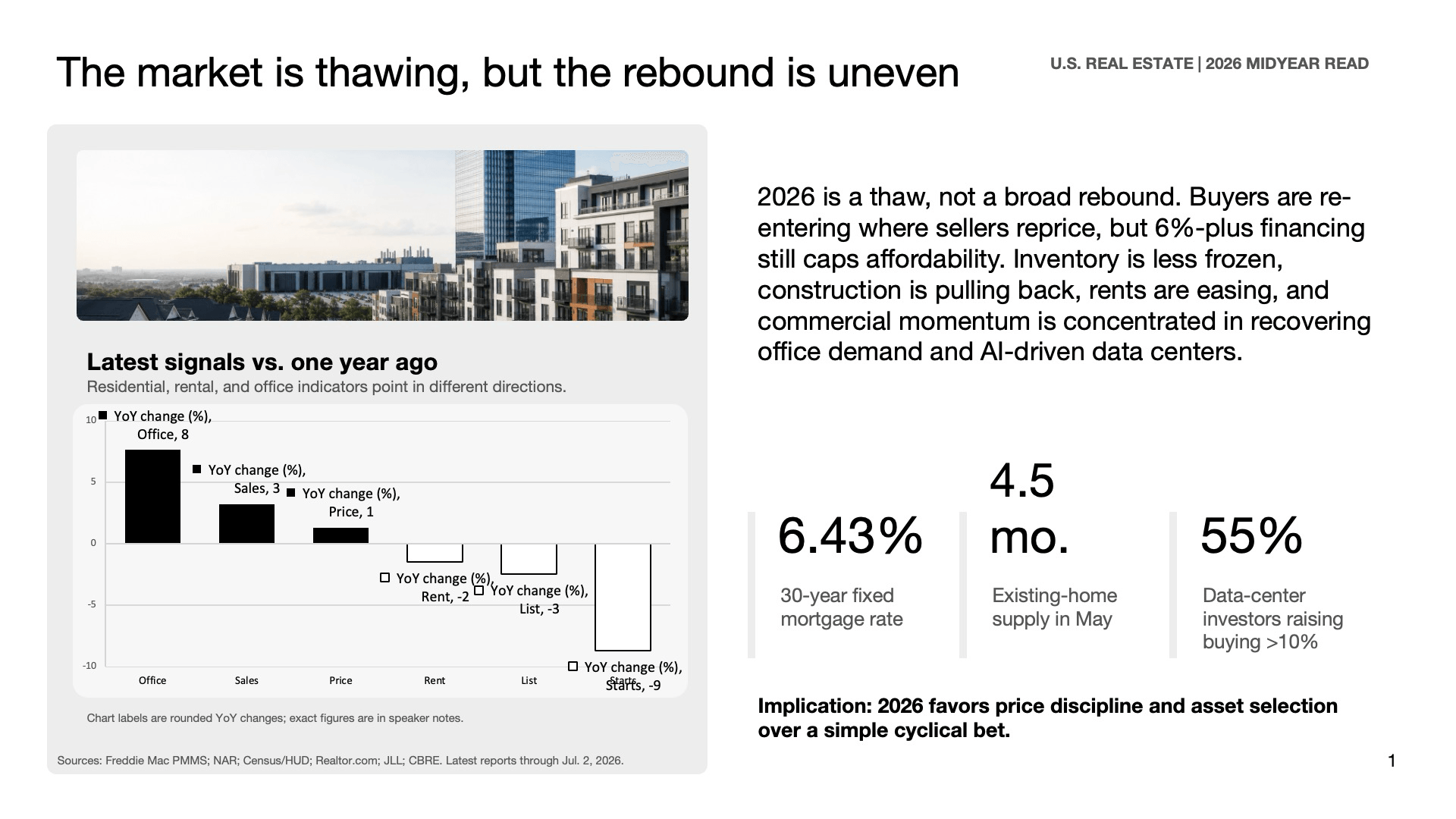
This looks okay but is not very good. Many thoughts and questions:
- Very vague title - it appears to say something profound but is quite vague
- How are we defining rebound?
- What is the unit of the graph?
- Why such a broad industry perspective?
- The title doesn’t match the content
- There’s no clear “so what?” here
I told it to use my Strategy Slides Skill and to focus on office and it created this:
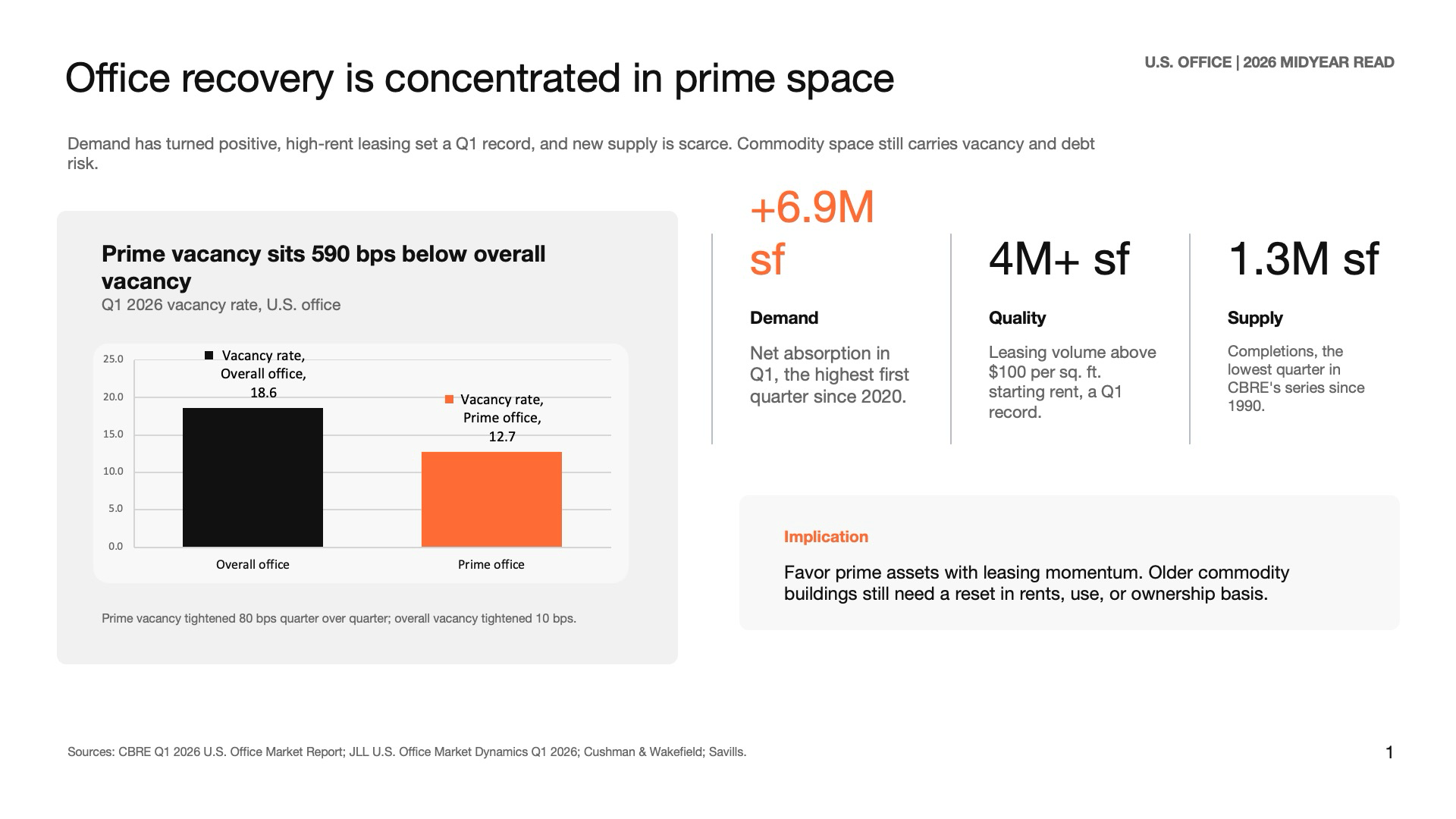
Definitely a lot better but still issues. I like the title and it matches the content on the left, but the right is unclear and I’m not perfectly sure that those data points are talking about prime office space and what the coloring of the numbers mean. Finally there’s another implication at the bottom. Do we need that or not?
I also ran this with Fable 5 in Claude Chat and while I didn’t intend for it to use my skills, it actually called my strategy slides skill (Fable is really good at calling skills) and so ended up with something a bit better.
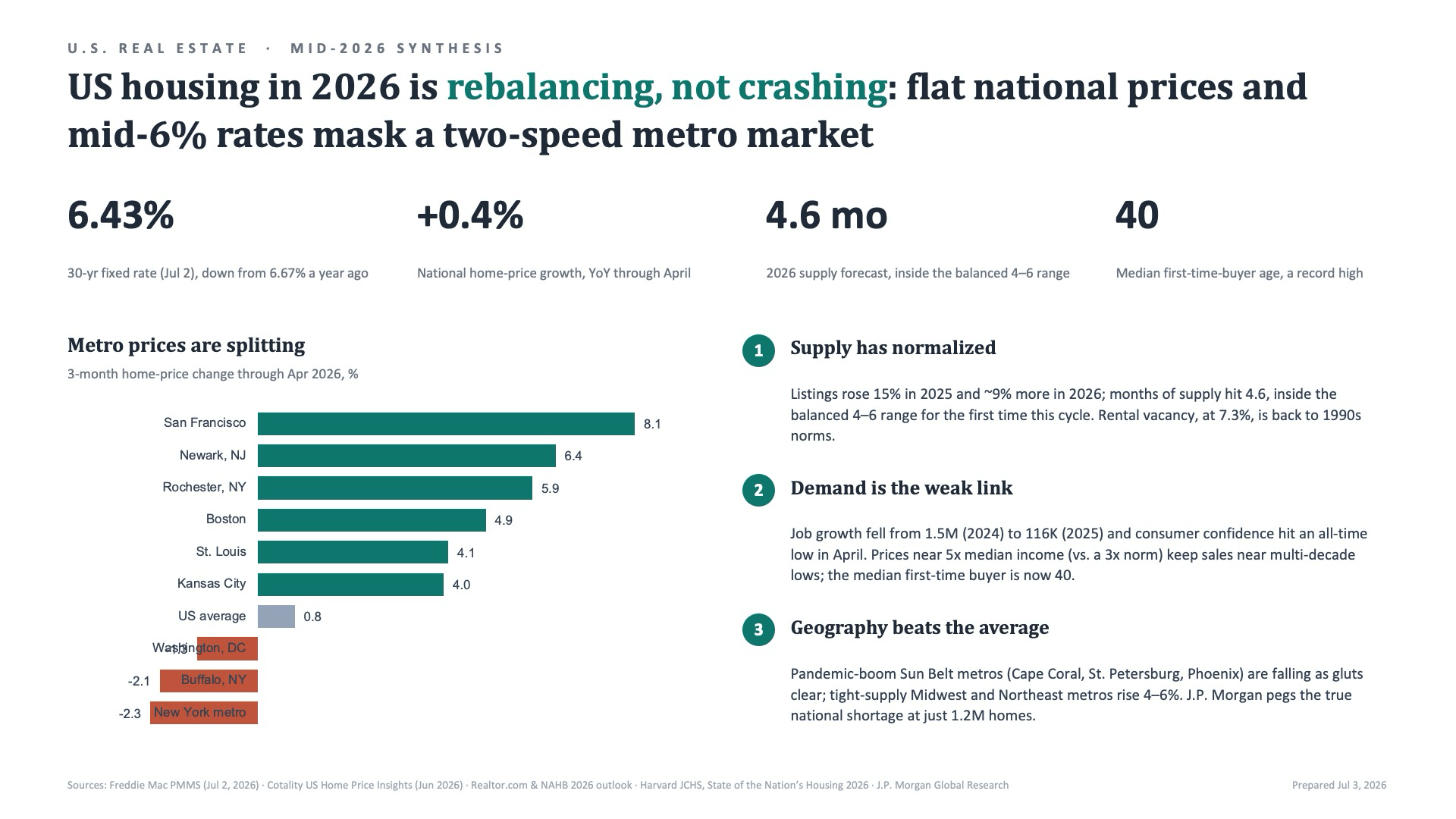
But even with this, I’d still have many questions:
- Rebalancing compared to what?
- Why did you assume the audience thought it was crashing?
- Why so many data points?
- How does the supply, demand, and geography three-part storyline back up the title you are doing
- Why did it focus on cities?
- It seems like a lot of information but I don’t see one clear takeaway from this.
Of course I didn’t give it a ton of context but this is exactly how you want to treat model outputs (for now), as something a teammate is giving you that you need to keep iterating on. I actually followed up with Fable saying, please consider these questions and decide on answers. Its resulting slide:
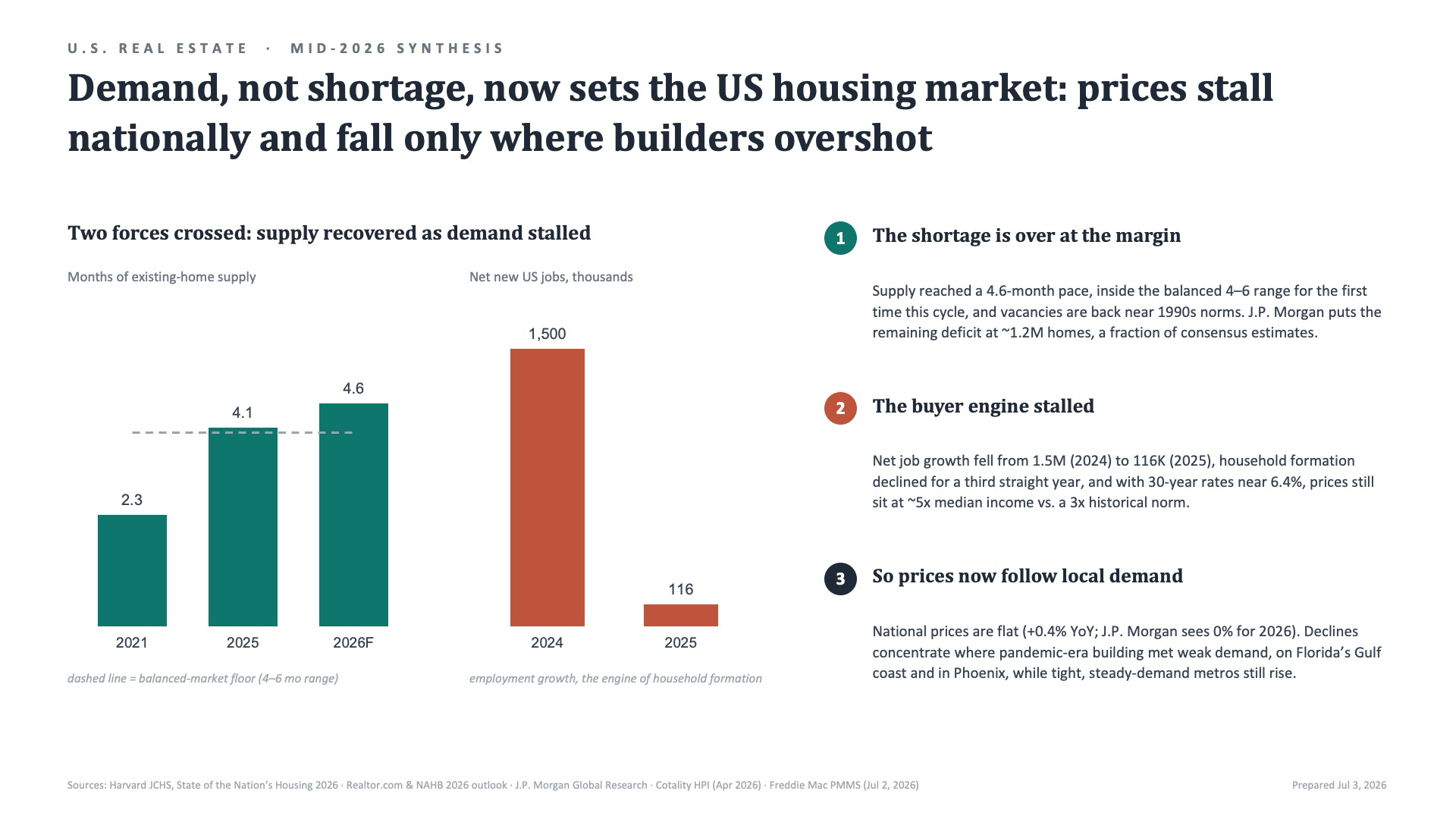
This is definitely better. It picked a clear lane, a clear hypothesis or question, and then attempted to back it up. While the slide could be more clear to pass the ten second test, it quickly:
- Makes a clear statement saying demand is driving the housing market and pricing had only dropped in places where builders built more housing (though I might challenge ‘overshot’ as a judgment)
- It shows a clear trend on the left: supply rising combined with falling job demand (and then backs up the point on the right that employment growth is leading to less demand)
- I like the “take” and I can see the point here. I might challenge the causality and go a bit deeper here but I am open to the hypothesis.
- The slide complicates itself with point #3 saying prices follow local demand - that may actually be the most interesting thing, I’d probably follow up with a deep dive around that point as that may actually be a much clearer way to say the whole thing.
As you can see, iteration is the key here. You want to keep challenging and keep asking questions. And learning how to do that is the result of lots of practice and the right models to help you.
The CEO test
The real test: could you talk to your slide or deck in under a minute to your CEO? Would you have the confidence to make the claims you are making with or without the slide?
Most people just think about finishing the work but if the models can ship work more easily, the bar must rise. I like the CEO test because it helps people think higher level too.
Coach, sparring partner, or “done for you”
When I teach this, I split working with AI into three modes.
As a coach, when you’re learning. Point it at a framework and have it walk you through SCQA or MECE, quiz you, and grade your answers. Hand it real material to work from and say: give me a ten-question quiz.
As a sparring partner, when you’ve done the thinking and want it pressure-tested. Paste in your issue tree and ask where the weak branch is. Have it role-play a skeptical client. The barrier to iteration was always bothering your colleagues. You can’t ask your intern to make three thousand turns on a document, but a model will keep going without getting tired or annoyed. So do exactly what I was doing above with Codex and Claude.
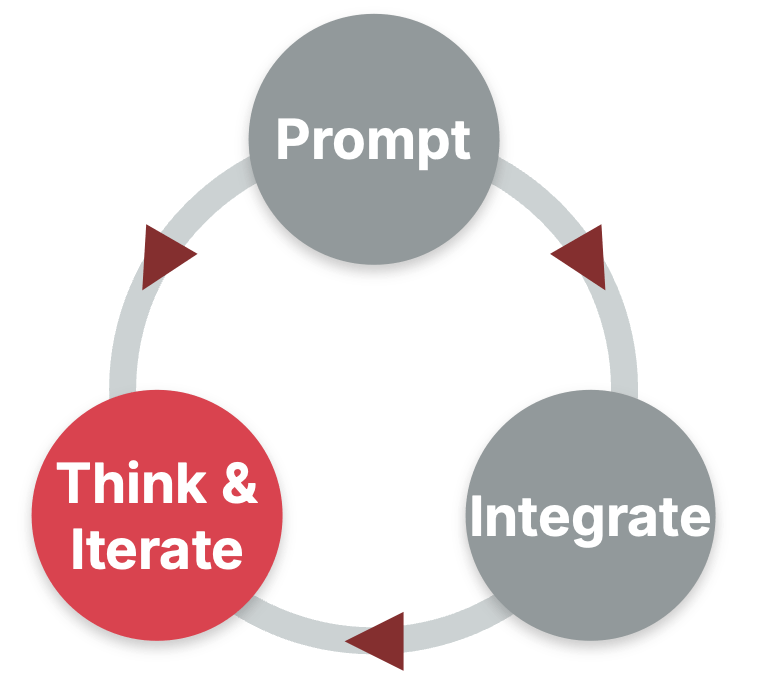
The magic of this is getting “in the loop” with the model and I think at its best it kickstarts what I like to call a reverse sensemaking cycle:
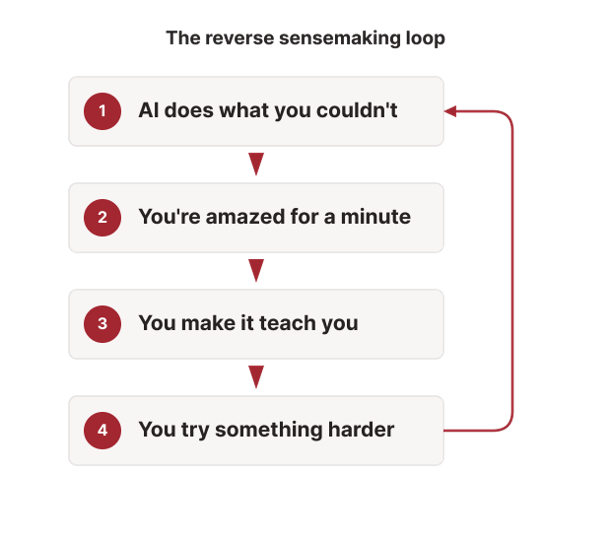
You ship, are impressed, and then get curious. You want to know more about the model’s behavior and also get curious how it made the thing you asked for. You then start wanting to learn about things like slide design, so you can give better feedback to the model.
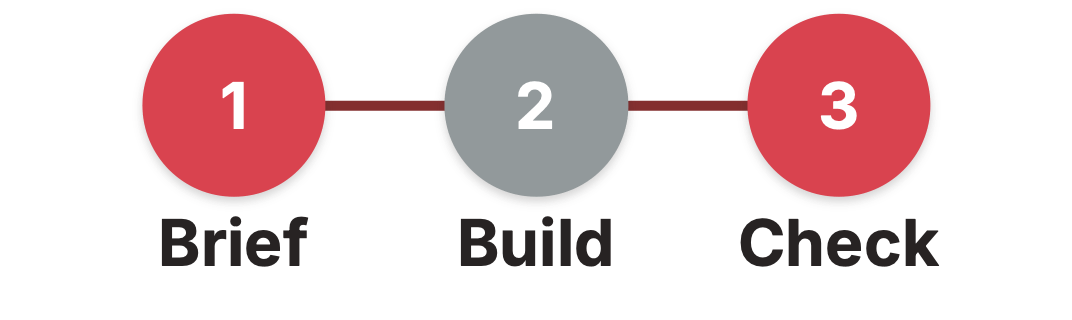
Finally, “done for you,” where you brief it, it builds, and you check. This can work well, but you really have to know what you’re looking at. It works best when the person validating is an expert.
I’ve written up all three modes with example prompts in the post on turning my course into AI skills.
Some tips for doing consulting work with models
Some of the best approaches I’ve seen:
- Generate skills files based on best practices. You can ask it to scrape my site and use my approaches, or download the skills I’m offering on the site. Use skills and call skills files explicitly with initial prompts. When you create something that is good, ask it to update the skill based on what it did.
- Create a multi step process that has redundancy. For example, ask it to avoid AI writing tropes before writing anything and then add a review step to double check that at the end
- Ship ouputs via the models as fast as possible. The goal is to have something to react to such that you figure out what you actually think.
- Always treat a first output as a draft, not a finished product. Since models can iterate fast, you should aim for more iteration, not less.
- Play with different formats. For example, outputting things in a simple HTML page is often easier for the models than PowerPoint.
The real work is the meta-process
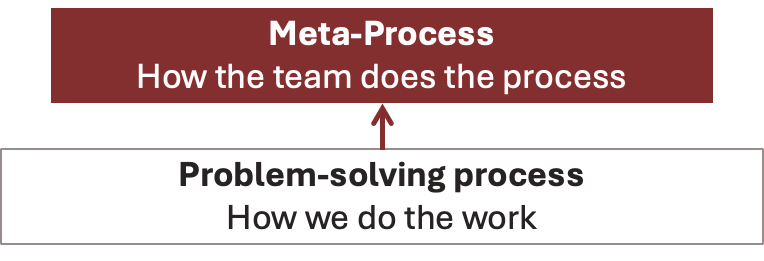
I open every workshop with the same claim: great work is the result of process, not genius. AI doesn’t change that, it just changes how fast and efficiently you can do various parts of the process.
The problem solving process remains the same: define the problem, structure it, do the analysis, and tell the story — all while shifting between top-down and bottom-up mode. What changes is which parts are scarce. When the drafting and the analysis get cheap, the work moves up a level to synthesis, storytelling, and understanding your client at a deeper level.
It also means that your process is dynamic and changing.
Which means you can’t just rely on “this is how things are done here.”
You should be spending much more time on your meta-process, asking:
- What does our process look like in the age of AI?
- Who is responsible for improving it?
- When do we talk about how we’re working, instead of only what we’re shipping?
- What are the shared names, terms, and phrases we use, so everyone is iterating on the same process instead of reinventing it alone?
- When do we introduce agents?
- How often do we talk about it?
- How do we know when the process is working?
All of this keeps moving. Every new model behaves a little differently, and you have to keep leveling up how you work with all of this.
Knowledge work is changing and it’s going to be a fun ride.
If you want to jam on this, hit me up. Let’s chat.
The course
Think Like a Strategy Consultant
Structured problem solving, MECE, the Pyramid Principle, and slides that make a point, in one self-paced video course. 1,400+ students in 65 countries.
Or 2 payments of $398.
Watch a free lesson from Think Like A Strategy Consultant →Free
Start with the email course
Six short lessons on consulting fundamentals, one a day.