Value chain analysis: how to break a company into its real sources of advantage
Most strategy frameworks look at the world outside the company. Porter’s Five Forces tells you about industry structure. PESTEL tells you about macro trends. The BCG growth-share matrix tells you how to allocate capital across a portfolio.
The value chain looks inward. It’s a framework for understanding what a company actually does, broken into the specific activities that create value for buyers and generate cost for the firm. If five forces asks “is this a good industry?” the value chain asks “what exactly makes this company better or worse than its competitors?”
[PAUL: If you have an anecdote about mapping activities on a consulting project or using value chain thinking internally at McKinsey/BCG, it would work well here. Something about the first time you realized that looking at a company as a collection of discrete activities, rather than as a whole, changed how you saw a problem.]
The origin and the idea
Michael Porter published Competitive Advantage in 1985, five years after Competitive Strategy had made him famous. Porter himself acknowledged the gap. As Kiechel recounts in The Lords of Strategy, Porter readily admits: “The Competitive Strategy book is basically a book about industries, because that’s what I’d worked with.” It couldn’t answer the question of how an individual company should position itself within an industry. The value chain was his answer.
The intellectual history is worth knowing. McKinsey had already developed something called the “business system,” which captured the idea that a firm is a series of functions. Porter addressed this in a footnote in Competitive Advantage, one that Kiechel writes would be “a strong candidate” if “there were an award for the most famous footnote in management literature.” As Kiechel tells the story:
In this footnote, the professor acknowledged that the business-system concept “captures the idea that a firm is a series of functions (e.g., R&D, manufacturing, channels), and that analyzing how each is performed relative to competitors can provide useful insights.” He also conceded that McKinsey “stresses the power of redefining the business system to gain competitive advantage, an important idea.” … But then, in two quick sentences, Porter contrasted the system to his own ideas and dismissed its relevance to the rest of his discussion … “The business system concept addresses broad functions rather than activities” — McKinsey hadn’t chopped the pieces small enough, apparently — “and does not distinguish among types of activities or show how they’re related.”
Kiechel adds that among McKinsey veterans, “mere mention of it still causes certain sets of teeth to grind.”
What made Porter’s contribution different was the level of detail and the organizing principle. Kiechel calls Competitive Advantage “a compendium almost breathtaking in its reach of the best thinking on strategy up until then.” The book provided a framework for understanding how each activity contributes to cost and differentiation, and how the linkages between activities create advantages that competitors can’t easily copy.
Porter also introduced the value chain in a 1985 Harvard Business Review article co-authored with Victor Millar, “How Information Gives You Competitive Advantage.” In that article, Porter and Millar described the value chain as a way to divide a company into “the technologically and economically distinct activities it performs to do business.”
The core concept is straightforward. As Porter wrote in Competitive Advantage, “competitive advantage cannot be understood by looking at a firm as a whole. It stems from the many discrete activities a firm performs in designing, producing, marketing, delivering, and supporting its product.”
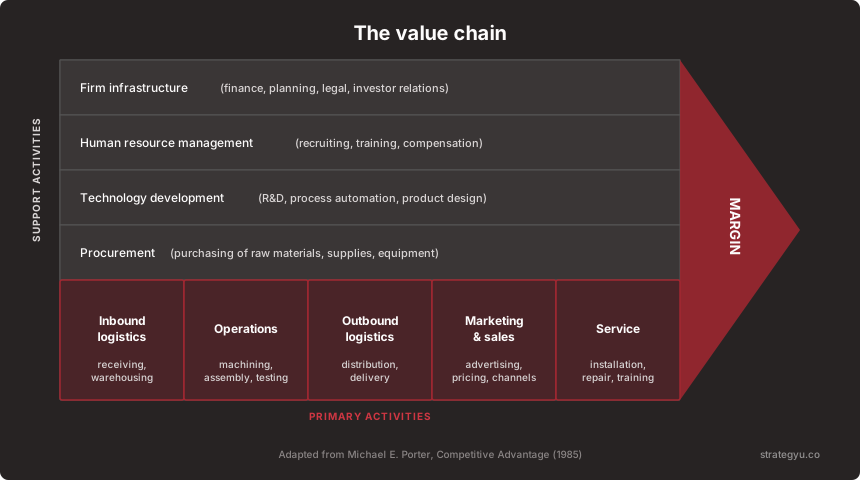
The value chain has two types of activities. In Competitive Advantage, Porter defined them with specific examples:
Primary activities are the five categories involved in physically creating, selling, and delivering the product. Porter defined each one:
- Inbound Logistics. Activities associated with receiving, storing, and disseminating inputs to the product, such as material handling, warehousing, inventory control, vehicle scheduling, and returns to suppliers.
- Operations. Activities associated with transforming inputs into the final product form, such as machining, packaging, assembly, equipment maintenance, testing, printing, and facility operations.
- Outbound Logistics. Activities associated with collecting, storing, and physically distributing the product to buyers, such as finished goods warehousing, material handling, delivery vehicle operation, order processing, and scheduling.
- Marketing and Sales. Activities associated with providing a means by which buyers can purchase the product and inducing them to do so, such as advertising, promotion, sales force, quoting, channel selection, channel relations, and pricing.
- Service. Activities associated with providing service to enhance or maintain the value of the product, such as installation, repair, training, parts supply, and product adjustment.
Support activities feed into all five primary activities. Porter broke these into four categories:
- Procurement refers to the function of purchasing inputs used in the firm’s value chain, not to the purchased inputs themselves. … I use the term procurement rather than purchasing because the usual connotation of purchasing is too narrow among managers.
- Technology Development. Every value activity embodies technology, be it know-how, procedures, or technology embodied in process equipment. … Technology development consists of a range of activities that can be broadly grouped into efforts to improve the product and the process. I term this category of activities technology development instead of research and development because R&D has too narrow a connotation to most managers.
- Human Resource Management consists of activities involved in the recruiting, hiring, training, development, and compensation of all types of personnel.
- Firm Infrastructure consists of a number of activities including general management, planning, finance, accounting, legal, government affairs, and quality management. Infrastructure, unlike other support activities, usually supports the entire chain and not individual activities.
Porter made a point about firm infrastructure that’s easy to miss: he argued it “is sometimes viewed only as ‘overhead,’ but can be a powerful source of competitive advantage.” Regulatory negotiations, management information systems, and top management’s role in dealing with buyers can all be sources of advantage, not just costs to minimize.
The arrow on the right side of the diagram represents what Porter called “margin.” As he defined it: “Margin is the difference between total value and the collective cost of performing the value activities.” A firm is profitable when the value it creates, measured by what buyers are willing to pay, exceeds the cost of performing those activities.
The value system: beyond the single company
Porter didn’t stop at a single firm’s activities. He placed the value chain inside a broader value system that connects supplier value chains, the firm’s own chain, channel value chains, and buyer value chains into one stream.
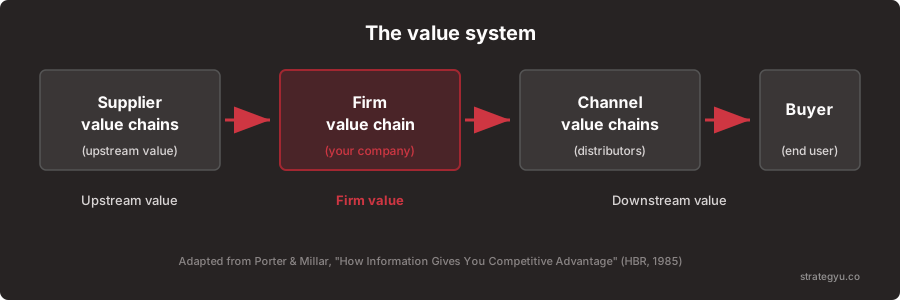
As Porter and Millar wrote in their HBR article, “the value chain for a company in a particular industry is embedded in a larger stream of activities that we term the ‘value system’.” Competitive advantage often comes from understanding how value flows through the entire system, not just within your own four walls.
The PC industry is a good example. Dell, HP, and Lenovo controlled the firm-level value chain (assembly, marketing, and distribution), but Microsoft and Intel controlled the most profitable activities in the upstream value chain. The PC makers’ own value chains were fine. The problem was that the highest-profit activities in the value system were controlled by suppliers.
Real examples
IKEA: redesigning the entire chain around one idea
IKEA is probably the most-cited value chain example in strategy courses, and for good reason. Almost every activity in the company is configured differently from a traditional furniture retailer, and the activities reinforce each other.
Start with product design. IKEA designs furniture for flat-pack shipping, which means the product itself is created with outbound logistics in mind. Traditional furniture retailers design the product first and figure out delivery afterward. IKEA reverses the sequence.
Because items ship flat, the company can fit more product into trucks and containers, reducing transportation cost per unit. Customers pick up items in-warehouse and assemble them at home, which eliminates the cost of last-mile delivery and in-home assembly that traditional retailers bear.
The store layout is designed for self-service. Customers walk a defined path through the showroom, choose items from the warehouse section themselves, load them into their cars, and take them home. The service activity is minimal by design. Compare this to a traditional furniture store where salespeople guide customers through options, delivery teams bring the product to your house, and installation crews set it up. Every one of those activities costs money.
Procurement is centralized and global. IKEA’s scale lets it negotiate with suppliers in low-cost countries and commit to long production runs, which reduces per-unit cost. The materials are chosen during design to keep manufacturing simple and repeatable.
No single activity is the source of IKEA’s advantage. A competitor could copy flat-pack design or self-service warehousing in isolation. The advantage comes from how the activities fit together. Each one reinforces the others, and replicating the entire system is far harder than replicating any individual piece.
Walmart in the 1980s and 1990s: logistics as the core activity
Walmart’s early competitive advantage is a good example of one value chain activity becoming the center of gravity for the entire business.
In the 1980s and early 1990s, most retailers treated distribution as a necessary cost, an activity you had to do but tried to spend as little as possible on. Walmart did the opposite. Sam Walton invested heavily in a private trucking fleet, a hub-and-spoke distribution center network, and (by the early 1990s) a satellite communication system connecting stores to headquarters and to suppliers.
The result was that Walmart could restock stores faster than competitors, which meant it could carry less inventory in-store while keeping shelves full. Less inventory means lower holding costs. Fuller shelves mean fewer lost sales.
The logistics advantage fed directly into other activities. Because Walmart could guarantee high volume and reliable ordering patterns, it could negotiate better terms with suppliers (procurement). Because replenishment was fast and data-driven, store operations required fewer decisions from individual managers. The company famously shared point-of-sale data with major suppliers like Procter & Gamble, creating linkages between its own value chain and its suppliers’ chains that competitors couldn’t easily replicate.
Porter and Millar’s HBR article described exactly this kind of dynamic, arguing that information technology creates new linkages between activities and makes coordination across the entire value system possible in ways that weren’t feasible before. Walmart proved it at scale.
The PC industry (again): where value gets captured
The PC industry is worth revisiting through a value chain lens because it illustrates a different point from the five forces view.
If you mapped the value chains of Dell, HP, and Lenovo in the 2000s, you’d see they were doing everything a value chain analysis would suggest: efficient assembly operations, tight outbound logistics (Dell’s build-to-order model was particularly good here), aggressive marketing, and competitive pricing. Their individual value chains were well-run.
The problem was in the value system. The two most profitable activities, the operating system and the processor, were controlled by Microsoft and Intel respectively. PC makers were assembling commoditized hardware around components whose pricing they couldn’t control. No amount of value chain optimization within a single PC maker’s operations could fix a structural problem in the broader value system.
This is the difference between value chain analysis and value system analysis. The first asks “are we doing our activities well?” The second asks “are we doing the right activities, and who captures the value from the activities that matter most?”
How to use it
Map the actual activities, not the generic ones
Porter was clear on this point: the five primary and four support categories are a starting point, not the analysis itself. As he wrote in Competitive Advantage, “everything a firm does should be captured in a primary or support activity” and “labeling activities in service industries often causes confusion because operations, marketing, and after-sale support are often closely tied.”
The labels should fit the business. For a software company, “inbound logistics” doesn’t mean receiving raw materials. It might mean acquiring customer data, onboarding users, or integrating with third-party platforms. “Operations” isn’t manufacturing; it’s product development, server infrastructure, and feature releases. Don’t force the generic categories. Adapt them.
Look for linkages between activities
This is the part that most people skip. Porter devoted significant attention in Competitive Advantage to the linkages between activities, and the passage is worth quoting at length because it’s the core of what makes the value chain more than a list:
Competitive advantage frequently derives from linkages among activities just as it does from the individual activities themselves. Linkages can lead to competitive advantage in two ways: optimization and coordination. Linkages often reflect tradeoffs among activities to achieve the same overall result. For example, a more costly product design, more stringent materials specifications, or greater in-process inspection may reduce service costs. A firm must optimize such linkages reflecting its strategy in order to achieve competitive advantage.
Linkages may also reflect the need to coordinate activities. On-time delivery, for example, may require coordination of activities in operations, outbound logistics, and service (e.g., installation). The ability to coordinate linkages often reduces cost or enhances differentiation.
The distinction matters because competitors can often copy individual activities, but the linkages between them are harder to see and harder to replicate.
The IKEA example shows both. Flat-pack design (technology development) reduces shipping costs (outbound logistics) and eliminates assembly labor (service). That’s optimization. The warehouse store format coordinates marketing (the showroom walk), outbound logistics (customer self-pickup), and operations (the warehouse and showroom are the same building).
In practice, the linkages are usually where the interesting insights are. Individual activities are easy to benchmark. The system-level fit is not.
Compare value chains between competitors
A single company’s value chain in isolation isn’t very useful. The framework is designed for comparison. Map your value chain and a competitor’s side by side, and ask two questions: where are the cost differences, and where are the differentiation differences?
In the Walmart example, both Walmart and Kmart had all five primary activities. The difference was that Walmart’s distribution and logistics operation was substantially better, and that advantage cascaded through other activities. In the IKEA example, a traditional furniture retailer performs the same types of activities, but the configuration and linkages are completely different.
The value chain doesn’t give you the answer. It gives you a structured way to find it.
Connect it to the value system
Don’t stop at the firm boundary. Ask where your suppliers sit, where your channels sit, and where the buyer’s activities are. The most profitable position in a value system isn’t always the most obvious one.
As Porter and Millar wrote in their HBR article:
Linkages not only connect value activities inside a company but also create interdependencies between its value chain and those of its suppliers and channels. A company can create competitive advantage by optimizing or coordinating these links to the outside.
Where the framework breaks down
The value chain was designed for manufacturing. The metaphor itself, a “chain” with a linear left-to-right flow, fits a company that buys raw materials, transforms them into products, and ships them to buyers. That sequence makes sense for a 1985-era manufacturer.
For service businesses, the fit is less obvious. A consulting firm doesn’t have “inbound logistics” in any meaningful sense. A hospital’s “operations” and “service” activities blur together. Porter acknowledged the problem: he noted in Competitive Advantage that “labeling activities in service industries often causes confusion.” You can still use the framework for services, but you’ll spend more time adapting the categories than applying them.
Digital businesses present a bigger challenge. A software platform like Google has no physical product flowing left to right through a chain. The “operations” (running the search algorithm) and the “marketing” (the search results page is the marketing) happen simultaneously, not sequentially. The chain metaphor implies a linear flow, and many modern businesses don’t have one.
Porter also assumed reasonably clear firm boundaries. In 1985, it was obvious where a company’s value chain ended and where a supplier’s or channel’s began. Today, with outsourcing, platform ecosystems, and API-connected business networks, those boundaries are blurry. A company that outsources manufacturing, uses third-party logistics, and sells through a marketplace partner may have very few activities in its own value chain. Is the framework still useful when most of the value-creating activities happen outside the firm?
The answer is usually yes, but you have to shift the analysis to the value system level. That’s actually consistent with what Porter intended. The problem is that most people stop at the firm-level value chain and never get to the system view.
How to think about it
The value chain’s lasting contribution is the idea that competitive advantage lives in the activities, not in the company as an undifferentiated whole. The specific diagram with its five primary and four support activities matters less than that shift in thinking.
Before Competitive Advantage, strategy was mostly about industries (five forces) or about broad positions (cost leadership versus differentiation). The value chain answered the question that came next: how do you actually build and sustain the advantage? Not at the level of grand strategy, but at the level of what the company does every day.
As Kiechel writes in Lords of Strategy, the value chain “may be the last central, universal concept in the intellectual history of strategy.” That’s a strong claim. But it captures something true: after the value chain, there’s no going back to talking about a company’s competitive position without asking what specific activities create it.
When you’re evaluating a company or building a strategy, the right question is specific: which activities do we perform better or differently than competitors, and how do those activities reinforce each other?
Recommended reading
Porter’s Competitive Advantage is the original source and still the most thorough treatment. The value chain is covered in chapter 2, but the entire book is built around applying the concept to cost advantage and differentiation. Porter and Millar’s 1985 HBR article, “How Information Gives You Competitive Advantage,” introduced the value chain to a broader audience and is a faster read. Walter Kiechel’s The Lords of Strategy places the value chain in the broader intellectual history of strategy and includes the entertaining backstory of McKinsey’s business system and Porter’s footnote.